
Crypto Exchange Licenses: The Easiest Jurisdictions for Fast Registration
A Practical Guide to Low-Barrier Markets and Simplified Licensing Paths
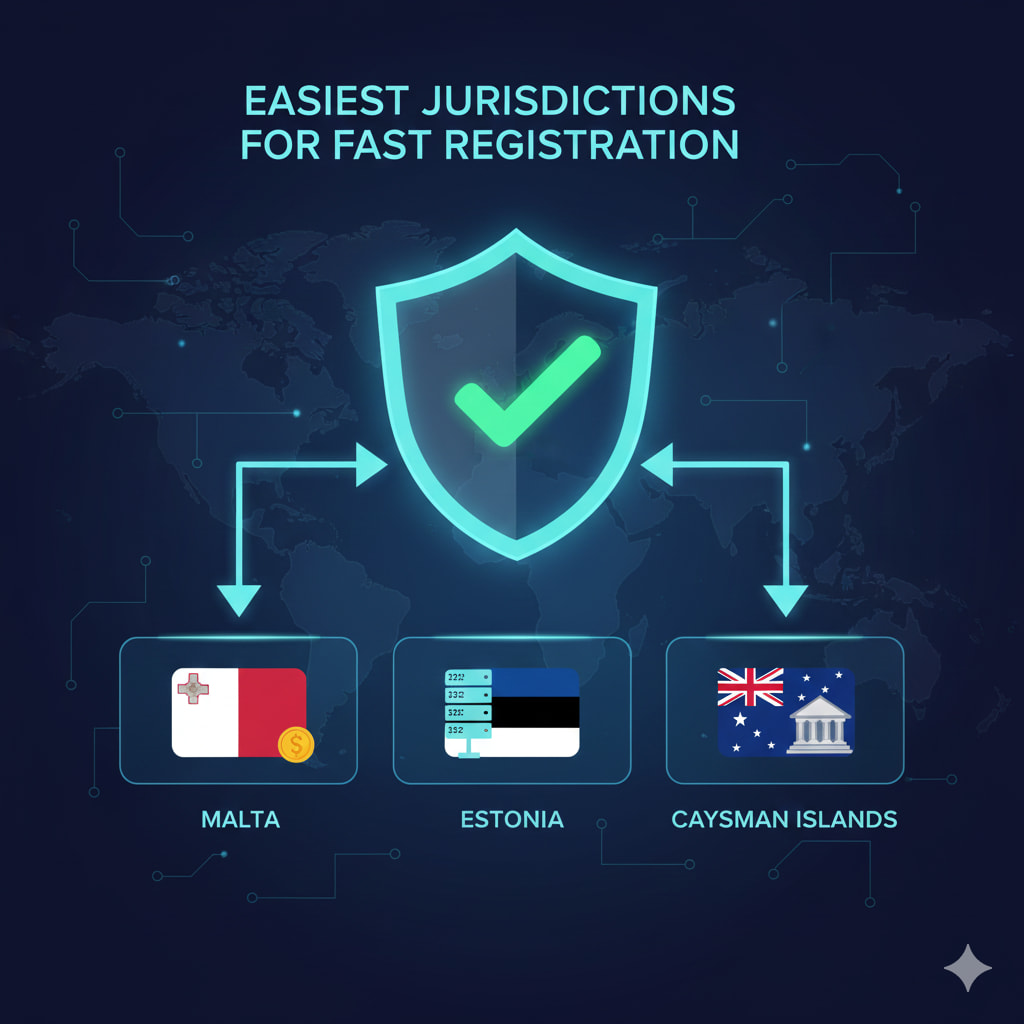
After helping over 40 crypto businesses navigate the licensing maze across different jurisdictions, I can tell you one thing with absolute certainty: choosing the wrong jurisdiction can kill your exchange before it even launches. I've watched promising startups burn through $200,000 trying to get licensed in the wrong country while their competitors went live in three months elsewhere.
The stakes have never been higher. With 700 million crypto users globally and the exchange market racing toward $264.32 billion by 2030, your licensing strategy isn't just about compliance—it's about survival. Let me share what I've learned helping founders make this critical decision.
Why Licensing Isn't Optional Anymore
In 2023, I had a client who insisted they could "figure out licensing later." Within six months, their banking partner cut them off, payment processors refused service, and they faced potential legal action. They spent another year getting properly licensed, losing their first-mover advantage and nearly $150,000 in the process.
Operating without a license in 2025 means account freezes, banking rejections, and regulatory shutdowns. But here's what most founders don't realize: not all licenses are created equal, and the "best" jurisdiction depends entirely on your specific business model and target market.
The European Fast Track: Estonia and Lithuania
I'll be honest—when clients tell me they want to serve European customers, I almost always point them toward Estonia or Lithuania first. Here's why.
Last year, I worked with a fintech startup that obtained their Estonian VASP license in exactly 7 months. They paid around €125,000 in minimum capital, spent another €50,000 on legal and compliance setup, and walked away with access to the entire European Economic Area—450 million potential customers.
Estonia's process is refreshingly straightforward. The regulators actually respond to emails, the requirements are clearly documented, and once you're approved, you can passport your services across the EU under MiCA regulations. I've seen applications approved in as little as 5 months when documentation is pristine.
Lithuania offers similar advantages with slightly lower costs. One of my clients launched there because they wanted EU credibility but had tighter capital constraints. The 15% corporate tax rate didn't hurt either. The UAB registration process is simple, and the Financial Crime Investigation Service provides clear guidance throughout.
What I love about both jurisdictions is their pragmatism. They understand crypto businesses and don't treat every application like a potential money laundering operation. That said, your AML/KYC policies need to be bulletproof. I've seen applications rejected for incomplete compliance documentation, even when the technology was perfect.
Cyprus recently entered the game with CASP licensing under MiCA, and I'm watching it closely. The 4-6 month timeline is attractive, and several clients are exploring it for its strategic location bridging European and Middle Eastern markets. The jury's still out on how smoothly approvals go, but early signs are promising.
Offshore Speed Champions: El Salvador and Seychelles
Sometimes speed matters more than prestige. I remember a client who needed to launch within 90 days to secure a major partnership. We went to El Salvador.
El Salvador has become the crypto world's fast-pass lane. As the first country to recognize Bitcoin as legal tender, they've built remarkably efficient licensing infrastructure. My client obtained their Digital Asset Service Provider license in 8 weeks with only €1,709 in capital requirements. They operated virtually—no physical office needed—and were processing transactions while their competitors were still filling out paperwork in other jurisdictions.
The catch? El Salvador works best as a starting point. It's perfect for proving your concept, building transaction history, and generating revenue while you pursue premium licenses elsewhere. I typically advise clients to view it as phase one of a multi-jurisdiction strategy.
Seychelles remains my go-to recommendation for serious projects that need offshore flexibility. I've guided at least a dozen companies through their Securities Dealer License process. Yes, it costs more than El Salvador—figure €80,000 to €120,000 all-in—but you get genuine regulatory credibility.
One client launched their derivatives trading platform in Seychelles specifically because the regulatory framework clearly supports both spot and leveraged products. The 3-6 month timeline was manageable, and the favorable tax environment meant they could reinvest more capital into technology development.
The British Virgin Islands deserves special mention, particularly if you're considering white label decentralized exchange development. The VASP Act of 2022 created a surprisingly sophisticated framework that accommodates both centralized and decentralized models. I worked with a DeFi protocol last year that obtained BVI authorization specifically because regulators understood their architecture—something that would have been impossible in more traditional jurisdictions.
Mauritius: The Hidden Gem
I don't talk about Mauritius enough, but it's become one of my favorite recommendations for clients with institutional ambitions. The 5-month timeline is competitive, the €38,427 capital requirement is reasonable, and the regulatory framework demonstrates real sophistication.
What sets Mauritius apart is banking relationships. I've had clients secure banking partnerships there that would have been impossible in other offshore jurisdictions. If fiat integration matters to your business model—and for most exchanges it absolutely does—Mauritius punches above its weight class.
The Banking Reality Nobody Discusses
Here's something critical from my experience: licensing is only half the battle. Banking access determines whether your exchange can actually function.
I've watched licensed exchanges struggle for months to open bank accounts. Premium jurisdictions like Switzerland, Singapore, and BVI typically provide smoother banking pathways because financial institutions understand their regulatory frameworks. One client licensed in a budget offshore jurisdiction spent seven months trying to secure banking before finally restructuring through a BVI entity.
This consideration particularly impacts the crypto wallet business model. If you're planning to offer both exchange and wallet services, you need banking partners who understand both custodial and non-custodial arrangements. Estonia and Lithuania excel here because European banks have experience with MiCA-compliant crypto businesses.
My Jurisdiction Selection Framework
After years of doing this, I evaluate jurisdictions across five dimensions:
Target Market Alignment: Serving Europeans? Get an EU license. Targeting emerging markets or crypto natives? Offshore works fine and costs less.
Speed Requirements: Need to launch in 60 days? El Salvador or Canada. Can wait 6-8 months? Estonia or Lithuania provide better long-term positioning.
Capital Availability: Tight budget? El Salvador (€1,709) or Cyprus (€50,000). Well-funded? Switzerland (€25,000 but €300,000+ total costs) buys prestige.
Business Model Specifics: White label dex projects often benefit from BVI's flexible framework. Traditional centralized exchanges can go anywhere but benefit from established jurisdictions.
Banking Priorities: Critical need for fiat integration? Stick to premium jurisdictions or Mauritius. Crypto-only operations have more flexibility.
Cost Reality Check
Let me give you real numbers from recent client projects, because online estimates are usually fantasy:
Estonia VASP License: €125,000 capital requirement + €45,000 legal/compliance + €18,000 annual office/staff + €12,000 annual renewals = €200,000 total first-year investment.
El Salvador DASP: €1,709 capital + €15,000 legal setup + €3,000 annual renewals (virtual office) = €19,709 total first-year investment.
Seychelles Securities Dealer: €50,000 capital + €35,000 legal/setup + €24,000 office/compliance + €8,000 renewals = €117,000 total first-year investment.
BVI VASP: €75,000 capital + €40,000 legal/compliance + €30,000 office/director + €10,000 renewals = €155,000 total first-year investment.
These are conservative estimates. Budget overruns happen when applications get rejected and you need multiple submission rounds. I always tell clients to add 30% contingency.
The Multi-Jurisdiction Strategy
Here's my most common recommendation: start strategic, expand tactical.
Launch in a fast-track jurisdiction like El Salvador or Canada to begin generating revenue and building operational history. Simultaneously, begin the application process in your target premium jurisdiction. Once approved there, transition customers to the premium entity while maintaining the offshore operation for specific markets or products.
I guided a derivatives exchange through exactly this process last year. They launched in Seychelles in 3 months, started generating revenue, then obtained BVI licensing 8 months later. The offshore operation proved their business model, which strengthened their premium jurisdiction application. They now operate both entities strategically—Seychelles for retail, BVI for institutional clients.
Final Advice From the Trenches
The easiest jurisdiction to register in isn't always the smartest choice. I've seen companies choose purely based on speed or cost, only to discover they can't access banking, can't onboard their target customers, or can't scale their business model within that regulatory framework.
Talk to someone who's actually navigated these jurisdictions. Read the actual regulations, not summaries. Budget realistically for total costs, not just licensing fees. And most importantly, align your jurisdiction choice with your three-year business plan, not just your 90-day launch timeline.
The crypto licensing landscape continues evolving rapidly. Estonia and Lithuania currently offer the best combination of speed, cost, and market access for EU-focused businesses. El Salvador and Seychelles provide fast, affordable entry points for testing concepts. BVI and Mauritius occupy the sweet spot between offshore flexibility and institutional credibility.
Choose strategically, execute thoroughly, and you'll have the regulatory foundation to build a sustainable exchange business in 2025 and beyond.
About the Creator
Rowan Meritt
Rowan Meritt is a Marketing Manager at CoinyExchange, specializing in crypto strategy and digital growth. With deep industry knowledge, he drives impactful campaigns in the evolving blockchain space.
Keep reading
More stories from Rowan Meritt and writers in Writers and other communities.
How to Integrate KYC Verification
Integrating Know Your Customer (KYC) verification into your white-label exchange is no longer an optional luxury it’s a cornerstone of regulatory compliance, risk management and user trust. As white laebl platforms scale across jurisdictions, embedding a robust, seamless KYC workflow becomes central to both safeguarding your business and delivering a smooth user experience.
By Rowan Meritt2 months ago in Writers
How 10 Minutes of Morning Yoga Changed My Energy Levels
When I Realized Something Was Wrong I’m not lazy. I like staying active. But my routine was inconsistent. Some days I would try a long workout, get sore, then quit for a week. Other days, I did nothing at all.
By Theworkouthaven.com5 days ago in Writers
Silver Screen Magic with Mae West
American actress and singer Mae West became a popular film actress during the Great Depression. She started entertaining in vaudeville, then performed on Broadway, and finally went to Hollywood. She signed up with Paramount Pictures and made her debut in the 1932 film “Night After Night.” She also starred in musicals, comedies, and crime dramas. The American Film Institute named her one of the best classic Hollywood actresses.
By Rasma Raisters4 days ago in Geeks


Comments
There are no comments for this story
Be the first to respond and start the conversation.