
At Least 45 Palestinians Killed in Israeli Airstrikes Across Gaza: A Humanitarian Tragedy Unfolds
45 Palestines Killed In Israeil

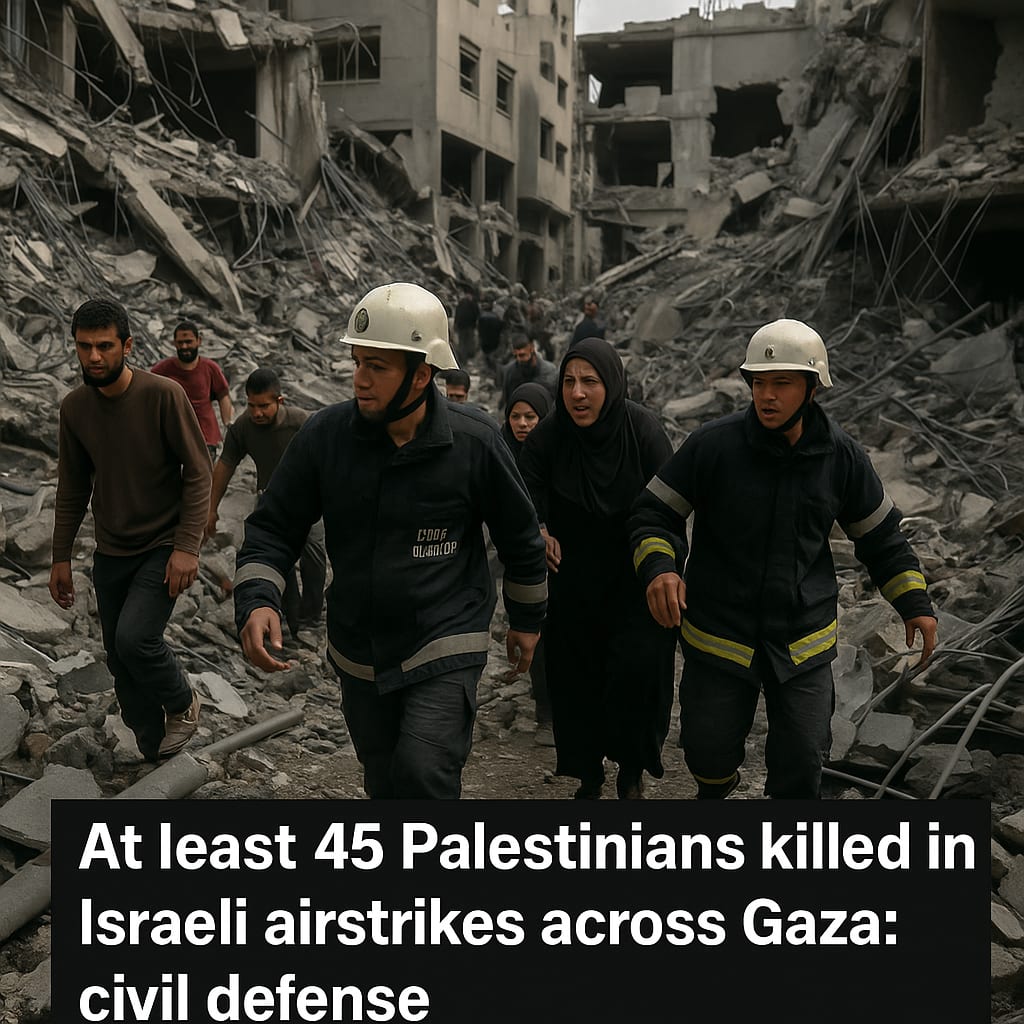
At Least 45 Palestinians Killed in Israeli Airstrikes Across Gaza: A Humanitarian Tragedy Unfolds
In the early hours of Saturday, a fresh wave of airstrikes by Israeli forces swept across the Gaza Strip, leaving widespread devastation and heartbreak in its wake. According to the Gaza Civil Defense, at least 45 Palestinians have been confirmed dead so far, while the number of wounded continues to rise as emergency crews search for survivors beneath the rubble.
This latest escalation comes amid months of ongoing conflict, further compounding the humanitarian crisis that has gripped Gaza since the outbreak of hostilities. Homes, hospitals, schools, and entire neighborhoods have once again become the frontline of a war that disproportionately affects civilians, many of them children, women, and the elderly.
A Night of Horror and Loss
Residents of Gaza described the night as one of the most terrifying and destructive since the conflict began. Whole families were trapped in their homes as Israeli warplanes targeted what the military described as “Hamas-linked infrastructure and weapon depots.” However, the civilian toll tells a different story — one of indiscriminate destruction in densely populated neighborhoods.
Many victims were found buried under collapsed buildings, while others were killed in the streets or in makeshift shelters they thought were safe. Ambulances struggled to reach some areas due to the damaged roads and ongoing bombardments.
“We were sleeping when the house suddenly shook like an earthquake,” said Mahmoud Abu Saeed, a father of three from central Gaza. “The next thing I knew, my neighbor’s house was gone. They didn’t survive. My children are terrified, and we have nowhere to go.”
Civil Defense Under Pressure
The Gaza Civil Defense teams, who are responsible for search and rescue operations, have been stretched to their limits. Facing a shortage of equipment, fuel, and medical supplies due to the ongoing blockade, these brave men and women are racing against time to save lives.
A spokesperson for Gaza's Civil Defense stated:
"We are working nonstop, but the destruction is immense. Many buildings have been completely leveled, and we fear the death toll will continue to climb as we reach more areas. We call on the international community to intervene and help provide urgent aid and equipment."
The Humanitarian Toll
The humanitarian consequences of this ongoing conflict are catastrophic. Over 2 million Palestinians live in Gaza, an area often described as the world's largest open-air prison. Years of blockades, wars, and political isolation have left the enclave with a crippled healthcare system, widespread poverty, and limited access to clean water and electricity.
Since the start of this most recent escalation, thousands of families have been displaced, crowding into schools, mosques, and UN-run shelters in a desperate attempt to escape the violence. However, even these shelters have been struck during previous air raids, leaving no truly safe haven for civilians.
The World Health Organization and other aid agencies have warned that Gaza’s hospitals are on the brink of collapse. Shortages of medical supplies, including anesthesia, antibiotics, and fuel for generators, make it increasingly difficult for healthcare providers to treat the wounded.
International Reaction
News of the airstrikes and the rising civilian death toll has sparked a wave of international condemnation and calls for restraint. Several humanitarian organizations have labeled the bombardment a violation of international law, citing the high number of civilian casualties.
The United Nations Secretary-General expressed deep concern over the escalating violence and reiterated the urgent need for both sides to agree on a ceasefire.
“Civilians must be protected at all costs,” he said. “This cycle of bloodshed must stop before more lives are lost. International humanitarian law is clear: the targeting of civilian areas is unacceptable.”
Despite these appeals, the violence shows little sign of slowing down. As of now, diplomatic efforts to negotiate a ceasefire remain deadlocked.
Voices from the Ground
Amid the chaos, the voices of ordinary Palestinians are filled with fear, exhaustion, and despair. Social media has been flooded with heartbreaking stories, photos, and videos showing families torn apart, children pulled from rubble, and once-vibrant neighborhoods reduced to dust and debris.
Samira Al-Khatib, a 28-year-old teacher, wrote on her Facebook page:
"We’ve lost our home, our school, and our neighborhood in a single night. I’ve lost students, friends, and neighbors. Each time the bombs fall, it feels like the end of the world. We are human beings — why are we being treated like this?"
For many in Gaza, life is a constant struggle for survival, punctuated by trauma, loss, and uncertainty.
The Bigger Picture
This latest round of airstrikes is part of a broader and deeply rooted conflict between Israel and the Palestinian people — one that has defied resolution for decades. The political impasse, ongoing occupation, settlement expansions, and repeated military operations have turned the Gaza Strip into a humanitarian disaster zone, where civilians are often the ones paying the highest price.
Despite international resolutions and peace talks, there has been little progress toward a lasting solution that ensures justice and security for both Palestinians and Israelis. For Gaza’s 2 million residents, the future remains bleak, overshadowed by the constant threat of violence.
A Call for Humanity
The scale of the destruction and the loss of innocent lives in Gaza is a grim reminder of the cost of war. As the world watches this tragedy unfold, many humanitarian voices are urging global leaders to take meaningful action, not just temporary ceasefires or statements of concern.
The situation calls for an immediate cessation of hostilities, the protection of civilians under international law, and the opening of humanitarian corridors to allow for the safe delivery of aid, medical assistance, and supplies.
At the same time, long-term solutions must address the root causes of the conflict: occupation, blockades, and systemic human rights violations that continue to suffocate the people of Gaza.
As the sun rises over Gaza once again, the survivors will dig through the rubble — for lost loved ones, for memories, and for the strength to endure yet another day in a world that seems to have forgotten them.
Conclusion
The death of at least 45 Palestinians in one night serves as a grim milestone in a conflict that has seen far too much bloodshed. Every life lost is not just a statistic but a family torn apart, a future erased, and a community devastated.
The international community must not remain silent. Peace, justice, and human dignity must take precedence over politics, and the world must rally to prevent further loss of innocent lives in Gaza.
About the Creator
Keep reading
More stories from TAYEF AHMED KABBO and writers in Writers and other communities.
Stocks Tumble as Gas Price Hike Dampens Business Sentiment
Stocks Tumble as Gas Price Hike Dampens Business Sentiment In recent weeks, stock markets around the globe have faced sharp declines, and one of the most significant drivers behind this downward trend is the sudden and steep hike in gas prices. The impact of rising gas costs isn't just felt at the fuel pump — it ripples across industries, affecting supply chains, consumer confidence, and overall business sentiment. Let’s break down why the stock market is tumbling and how the surge in gas prices is making investors, businesses, and everyday people nervous.
By TAYEF AHMED KABBO9 months ago in Writers
It's Winter
Anne Bernays and Pamela Painter — What If? Writing Exercise for Fiction Writers prompts The Exercise —Write a scene involving two characters. Have the point-of-view character presume something entirely different about the situation from what the other character's overt behavior seems to imply. For example, a landlord comes to visit, and the tenant suspects that it isn't a visit but an inspection. Make up several situations in which one character can fantasize or project or suspect or even fear what another character is thinking. The Objective - To show how your characters can use their imaginations to interpret the behavior and dialogue of other characters.
By Denise E Lindquist19 days ago in Writers
Why You Should Write Love Letters to Yourself
The term of endearment hyperbole, ‘I Love You to the Moon and Back’, which I often tell my daughter, with the additional elongated: ‘and back again, beyond infinity’, is believed to have originated from Sam McBratney’s 1994 children’s book: ‘Guess How Much I Love You’.
By Chantal Christie Weiss5 days ago in Writers
Rachel Reviews: The Spiral Archive by Pieter Hendrik
It's difficult for me to know where to start with a review of this book as it was, for me, an entirely unique experience and one that I'll probably never have again. I don't want that to be interpreted as unenjoyable but it has left me scratching my head a little and ruminating on its content, its themes and its characters.
By Rachel Deeming3 days ago in BookClub


Comments
There are no comments for this story
Be the first to respond and start the conversation.