
AI vs Human Creativity: Who Shapes the Future?
What Makes Human Creativity Unique?

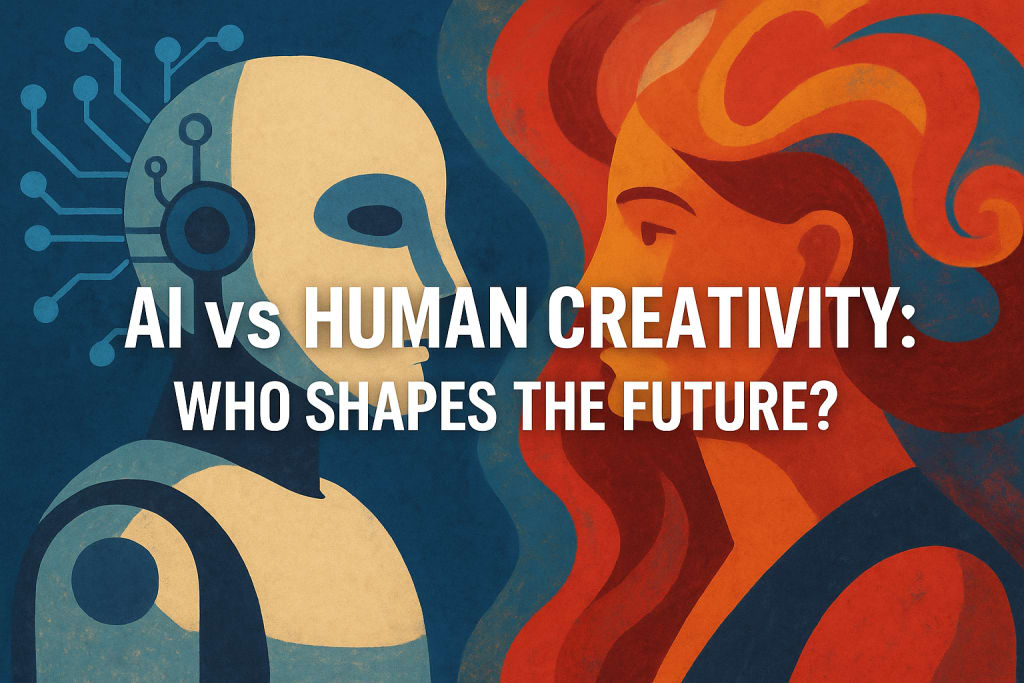
In a world where artificial intelligence (AI) is becoming increasingly adept at mimicking human abilities, one question continues to spark debate: Can AI truly be creative, or does it merely imitate human ingenuity? The conversation around AI’s creative potential has accelerated in recent years, particularly as AI systems like GPT-3, DALL·E, and Midjourney push the boundaries of what machines can "create." Yet, the question of creativity remains uniquely human—rooted in experience, emotion, and intuition.
In this article, we will explore the fascinating intersection of AI and human creativity, shedding light on the strengths and limitations of both. By the end, you’ll have a deeper understanding of how AI can be used as a creative partner rather than a replacement, and how humans and machines can collaborate to shape the future of creative work.
Defining Creativity: Human vs. AI
What Makes Human Creativity Unique?
Creativity, in its truest form, is a deeply human trait. It’s more than just producing something novel; it’s about connecting ideas, feeling emotions, and drawing upon personal experiences. Think of a writer crafting a poem that speaks to a universal human truth or an artist painting a portrait that captures the complexity of their subject's emotions. Creativity is often driven by intuition, emotion, and a personal connection to the world.
Humans create not just based on patterns but also through abstract thinking, empathy, and a deep understanding of context. For instance, a musician may compose a melody inspired by a particular moment in their life, imbuing their work with a personal meaning that resonates with listeners.
How Does AI “Create”?
On the other hand, AI’s form of creativity is different. AI "creates" by identifying and replicating patterns from vast datasets it’s been trained on. Unlike human creativity, which stems from lived experiences and emotional depth, AI creativity is rooted in statistical models and algorithms. While AI can generate new combinations of patterns and ideas based on this data, it lacks the intrinsic emotional understanding that human creators bring to their work.
The secret to AI’s creativity lies in generative models. These models, such as GPT-3 (for text generation) or DALL·E (for image creation), analyze enormous datasets, learning how various elements fit together. Once trained, AI can then generate new content that mimics the patterns it has learned. It doesn’t "understand" the content it creates the way humans do, but it can create surprisingly sophisticated outputs that often mimic human creativity.
How AI Generates Creative Content
Overview of Generative Models
Generative models like GPT-3 (for text), DALL·E (for images), and Midjourney (for art) are all examples of AI systems that create content based on pre-existing data. These models work by identifying patterns in large datasets of text, images, or sound. The process works through machine learning, where AI algorithms "learn" to identify relationships between inputs and outputs.
GPT-3: A language model trained on an extensive range of text data, GPT-3 can generate articles, stories, poetry, and even code. It can take a simple prompt like "Write a short story about a time traveler" and produce an entire narrative based on patterns it’s learned from countless stories.
DALL·E: This model generates images from textual descriptions. For example, if you input "an astronaut riding a horse in a futuristic city," DALL·E can generate a creative visual representation of that exact scenario.
Midjourney: A more art-focused AI tool, Midjourney specializes in creating surreal and abstract visual art, often used by designers and digital artists to generate unique mood boards or artistic concepts.
Step-by-Step Look at Prompt Engineering and Model Training
To get the best out of AI creative tools, it’s essential to understand prompt engineering. This is the practice of crafting precise, detailed input prompts to guide the AI in generating the desired output.
For example, when writing with GPT-3, a vague prompt like "Write a poem" might produce a generic result. However, a more specific prompt, such as "Write a poem about the loneliness of a sailor lost at sea during a thunderstorm," will guide the AI to create something more targeted and meaningful.
Similarly, AI art tools like DALL·E and Midjourney require carefully constructed prompts that describe the type of art you want—color schemes, style, mood, and subject matter all play a part in shaping the outcome.
Case Study: AI-Written Short Story
Let’s take a look at an AI-generated short story. Imagine using GPT-3 to write a story about a child who discovers they have the ability to control fire. The model would use its training on thousands of stories to generate dialogue, plot development, and resolution. However, while the structure may be well-crafted, the emotions and depth of the character’s journey might feel less impactful than something created by a human writer who can draw from their own experiences.
The Unique Strengths of Human Creativity
Empathy, Storytelling, and Cultural Context
Human creativity thrives on empathy and context. When a writer creates a compelling character, they are often drawing from their own experiences or observations of others. A painter’s brush strokes convey deep emotions tied to personal history. These aspects of human creativity are what AI lacks—machines don’t experience the world as humans do, and thus, their creations lack the richness that comes from lived experience.
Examples from Art, Literature, and Design
One of the most striking examples of human creativity is seen in art. While AI can generate beautiful paintings, it can’t truly understand the human experience that inspired works like Picasso’s "Guernica," which was painted as a response to the horrors of war. Similarly, the literary works of authors like Virginia Woolf and Gabriel García Márquez offer profound insights into the human psyche, things that AI cannot replicate with the same emotional depth.
Even in design, while AI can help create patterns or color schemes, the creative decisions that come from a human designer—like the feel of a brand identity or the cultural significance of certain symbols—are rooted in a human understanding that machines simply cannot replicate.
Collaboration: Humans and AI as Creative Partners
Hybrid Workflows: Designers Using AI Moodboards
Rather than seeing AI as a competitor, many creatives are learning to collaborate with AI to enhance their work. Designers, for example, can use AI to generate mood boards, testing various visual combinations in a matter of minutes that would have taken hours or days to create manually. Writers may co-write with AI, using tools like ChatGPT to generate ideas or dialogue prompts, while still retaining full creative control over the narrative.
Real-World Examples
In the world of fashion, AI is being used to design clothing patterns that are then refined by human designers. In music, artists are experimenting with AI to generate melodies or instrumental loops, which they can then build upon to create unique tracks.
Ethical and Practical Considerations
Authorship and Copyright
One of the biggest questions surrounding AI-generated content is authorship. If an AI generates a piece of art or music, who owns the rights to it? The person who trained the AI? The AI itself? Or the company that developed the AI?
There are currently no clear rules, and the ethical implications are still being debated. Some argue that AI-generated work should be treated the same as human-created work, while others believe that the lack of emotional and experiential input makes AI-generated content fundamentally different.
Bias in AI Outputs and Job Displacement
AI systems are also prone to bias, as they learn from the data they are trained on. If the training data contains biases—such as gender, racial, or cultural biases—these can be reflected in the outputs. In creative fields, this could mean that AI-generated art or writing might unintentionally reinforce harmful stereotypes or omit underrepresented voices.
Furthermore, concerns about job displacement loom large. As AI tools become more sophisticated, many worry that creatives might lose their jobs to machines that can produce work more efficiently. While AI can help amplify creativity, it’s unlikely to replace the need for human imagination anytime soon.
Best Practices for Responsible AI Use
As with any new technology, responsible use of AI is critical. Creatives must remain transparent about how they use AI and ensure that the outputs respect copyright, avoid bias, and contribute positively to the creative ecosystem.
Conclusion
AI and human creativity are not mutually exclusive. While machines are excellent at replicating patterns and generating content based on data, they lack the emotional depth, intuition, and life experiences that fuel true human creativity. However, by collaborating with AI, humans can unlock new dimensions of creativity, pushing the boundaries of what’s possible.
Rather than replacing human artists, writers, and designers, AI has the potential to enhance and expand their work, enabling new forms of artistic expression and innovation. The future of creativity lies in how we, as humans, choose to integrate AI into our creative processes.
Call to Action
We encourage you to explore AI tools in your own creative projects. Whether you're an artist, writer, musician, or designer, the possibilities for co-creation with AI are endless. Share your AI-human collaborations and join the conversation on how we can shape the future of creativity together.
FAQs
Can AI truly replace human creativity?
No, AI can generate creative content, but it lacks the emotional depth, lived experience, and intuition that define human creativity.
What are the best AI tools for creative work?
Popular tools include GPT-3 for writing, DALL·E and Midjourney for visual art, and Jukedeck or Amper Music for music composition.
How do I balance AI assistance with my own vision?
Use AI as a tool for inspiration or as a collaborator to amplify your ideas, but retain creative control to ensure the work aligns with your vision.
Are AI-generated works protected by copyright?
This is still an open question. In many jurisdictions, the creator of the AI tool might hold copyright, but the laws surrounding AI and copyright are evolving.
Will AI take away creative jobs?
AI will likely not replace creative jobs but will change how creative professionals work. It can enhance efficiency and offer new ways to collaborate, rather than replace human workers.
How can I get started using AI in my creative projects?
Start by experimenting with AI tools for writing, art, or design. Platforms like OpenAI and Midjourney offer easy access to these tools for creative exploration.
About the Creator
Nomidl Official
Nomidl - Lets Jump into AI world
Keep reading
More stories from Nomidl Official and writers in Writers and other communities.
Understanding the Retrieval-Augmented Generation Thief: Protecting Your Creativity in the Age of AI
In today’s fast-paced world of technology, artificial intelligence (AI) is becoming more and more integrated into our lives. From smart assistants to content creation tools, AI is everywhere, making tasks easier and faster. One particular area of AI that’s gaining traction is content generation, where AI helps produce written content, images, and even videos. It’s pretty cool, right? Well, yes, but there’s a catch. While AI can create incredible content in a snap, it can also raise concerns about originality and ownership. This brings us to the concept of Retrieval-Augmented Generation (RAG) and a new concern known as the ‘RAG Thief.’
By Nomidl Official11 months ago in Writers
Barriers to NLP Adoption in Healthcare Organizations
Natural Language Processing (NLP) has the potential to unlock enormous value in healthcare from improving documentation quality to streamlining revenue cycle operations and strengthening data governance. Yet despite years of promise, NLP adoption across healthcare organizations remains uneven and slow.
By Lilly Scott6 days ago in Writers
🅼🅸🅳🅽🅸🅶🅷🆃 🆂🅽🅰🅲🅺🆂
"It's 10 in Tuscon! We all know what that means... It's Time for Midnight Snacks with your man, Gerald Gee! Ready to spend the night together? Me too! I'm full of snacks and can't wait to regurgitate them all back into your hungry ears. Crack a brew! Pop some corn! Anything to get ready for one hell of a show where the talk maybe cheap but the words cut deep...
By Lamar Wiggins3 days ago in Fiction


Comments
There are no comments for this story
Be the first to respond and start the conversation.