
Action is More Than the Verbs
Action seems can be some of the hardest scenes to write correctly. However, once you know how they work, they're actually simple.

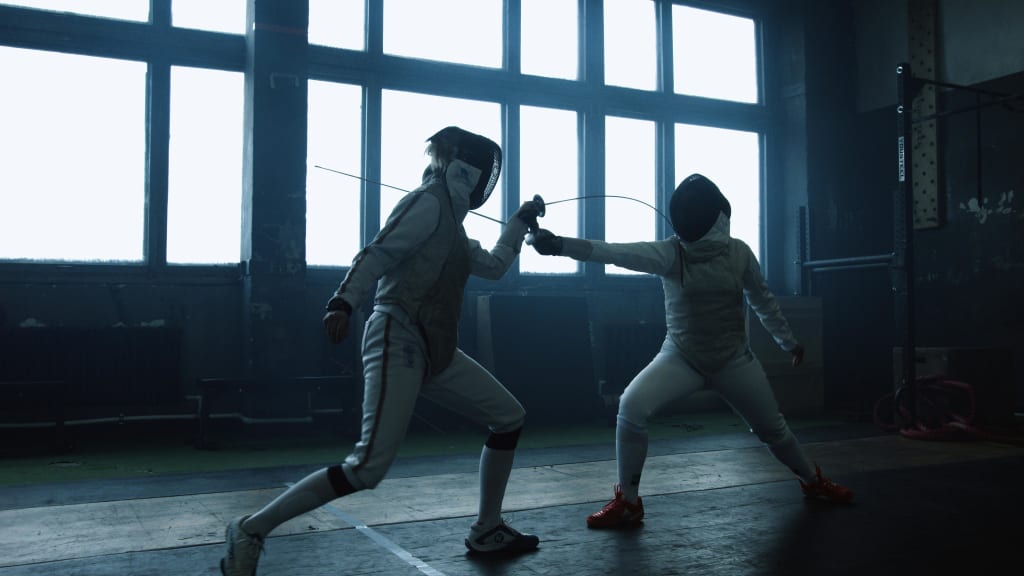
The demon appeared before them in a pillar of fire. Douglas unsheathed his sword and adopted a defensive stance. The pillar disappeared in a cloud of embers. The demon charged him. He swung his steel down. The demon dodged. Douglas adjusted for the demon's new position. The demon smiled. Douglas lunged. The demon parried the blade. Douglas pulled it back. The demon clawed at him. Douglas parried the talon, then stepped into the strike. He brought his sword across the demon. The demon split into two. Each half fell to the ground and melted into lava. Douglas allowed himself a moment to breathe.
The sword fight between the hero and the villain, the shootout as the hero lays into the enemy fort, and the chase scene as the villain tries to stop the hero from escaping with the plans: These are all action scenes, but as common as they are some writers don't write them all that well while others are just scared when it comes to writing action scenes. It really doesn't take much to write a good action scene, but they do need some planning to pull it off right.
[While most action scenes tend to be combat-based, this does not need to always be the case. For thieves, most of the scenes would be picking pockets, opening locks, and cracking safes, while for spellcasters it would be summoning an elemental before the horde gets to him, a shape-shifting duel, or solving puzzles to get to the goal. It's also one that needs some special considerations, especially at the research stage.]
Do Your Research
There are three areas most people have trouble with when it comes to writing action scenes: limited knowledge, limited experience, and too much of the "rule of cool." Limited knowledge is the easiest to dispel given the sheer number of research materials available, from encyclopedias, weapon wikis, and even history videos; there is no legitimate reason for ignorance. Even just swinging a wooden sword can help with the experience, and there are plenty of organizations from firing ranges to medieval re-enactors to martial arts dojos.
You should also avoid doing things just for the sake of being cool; once or twice, sure, but if you bend reality too often then it becomes questionable how the characters keep pulling off even the most ludicrous moves. This is not to say you shouldn't try to pull off some anime-style moves; those sweet, sweet moves occasionally just add that something special to the story. However, if your hero is in the middle of combat and starts pulling off the moves for the Sweet Nuclear Pineapple Punch which takes a full thirty seconds, there is the issue of why everyone was letting you set it up, especially if they knew it was going to devastate them.
[You are not required to become a master of blade, gun, and fist so don't sweat it if you don't have the time or inclination to do so. You just want to become good enough to know the difference between how shotguns work in real life versus in Hollywood, and how to put that in words. So don't feel bad if you don't know every individual kata of kenjutsu; just know the difference between a katana (long, curved sword used by samurai) and a wakizashi (short sword used by samurai) and when it's proper to use them.]
Research helps other types of action scenes as well. Knowing specifics of how safes work can only help with a heist scene while knowing how computers work can help with a hacking story. The more knowledge you have going in the more accurately you can portray what is happening to your characters. Information is the power to make your scenes that much more realistic and thus more powerful.
Know the Limits of the Weapons
It's important to remember the limits of any weapon. It's easy to remember the advantages of any particular weapon, but the disadvantages seem to be forgotten. This is why you get people swinging a scythe with the speed of a sword, cutting off limbs with a hammer, or having an arrow flying faster than someone tosses a couple of daggers. This can get especially ludicrous when you have pistols with infinite magazines. While this is great if you're trying to show how epic the characters are, if done too often it brings into question why you wanted that particular weapon; sure, the scythe is great for death-oriented characters but have you ever tried doing an overhead swing with it?
There will come a point where the weapon just feels wrong and that will take your readers out of the story in a heartbeat.
Where Are They Fighting?
You need to allow for the geography of where the fight is happening. Not only can the proper location add weight to the drama of the scene, but it can provide some additional tactics to the combatants. If you put your final combat in the Swamp of Regrets, the two will need to deal with waist-high water (slowing them down but letting them hide in the water), dodge around mangroves, and deal with the fog if they have ranged weapons. Conversely, the Sandy Desert's heat will limit where they can hide, will make heat a potential issue, and will make movement much more strategic. If you can allow for these additional issues, it just adds to the combat scene and additional suspense to the scene.
This really works when you use the environment to give the bad guy an advantage, such as a heroic sniper who has to deal with a villainous stealth expert in the swamp. This can also add a limiting element to a fight, even if it looks like the bad guy has an advantage at the beginning: A speedster has an initial advantage against a tank in the desert (all of the wide-open spaces give the speedster) but the possibility of heat exhaustion increases exponentially every minute the speedster exerts himself while the tank just has to endure the initial part of the fight.
People Don't Fight Just to Fight
This may sound obvious, but it only helps to add an additional level to the fight. This adds to the suspense ("Will they get what they need?") and raises the stakes. While this doesn't need to be done to every fight (this over-use can actually create eye-rolls), it is something that needs to be considered, especially when the heroes are fighting the top henchmen; this is where grudge matches can work well for you. The more emotion you can add to a fight, the higher the stakes, and the more effective the scene.
However, there can be other reasons that work, such as answering who has the greater sword skill, who can run faster or lift more, or who is better at solving puzzles. You can even dramatically match skills: The stealth expert has to sneak up on the sniper or the mechanical expert has to disable a gun apart before it fires; this gives the character a chance to show off. If this is done towards the beginning, it helps establish the credibility of the character; it can even be used to show how good or bad a team works together. Heck, dealing with the same problem before and after a training montage can show how effective the training was.
Motivations are the key to writing a good scene, even it it's just an excuse to show off.
[Since it needs to be said: Failure is an option. While this has some obvious comedic advantages (a guy showing off for a girl botches it), it can also help up the stakes later on, especially if the character has to deal with the same or similar problem. You can also have the failure necessary to the plot (someone takes pity on him and it turns out to be the character's soon-to-be sensei). However, don't use the failure/hidden success twist too often or it kills any suspense; sometimes your character needs to fail.]
Keep It Short
This is where a lot of people screw it up. They get so into a particular style of writing that it permeates all of their scenes, and this hurts them when they start doing action scenes; action scenes need to be short, both in terms of sentences and paragraphs: The action needs to keep up a fever pace (ergo the shorter sentences) and if it's kept for to long the fast pace will cause the reader to get bored.
This means that the sentences need to be short, no more than 10–15 words long, with no colons, semi-colons, or conjunctions; there should be no more than one thought or action per sentence. This staccato rhythm needs to be maintained throughout the scene, with a return to regular sentences signaling a return to the non-action part. Paragraphs need to be short, no more than 50–90 words, and no more than 3–5 paragraphs if you want the reader to maintain interest.
[Let's talk about the fight scene in "Sherlock Holmes" (2009) for a second: This is not an action scene. The point of the scene is to show how Holmes is always thinking, so what would normally be an action scene is made into more of a character development scene (they don't need to be exclusive, but they are here). This is why the scene was slowed down; you see this is a lot of British detective fiction, where the lead finds a clue in the middle of a chase scene or has an epiphany during a fight, where the clue or epiphany needs to be explored. It's a different approach worth trying.]
While this does seem to be a lot at first glance, it does get easier the more you write them. You need to do less research each time, and it does sort of become second nature after a while. There are numerous YouTube channels where they go through the use of weapons and how they interact with other weapons as well as other items; the guntubers are particularly infamous for seeing what firearms do, so there's no real excuse for ignorance. The key is to just have fun writing these scenes as they are so important to your stories, and a badly written action scene can damage your story. But a really, really well-written can leave the reader breathless, making it all worth it.
About the Creator
Jamais Jochim
I'm the guy who knows every last fact about Spider-man and if I don't I'll track it down. I love bad movies, enjoy table-top gaming, and probably would drive you crazy if you weren't ready for it.
Keep reading
More stories from Jamais Jochim and writers in Writers and other communities.
The Necessary Balance Between Light and Darkness
A Sailor and A Husband Consider if you will Odysseus and Darth Vader. Odysseus was a great person: He was loyal to his wife; he was able to maintain a love for his wife over 20 years. He was able to figure out clever solutions to hard problems, and there's no doubt that his crew was willing to follow him no matter where he would lead them. There's no question the guy was a hero.
By Jamais Jochimabout a year ago in Writers
Early March 2026: 4 Goals Accomplished
It's early March and I've now accomplished my 4th writing goal for the year of 2026. Before diving into the behind-the-scenes of it... why not tell you up front what that accomplishment was? I was published in a 2nd publication for this year. Published in Helix Literary Magazine out of Central Connecticut State University. You can read it for free right now!
By Stephen Kramer Avitabile5 days ago in Writers



Comments
There are no comments for this story
Be the first to respond and start the conversation.