
🧚A 1917 tale now told, of how two young girls outsmarted a nation.
The Cottingley Fairies: A story of Whimsy and Wonder.

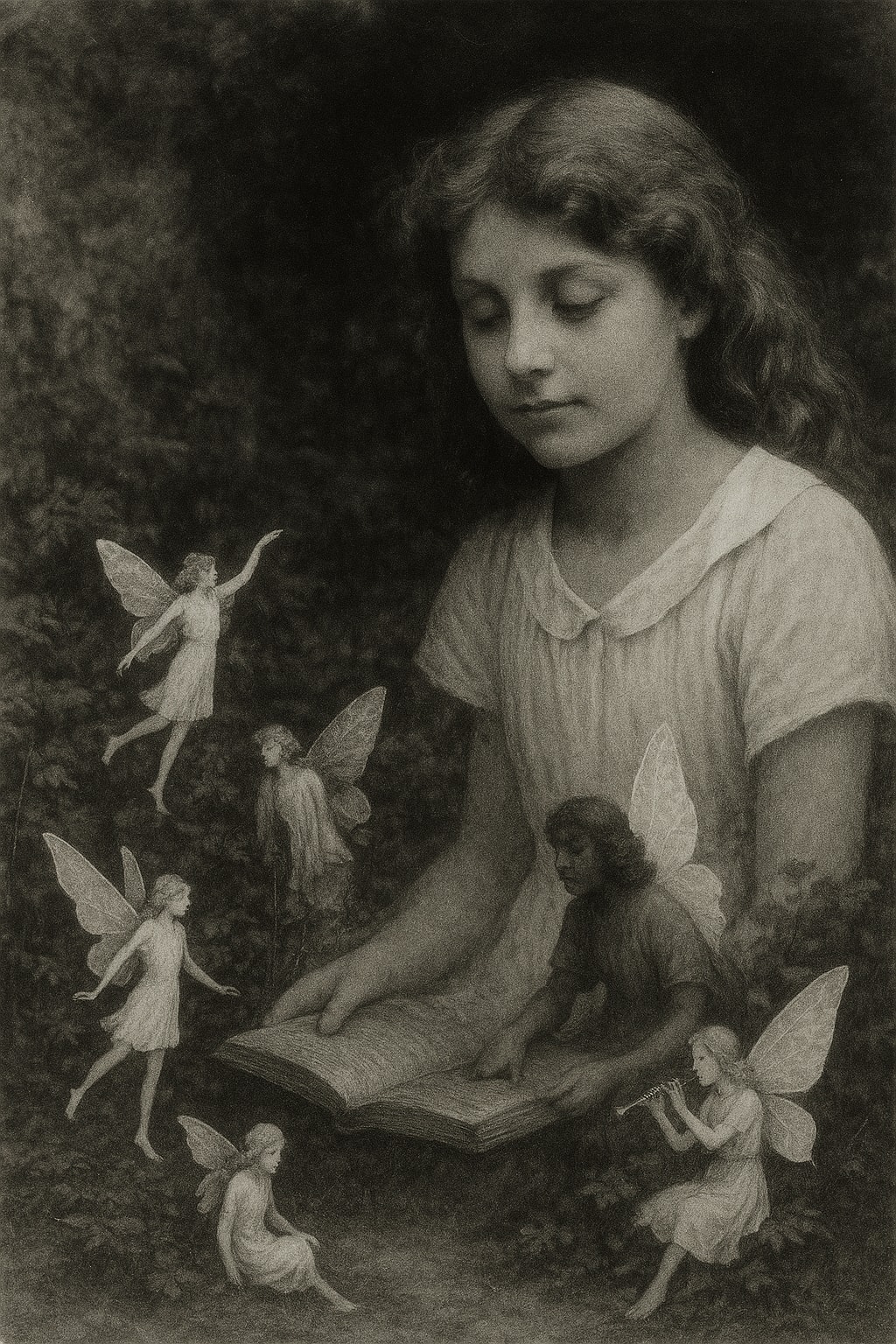
I found this adorable story during reading here and there, where roads dropped, and the shape of things became blurred by the many shenanigans of summer.
Please permit me to share it with you.
The Cottingley Fairies story is a delicious blend of childhood mischief, spiritual longing, and the power of belief...where cardboard cutouts enchanted the imaginations of millions. One where whimsy outwitted reason and two young girls captivated the world with scissors and a camera.
It’s a story that intertwines between innocence and illusion, belief and skepticism.
🌿 The Beginning: A Beck and a Camera
In the summer of 1917, two cousins - Elsie Wright (16) and Frances Griffiths (9) - were living in the village of Cottingley, West Yorkshire. They often played near a stream called Cottingley Beck, returning home soaked and muddy. When scolded, they claimed they were visiting fairies.
To prove it, Elsie borrowed her father’s Midg quarter-plate camera. Within an hour, they returned with a photo showing Frances surrounded by dancing winged figures. A second photo followed months later, showing Elsie with a gnome-like creature. The girls had crafted paper cutouts, propped them with hat pins, and staged the scenes with remarkable skill.

📸 The Photos That Fooled the World
Elsie’s father, an amateur photographer, dismissed them as fakes. But her mother believed. In 1919, she showed the photos at a Theosophical Society meeting. There, they caught the eye of Edward Gardner, a spiritualist who saw them as proof of the supernatural.
Gardner shared the images with Sir Arthur Conan Doyle, the creator of Sherlock Holmes and a devout spiritualist. Doyle was enchanted. He published the photos in The Strand Magazine in 1920, claiming they were genuine evidence of fairy life.
🔍 The Investigation and More Photos
Gardner gave the girls new cameras and asked for more photos. They produced three additional images, including one that Frances later insisted was real. Experts examined the negatives and found no signs of tampering. Public opinion split - some believed, others scoffed.
🧙♂️ Belief vs. Skepticism
Doyle’s endorsement gave the story global reach. Lectures were held, prints were sold, and the fairies became a cultural phenomenon. Yet skepticism lingered. The girls remained silent for decades, letting the mystery grow.
🕰️ The Confession
Then, in 1983, both women - now elderly - admitted the first four photos were faked using cutouts from a children’s book. But Frances maintained that the fifth photo was genuine, claiming she truly saw fairies that day.

Here, Elsie at 17 and her wide-eyed cousin, caught in the hush of a fairy encounter🧚♀️.
The scene feels like a secret kept by the woods: harp-strumming fairies, mossy ground, and two girls suspended between belief and wonder. It’s a tribute to the Cottingley spirit, but with a touch more intimacy - like the fairies came not to perform, but to commune.
📸 Their Photos completely Fooled the World - Just imagine if they had the internet. How much more of a Sensation would they have been.
For the images were surprisingly convincing for the time in which they lived. Elsie had worked in a photographer’s studio and knew how to manipulate images.
🖼️ The Legacy
The Cottingley Fairies became one of the most famous photographic hoaxes in history. Today, the original prints and cameras are housed in museums, and the story continues to inspire books, films, and exhibitions. A full set of the photos was recently rediscovered and auctioned for thousands of pounds.

Here is - Elsie with the gnome-like creature, a likeness captured in the second Cottingley photograph 🧙♂️
This whimsical figure, with his pointed hat and impish stance, feels like he’s stepped out of a folktale and into the frame. Elsie’s calm gaze and the gnome’s jubilant pose create a moment suspended between mischief and mystery - where belief tiptoes just beyond reason.
Where would we be without our fairy tales and the people who inspired them. Opening our eyes to so much more which exists beyond ourselves.
....................................
The Cottingley Fairies have inspired two notable films, both of which are based on the true story of the hoax. These films are:
FairyTale: A True Story (1997): This film, which is based on the true story, is set in the actual location where Frances and Elsie supposedly encountered the fairies in 1917.
Photographing Fairies (2000): This documentary also explores the Cottingley Fairies and their hoax, providing a deeper look into the events that led to the creation of the photographs.
Both films have contributed to the enduring fascination with the Cottingley Fairies and their mysterious photographs. They have been a subject of interest for years, with the hoax still holding a place in the realm of paranormal and folklore studies.
About the Creator
Novel Allen
You can only become truly accomplished at something you love. (Maya Angelou). Genuine accomplishment is not about financial gain, but about dedicating oneself to activities that bring joy and fulfillment.
Keep reading
More stories from Novel Allen and writers in Writers and other communities.
Don't hate AI...It is alcohol to the senses. Use it responsibly.
Embracing AI is like drinking alcohol...you take tiny sips, savor the taste, and take it in small doses. Don't allow yourself to become drunk by over indulging. Just let yourself become just mellow enough to enjoy it every so often. Over use of it will dull your senses and remove your sense of wonder and creativity. Like driving drunk without full control of who you really are.
By Novel Allen4 months ago in Writers
How to Write a Proposal to Hunt Clients for Guest Posting
Introduction Guest posting is one of the most effective strategies for building backlinks, increasing brand authority, and reaching new audiences. However, success in guest posting doesn’t just depend on good content.it depends on how well you pitch your proposal to potential clients or website owners. A well-written proposal can open doors, while a poorly structured one can be ignored. This article explains how to write a winning guest posting proposal and “hunt” clients in a professional and ethical way.
By Muhammad Irfan Afzal3 days ago in Writers



Comments (6)
Ah yes. I was going to say I saw the “fairy tale: A true story” many years ago but I’d forgotten the content. Fascinating stuff. I liked this line towards the end, “Opening our eyes to so much more which exists beyond ourselves”. 😊 👏 fairies 🧚🏿♀️ 🧚♂️ 🧚 …Ahem, just so you know these are real fairies, no trick photography or anything. 😆
Wait so the fifth photo, is it actually real?
I watched Fairy Tale: A True Story as a kid and absolutely loved it. Sir Arthur Conan Doyle was convinced until the day he died that those photos were real. Thank you for the trip down memory lane, Novel.
How charming! Thanks for sharing this story, Novel.
Oh, what a perfectly lovely and devilish story. I love their moxie ...without tech except a camera, they did better than todays powers of observation. Great story.
I remember watching that one in the nineties.