
Did the U.S. ever have a match for the Sierra Cosworth or Lotus Carlton in the '80s and '90s?
Could '80s and '90s American Cars Keep Up with Europe’s Finest?


The idea of fast cars in America has pretty much always been the same: take the cheapest cars and stuff the biggest engines into them—that's the whole muscle car thing. Europe, on the other hand, leans more toward smaller cars with small engines and sharp handling. I guess that’s because the roads over there are a lot different than in the U.S.
Back in the '80s, Americans didn’t really seem interested in following Europe when it came to sports cars. They didn’t have much direction in that area. Even now, Americans still tend to prefer bigger cars with bigger engines. Sure, there were some turbocharged inline-4s here and there, but they weren’t the norm and didn’t really catch on. I think the whole idea of a “small, nimble sports car” just didn’t click with American carmakers—though I kind of get it. They were looking at performance from a different angle.
Yeah, American cars did get smaller and more fuel-efficient in the '80s, but that also made them way less powerful. I mean, a lot of you probably remember when horsepower took a nosedive. Even iconic muscle cars like the Camaro and Mustang were putting out way less power than they had just a couple decades earlier, mostly because of emissions regulations and stuff like that. I think that's a big reason why America never really ended up with its own version of the European-style sports car.
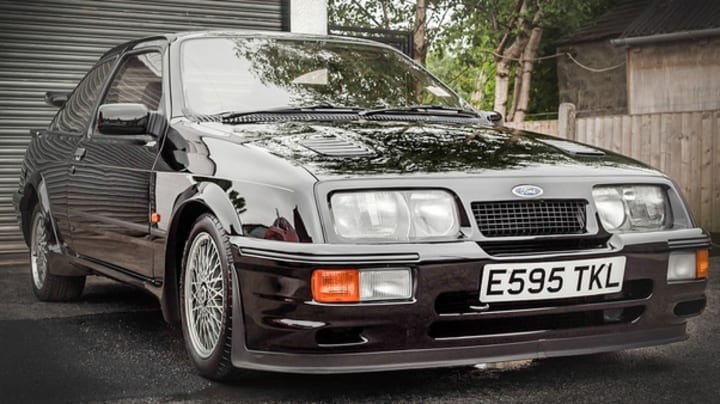
The Ford Sierra Cosworth is about as un-American as it gets—Ford of Europe built it around a 2-liter turbocharged engine. The Sierra RS Cosworth basically captures the whole vibe of ‘80s performance cars: turbocharged, loud, and totally in your face. It dropped in 1985 with a Garrett T3 turbo that gave Ford’s 2.0-liter engine some serious punch. In standard trim, it made 204 hp—around the same as most American muscle cars at the time, which needed way bigger V8s to hit those numbers. I guess American buyers didn’t care, so U.S. carmakers didn’t really build anything like it.
As far as I know, there was never a car like that in the U.S. because the priorities were just different. Americans didn’t really go for the whole European sports car philosophy—smaller engines, more tech, better handling. Back then, most American cars were still running V8s that were detuned to meet emissions standards. Europe didn’t have to do that as much because they never used big engines anyway. They just squeezed more power out of smaller ones.
Honestly, it kind of makes sense. The U.S. has long, open highways, and people often drive big distances, so buyers wanted roomy cars with lots of torque. I don’t think European-style performance cars really fit that lifestyle, and there wasn’t much demand for them here. So naturally, manufacturers didn’t bother making them.
The American market never really had a car like the Sierra because there was no need for it. People here preferred cars that suited their own roads and habits—big sedans or coupes with V8s or inline-6s. Importing or adapting something like the Sierra probably wouldn’t have made much sense. Plus, car specs and regulations vary between countries, so just because something was a hit in Europe doesn’t mean it would’ve sold well in the U.S.
It seems like Americans figured those kinds of cars would only sell in Europe, so there wasn’t much urgency to bring them to the U.S. at the time. It was really just a difference in taste, and in the 1980s, companies like Ford didn’t see the point in making cars like that. They just didn’t think there was a real need for them—the market was different. Kind of a shame, honestly, but that’s how it went.
About the Creator
Pinesthi Mukti Rizky Wibowo
Hi, my name is Eky and here I will write about automotive and other things, most of the writing will be taken from my personal Quora or Medium account. Most of my writing is curated from my Quora account which I have more than 4,000 answers
Keep reading
More stories from Pinesthi Mukti Rizky Wibowo and writers in Wheel and other communities.
Bezos-Backed Slate Auto Unveils Affordable EV Truck: Can It Succeed in a Shaky U.S. Economy?
It's a bit hard to see; the concept is great, but I'm not sure how Americans will react, especially because of its size. I mean, the Slate Truck is basically a small car, and I'm not sure Americans are going to love that, especially when it comes to pickups. It could end up being a niche vehicle, like the Kei cars in Japan, but how's that going to play out in the U.S.? I really don't know.
By Pinesthi Mukti Rizky Wibowo9 months ago in Wheel
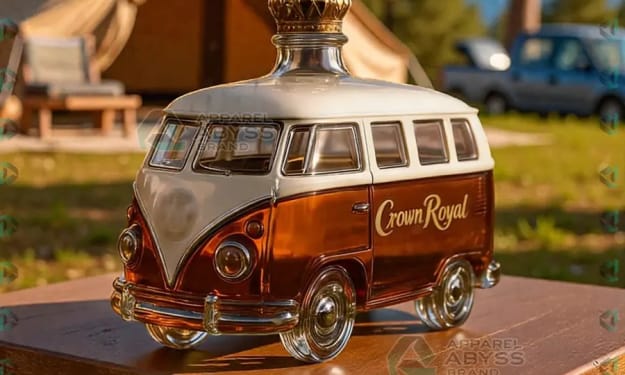
The Volkswagen T1 Camper Van Decanter Whiskey Bottle
Get it on : https://apparelabyssbrand.com/product/volkswagen-t1-camper-van-decanter-whiskey-bottle/ The Ultimate Blend of Nostalgia and Spirits: The Volkswagen T1 Camper Van Whiskey DecanterFor decades, the Volkswagen T1 Camper Van—affectionately known as the "Bus" or the "Bulli"—has been a global symbol of freedom, adventure, and the "Van Life" spirit. Today, that iconic silhouette has found a new home: not on the open road, but on the top shelf of the world’s most stylish home bars. The Volkswagen T1 Camper Van Whiskey Decanter is a stunning piece of functional art that captures the heart of 1960s counter-culture and pours it into a glass of premium bourbon or scotch.A Design That Drives ConversationAt first glance, these decanters are a masterclass in detail.
By gia ton hanha day ago in Wheel



Comments
There are no comments for this story
Be the first to respond and start the conversation.