
What the Orange Wall Knew.
A walk through MIMA (Middlesbrough Institute of Modern Art) with two quiet encounters.

The weather was undecided. Rain in the air but not on the ground. A grey that did not press too hard. Still, I felt restless, like something inside me needed air. Not errands. Not chatter. Just space.
I left the bus station with no destination, only a quiet pull. Like hunger without a craving.
Not far from the gallery, a woman stood offering gospel tracts. Her voice was steady and sure, carrying that tone that does not force but invites. We talked. We prayed. I felt the presence of something real. Still, I kept walking. Not because the moment lacked meaning, but because it pointed toward something just beyond it. Like a doorway slightly open.
Upstairs, on the first floor of the gallery, I found myself in front of a wall the color of citrus and flame.
Bright orange Perspex panels stretched along the wall. Each one etched with recipes. But they were not for food. Not in the usual sense. One read: Dislocation. A rebellious will. Love of land.

I stayed longer than I planned. Not thinking much. Just listening without needing words. The work is called The Mangrove Banquet, created by Zina Saro-Wiwa, daughter of Ken Saro-Wiwa, the writer and activist who gave his life speaking up for the Niger Delta. This was not art that asked to be admired. It asked to be witnessed. It offered ingredients for survival. For remembering. For becoming.
The orange glowed like something between sunlight and warning. It stirred things I had not spoken aloud. I know what dislocation feels like. Not just being in the wrong place, but living between worlds. I know what it is to carry a will that cannot be tamed for the sake of politeness. And I know what it is to love land that is not land. A calling. A place inside. A knowing that has no coordinates.
The recipes were not sentimental. They were sharp and beautiful and necessary. I did not want to leave.
Later, I made my way to the roof terrace. I was still thinking about the banquet, still carrying its textures somewhere behind my ribs. In the gallery store up there, I noticed a vessel sitting quietly near a chart. The chart said it contained the ashes of someone the artist loathed above all others.
I paused.
It was a piece by Grayson Perry. Coil-built earthenware. 1990. The urn had a stillness to it. Nothing flashy. But it stopped me in a different way than the banquet had. Not fire. Not warmth. More like stone.
I did not know her. The woman whose ashes were said to be inside. But something in me understood. That strange ache of seeing yourself in someone you reject. The discomfort of standing before the person you might have become if you had not been delivered. That feeling of something trying to claim you, but you slipped through. Not by cleverness. By mercy.
The urn did not explain. It did not apologize. It simply held the story. Loathing and preservation, side by side. Fire and form.
And standing there, still full of the banquet’s glow, I saw how both moments were part of one encounter. Not opposites. Not even contrast. Just two truths breathing in the same space. One offered nourishment. The other reminded me what hunger can destroy.
I felt the quiet tension of being spared. The kind of quiet that does not shout thanksgiving, but breathes it. The kind that sees the path you could have walked and still loves the ones who had to walk it.
Somewhere in that moment, I felt a shift. Not dramatic. Not cinematic. Just a subtle rearranging of the atmosphere inside. A soft realignment with a version of myself that had been waiting for me to arrive.
I stepped back out into the city. The world felt just a little different. Not larger. Just clearer. As though something ancient and gentle had spoken and I had simply said yes by listening.

Some things are not meant to be understood all at once.
Some are not meant to be spoken out loud.
But once you have stood before the orange wall and the urn, you do not forget them.
You carry them. Not as burden. As light.
Like the memory of a song you never learned but always knew.
Like color behind your eyelids when you close your eyes in prayer.
Like a table already set before you even knew you were hungry.
And that is enough.
About the Creator
Away from the Crowds in Wyoming
Devils Tower is the first declared National Monument in the US. It is not really known how this formed into such a unique shape. Legend has it that two girls were playing, and along came giant bears. They tried to run away from the bears and climbed to the top of a rock, praying to be saved. Then the rock rose high up into the air, and the girls were saved while the bears left their claw marks on the side of the mountain trying to climb it but failing. The Devils Tower received the honor of becoming the first National Monument in 1906, 13 years after the first recorded climb of the mountain by William Rogers and W.L. Ripley in 1893.
By Rasma Raistersabout 13 hours ago in Wander
The Kelpies and The Falkirk Wheel
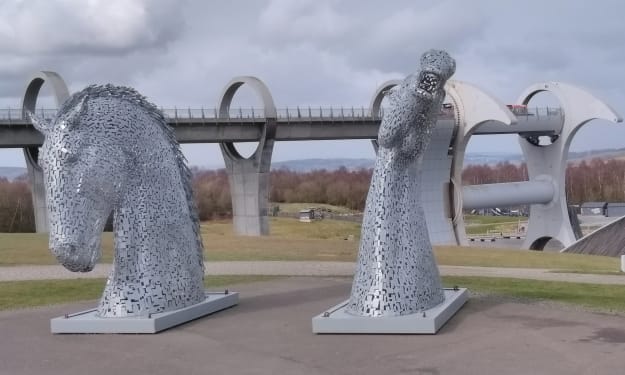
The Kelpies The Kelpies A few years ago I was driving up the M9 towards Dollar in Scotland, it was dark and raining and suddenly I nearly crashed the car when I saw two huge hundred-foot-high horses' heads to my left-hand side. I had to pull over. I am not sure if I tried to take a photograph but I was dumbfounded.
By Mike Singleton 💜 Mikeydred 5 days ago in Wander
Pearl
1980 something. we all hung out at Pearl and you and i were nothing special, or so i thought. i mean we all danced, drenched in our own sweat, our own saline solution of fear, too many beers, shots, laughter, tears, fucks in the bathroom and i don't know when we began to be afraid. do you?
By ROCK aka Andrea Polla (Simmons)4 days ago in Fiction



Comments (1)