

I was most impressed by the refreshing change around the regenerated Royal Victoria Docks. I last visited the Excel Centre many moons ago and saw extensive work around the area. The finished outcome is impressive. Let me tell you more about Royal Victoria Docks
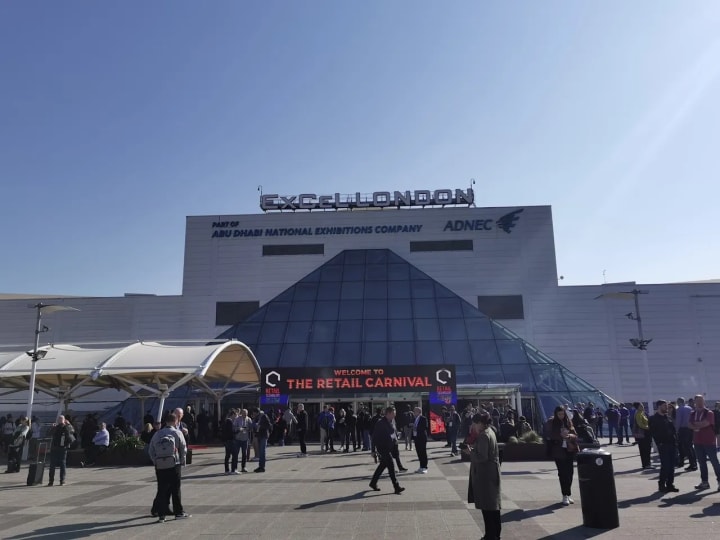
The ExCeL Centre sits on the northern quay of the Royal Victoria Dock, part of the historic Royal Docks complex, which includes Royal Victoria, Royal Albert, and King George V docks.
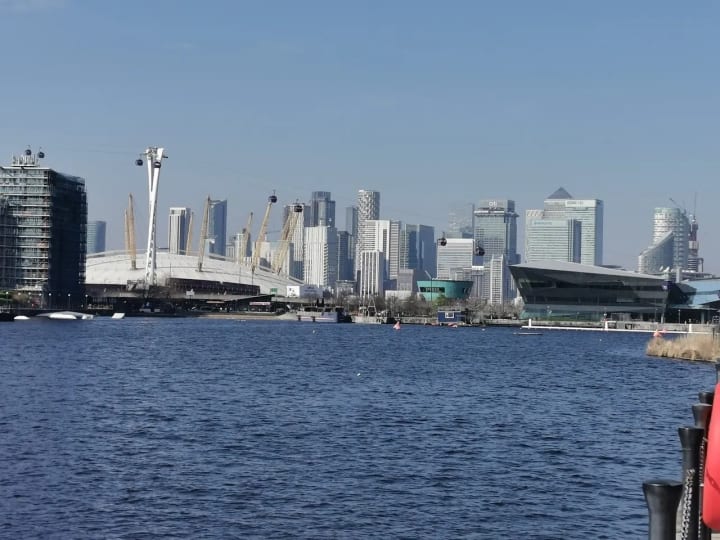
The weather was perfect, so a quick and brisk walk around the river path was a welcome relief. The area is roughly between Canary Wharf to the west and London City Airport to the east. I also saw the IFS Cable Car in the distance. It’s not a touristy cable car, but it links to the O2 in Greenwich. It’s a fun, non-touristy thing to do for a fair price.

Royal Victoria Docks
These docks, constructed between 1855 and 1921, were at the centre of London’s maritime trade. They were constructed to accommodate the growing demands of the British Empire’s shipping industry, which handled goods like tobacco, ivory, and spices. At their peak in the early 20th century, they employed thousands and were among the largest enclosed docks in the world.

After the trade stopped after WWII, and with extensive bomb damage, the area fell into disrepair and was abandoned. Plus, there was a shift to container shipping, which moved to deeper ports like Tilbury.
Thankfully, the London Docklands Development Corporation (LDDC) kicked off regeneration in the late 20th century, which has turned the area's fortunes around. The ExCeL Centre, which opened in 2000, became a cornerstone of this revival. Today, it’s refreshing to see people coming into the area for exhibitions, trade, and cultural activities.

Facts
✳️Three-Part Complex - The Royal Docks consist of three distinct docks—Royal Victoria Dock (opened 1855), Royal Albert Dock (opened 1880), and King George V Dock (opened 1921)—forming one of the largest enclosed dock systems in the world at their peak.
✳️Victorian Engineering Feat - Built to handle the British Empire’s booming trade, the Royal Victoria Dock was the first to use hydraulic power for cranes and locks. It was a cutting-edge innovation when it opened in the mid-19th century.
✳️Massive Scale - Together, the docks once covered over 250 acres of water and had more than 22 miles of quays, dwarfing earlier Thames docks and designed to accommodate the largest steamships of the era.
✳️City Airport - built in 1987 between Royal Albert and King George V Docks, repurposed part of the dockland site, its runway uniquely positioned amidst the water.
✳️Cultural Relics: Remnants of the docks’ past endure—cranes still stand along the quays, and the Grade II-listed Millennium Mills, a derelict flour mill from 1905, looms as a symbol of their industrial heritage, slated for future redevelopment.

Hotels
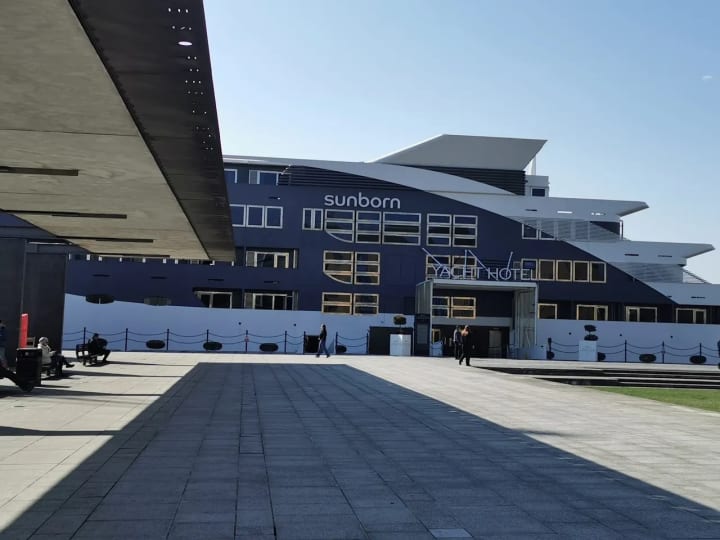
There are many hotels with over 1,400 rooms on-site, and one caught my eye. It’s a moored ship. There’s no shortage of rooms, as there are plenty more within 20 minutes. Food-wise, there are eateries inside ExCeL (it is pricey, so either you eat before or pay a high price). I spent nearly £7 on a tuna and mayonnaise baguette.
The area lacks the organic bustle of a high street; it’s more event-driven.
The streets around the venue—Western Gateway, Sandstone Lane—aren’t buzzing with social life after the visitors go home. It’s more a place of purpose than leisure. The dockside setting, with its cranes and old warehouses, lends a gritty, post-industrial allure.
Transport Links
The area is exceptionally well-connected. The ExCeL Centre has two Docklands Light Railway (DLR) stations—Custom House (west entrance) and Prince Regent (east entrance)—making it easy to reach from central London via connections at Canning Town (Jubilee Line).
Thankfully, The Elizabeth line has made it even more accessible to Custom House. It’s a very short and pleasant ride from Liverpool Street Station. I wouldn’t recommend driving, but if you do, there is parking at ExCeL, which costs around £20 a day and should be booked in advance.
Parting Comments
The Royal Docks have evolved from a gritty trade powerhouse to a symbol of East London’s reinvention, blending history with modernity.
Seeing and enjoying the city as it starts expanding eastwards was refreshing. As I looked to the right, I saw the O2 and Money Hood—Canary Wharf. To the left, I saw the Thames Barrier. In between, there is some opportunity for regeneration on the opposite side of the ExCeL centre. As I understand, the derelict Millennium Mill is due for renovation and will create 225,000 sq ft of extra workspace.
I look forward to seeing how this hood develops and how the area transforms into a thriving community.
If you enjoyed reading this article and want to support my work, you can now buy me a coffee ☕️.
https://www.buymeacoffee.com/TabbyLondon
Thank you for your attention.
Best wishes
Tabby
About the Creator
Tabby London
The London I've been discovering is usually off the well-beaten track.I love the nooks and crannies and walking along the streets steeped in centuries worth of history. I'm fond of Zone 1 because that's where it all began centuries ago.
Keep reading
More stories from Tabby London and writers in Wander and other communities.
Minories
Minories is my old student stomping ground. Back then, it felt like Students vs. suits. I’m sure they looked at us with envy as we made our way to the canteen with the best views of the Tower of London. I wish Snoopy was invented back then because of the front house views.
By Tabby London11 months ago in Wander
Photography Tours: Everything You Need to Know
If you have ever returned from a wildlife trip with images that fell short of the experience — blurry shots, blown highlights, or subjects that disappeared before you could compose the frame — you already understand the core argument for booking dedicated photography tours rather than standard nature or wildlife excursions. Photography tours exist to close the gap between the wildlife you see and the images you actually bring home.
By Michael Wilson4 days ago in Wander
A Knight of the Seven Kingdoms Series Review (Season 1)
As one of the biggest properties in fantasy, A Song of Ice and Fire remains immensely popular with audiences. After reaching far into the past with House of the Dragon, a second spin-off was on the cards. A Knight of the Seven Kingdoms serves up a bite-sized slice of action and drama, but it still claims a spot among the best small-screen titles.
By Robert Cainabout 24 hours ago in Geeks




Comments
There are no comments for this story
Be the first to respond and start the conversation.