
Adventure was a romanticized relic belonging to star-gazing men of a bygone era. The narrative map of her “adventure” was not pinned with the same serendipitous fortunes, freshly discovered natural splendors, or altruistic strangers turned companions that she had read about in her grandfather’s journal. It was mostly a lonesome trip, with occasional awkward encounters, frequent mishaps, and rare moments of beauty that she felt obligated to capture on camera.
At her darkest moments, she felt betrayed. Finding the green, leather backed journal, smoothed with decades of handling, among her mother’s belongings had felt like fate. She was flailing in a shoreless sea of existential torments. Mabel, her mother, had passed in the night, unexpectedly. Kiara was learning that the things she thought most important hardly mattered at all. If everything was taken from her, like it had been from Mabel, her own life would have ended without having been lived.
And then she found the journal. It was her grandfather, Edward’s, travel journal from his twenties, around her age now. She remembered his stories about those vagabond years—how freeing and whimsical everything had sounded. He was a fulfilled man, and so Kiara had decided that following the path of his journal could possibly bestow that same fulfillment onto her. All she needed to do was see some sights and meet some strangers.
She quit her job, used a chunk of savings to buy a 1977 Dodge Sportsman RV (the cheapest on the lot), and took off north from Rhode Island to her first stop, Acadia National Park, to backpack along the ocean cliffs. The first pages of Edward’s journal reflected, “This ocean, in constant communication with a moon so many miles away, is the best teacher, hammering the truth of insignificance into its pupils with each wavebreak.”
Kiara was prepared to be a pupil. But her tires had gotten stuck in the mud somewhere in New Hampshire. She fought an hours long struggle for her independence—pushing, digging, screaming, finally slipping like a trite comedy personality. When she finally got to Acadia, it rained all three days of her stay.
Next she had looped around the north east—Vermont, upstate New York, Pennsylvania. A truck driver in upstate had propositioned her at a rest stop after spying on her while she peed in the woods. The bathrooms had been out of order. This was her altruistic stranger. Edward had met “a mystic woman with red hair” outside of Horseheads, and she had met a sleep deprived man with a selfish hunger in his eyes while she squatted like a creature from Tolkien in the woods on the side of 81.
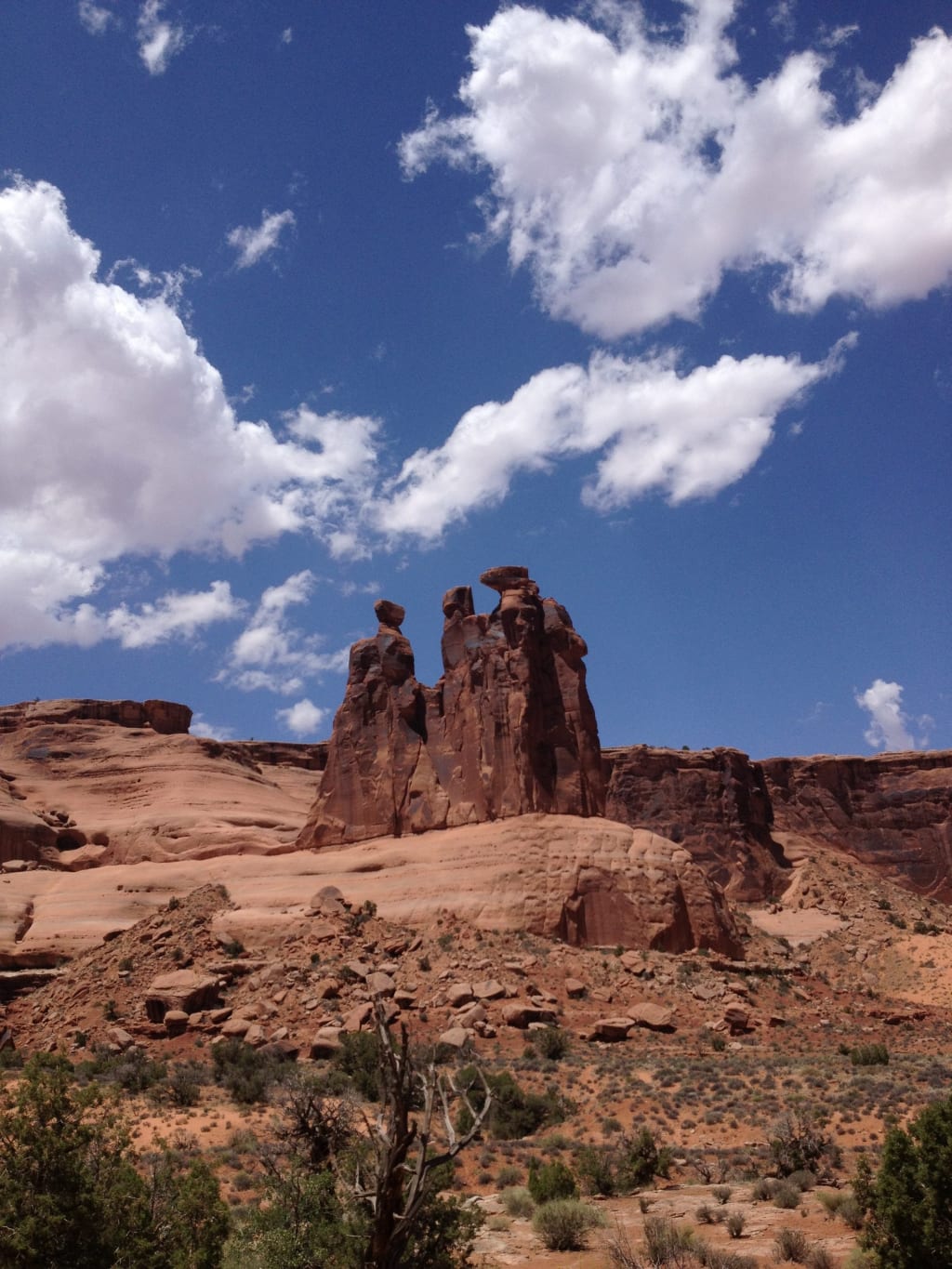
But there was beauty, and opposite her darkest moments were times of brilliance. There were Bison sitting in the sulfuric steam of Yellowstone. Vistas on Route 66 that opened portals into the past of families traveling west. The Utah desert with red canyons, red squared cliffs, red arches; everything red except for the sky. It was of another world.
She met a traveling man in New Mexico. He was always smiling, and his skin was tan and just starting to wrinkle beside his eyes. A waterline on her Sportsman had cracked, leaving her parched in dry lands. He, Ansel, had found the issue and repaired it for her.
Her next stop was Shenandoah’s Skyline Drive to see the fall foliage. Edward had written on a page with some splatter, maybe coffee, “Hardly the most dramatic landscape, but if a leaf of grass is no less than the stars, these rolling colors of leaves make the most beautiful thing I have ever seen. A beauty that does not demand, as the western mountains do, but rather lets you appreciate it at will and ponder something more.”
Ansel traveled with her. For the first time in her months of wandering, Kiara had felt that she was doing something right. Outside of Shreveport they had visited with some of Ansel’s friends. To Kiara they seemed like golems of the land, formed from the silt at the bottom of the bayous, authentic to a place in a way that she could never be. She woke in the middle of their last night there before heading to Alabama in the morning. Ansel and his van were gone. She drove to his friends’ home. Their truck was replaced with a shiny SUV. The woman who answered the door seemed confused. “Two men and a woman in their late twenties do not live here.” Her husband loomed behind her with a growing scowl.
Kiara’s vision had started to pulse black around the edges by the time she arrived at the gas station, and when her wallet opened, as empty as her gas tank, things began to slowly tilt to the right. Her mouth dried up like the Sportsman had in New Mexico.
Edward had written about running out of money in the plains. He had described it as the ultimate freedom. Having nothing permitted him the greatest opportunity to appreciate everything, or something like that. He had hitchhiked for weeks before earning cash working a farm in Nebraska. Her world did not permit young women to hitch rides across continents. Her world did not have surplus gas, food, and kindness in the ways that Edward’s had.
She had a credit card and three hundred dollars hidden under her dinette booth. She bought gas on the card and tried not to think about the debt that would grow until she relinquished her quest for living to find work.
The night was spent in a Walmart parking lot in Minden, Louisiana. With a bottle of something that tasted a bit off, Kiara tapped away on her phone between bursts of laughter. She entered into free giveaways and paid contents to win a new home, a gaming computer set, a dinner with someone she didn’t recognize, a sprinter van, and a trip through the Scottish Highlands. She poured a drink onto the floor for her email inbox which would never recover and giggled herself into a short nap. She woke in the dark, meandered into a convenience store, and left with half of her cash and a stack of scratch tickets.
--
She had driven straight to Virginia and had arrived too early; the leaves were a week from turning.
Sitting atop a stone wall on Skyline Drive, she wondered about the “something more” Edward had pondered while visiting this land. Did he ponder his dire financials, or the alarming noise his vehicle was making when braking downhill, or perhaps the Damoclean sword threatening a normal life of coworkers, dead houseplants, and overdue rent? Or did Edward only think of connectedness and immortality or some transcendental nonsense in the absence of the things that consumed her?
--
It did not rain that night, and the moon was the brightest of the year. Kiara pulled the tent from storage; without its rain cover, she could see through the fine mesh out into her farm host’s fields. She could see the world as it went on in its secret hours, a world of sharp silhouettes in a silver haze.
It was too bright to sleep deeply, and it made her dreams feel more alive. At the kitchen table of her childhood home, her mom placed pecan pie, a specialty of hers. Kiara recognized her mother’s apron with small illustrations of animals dressed as chefs.
“You need to eat quickly, Kiara. Okay?”
Kiara woke on her side. The moonlit field was barely in focus. She spotted a barn cat in the next pasture—nice that the neighbors let cats roam the fields—a dreamy thought before her eyes closed once again to return to Mabel. She didn’t want to eat quickly; she wanted to savor the pie and the sound of her mother’s voice.
Maybe seconds, maybe minutes had passed, but her eyes were open now, blinking hard, clearing sleep as she propped herself on an elbow. From sixty yards away, a barn cat’s head should not have looked so large.
It began to stalk through the field, toward the tent. Kiara did not blink; her body hummed. She felt around for her key, not taking her eyes from the mountain lion as it approached. She glanced down to find the alarm button, and when she lifted her gaze, the creature was jumping the fence into her pasture, its body flowing like ink. It had flanked the tent and was crouching twenty yards away, watching her from the tall grass. She froze, hoping it would go away. Instead, it contracted into itself. Kiara pressed her thumb down. The lights flashed once and the RV made a single, subdued beep; she had hit the unlock button instead of the alarm. There was a throaty hiss. The mountain lion jumped over the fence and ran across the field, two-hundred yards, in seconds.
Kiara made for the Dodge, slammed and locked the door, let out a breath, and watched in disbelief as the creature, having returned during her flight, prepared to jump the same fence post. Kiara hit the horn; it hissed once again before retreating to the forest.
“I was almost mountain lion dinner.” Her hand trembled as she spoke to her sister in Fresno.
“It’s funny,” there was a pause as Kiara’s nephew shrieked at his mother, “that story reminds me so much of Grandpa’s bear encounter in Wyoming.”
“I haven’t heard that one. When did he tell you?”
“I think it was in his journal.”
“His travel journal? It’s definitely not in there.”
“I’m pretty sure it is, Kiara.” Her sister’s tone was somehow an eye roll.
“You mean the green one that I have?”
“No, the black one at my house with strings marking pages.”
It was difficult to not yell through the phone. She had been traveling with the specific purpose of following Edward’s adventures. Surely her sister had retained that much from their few conversations since Kiara had left, and yet she had failed to share the existence of the black journal until now.
“What else is in it?”
“It’s pretty grim. There’s the almost bear attack. He lost a ton of money at a casino and had to work on a farm. He broke his leg falling on some hike up north. There was some stuff about the war I think.”
Edward had been a master of two narratives, and she had only known one. She had been following his path with only half of the events that made him whole.
“Can I come get it from you?”
--
Kiara tried to sleep, but between the lurking mountain lion, whose bovine prey she heard wail from a nearby farm, and the prospect of getting the black journal, it did not come. She opened her phone to order two journals for herself.
She had settled on one with lemons on the cover for the good stuff, and a black one, maybe like Edward’s, for the grit, when an email notification interrupted her. It was her second intense physiological experience of the night. It was strange how dissimilar events could evoke such similar responses. Her body tingled; her mind froze. Thawing that freeze was a fractured memory of that night in the Walmart parking lot after discovering her near destitution. She had submitted photos from her travels and saw them now copied on the email: a vista on route 66, the license plate of the man who watched her pee, his hollow face barely visible in the driver’s side mirror, a picture of her shoes after falling in the mud. She had won a photography contract of twenty thousand dollars from an art institute in Arizona.
She would drive on. She would capture the essence of adventure—the grotesque and the picturesque, the aching misery and the good fortune, the betrayal of men and the kindness of strangers—she would capture it all as truthfully as she could.
About the Creator
Keep reading
More stories from writers in Wander and other communities.
Avalanches Kill Five Off-Piste Skiers in Austrian Alps
The Austrian Alps, long celebrated for their breathtaking beauty and world-class winter sports, were struck by tragedy when five off-piste skiers lost their lives in a series of avalanches in the Salzburg region. What should have been a thrilling day in fresh powder turned deadly, once again highlighting how quickly nature can shift from majestic to merciless.
By Aqib Hussainabout 19 hours ago in Wander
Wild Card Weekend Recap: What Happens Now?
I think I figured out why I love Wild Card Weekend so much. It's because it's the first playoff anything of the calendar year. The NFL season starts in the fall, and once upon a time, the champion was crowned either on or slightly before New Year's. The evolution of the NFL schedule has resulted in the playoffs starting just into the New Year, and currently, the final week of the season falls on the first weekend of the New Year, with Wild Card Weekend coming a week after that. So yes, chronologically, the NFL's Wild Card Weekend serves as the first playoff anything of the calendar year.
By Clyde E. Dawkins6 days ago in Unbalanced



Comments
There are no comments for this story
Be the first to respond and start the conversation.