
The most beautiful place where the sun rises and sets: Mount Nemrut
Exploring the place that has been inscribed on the UNESCO World Heritage List and received the Golden Apple award

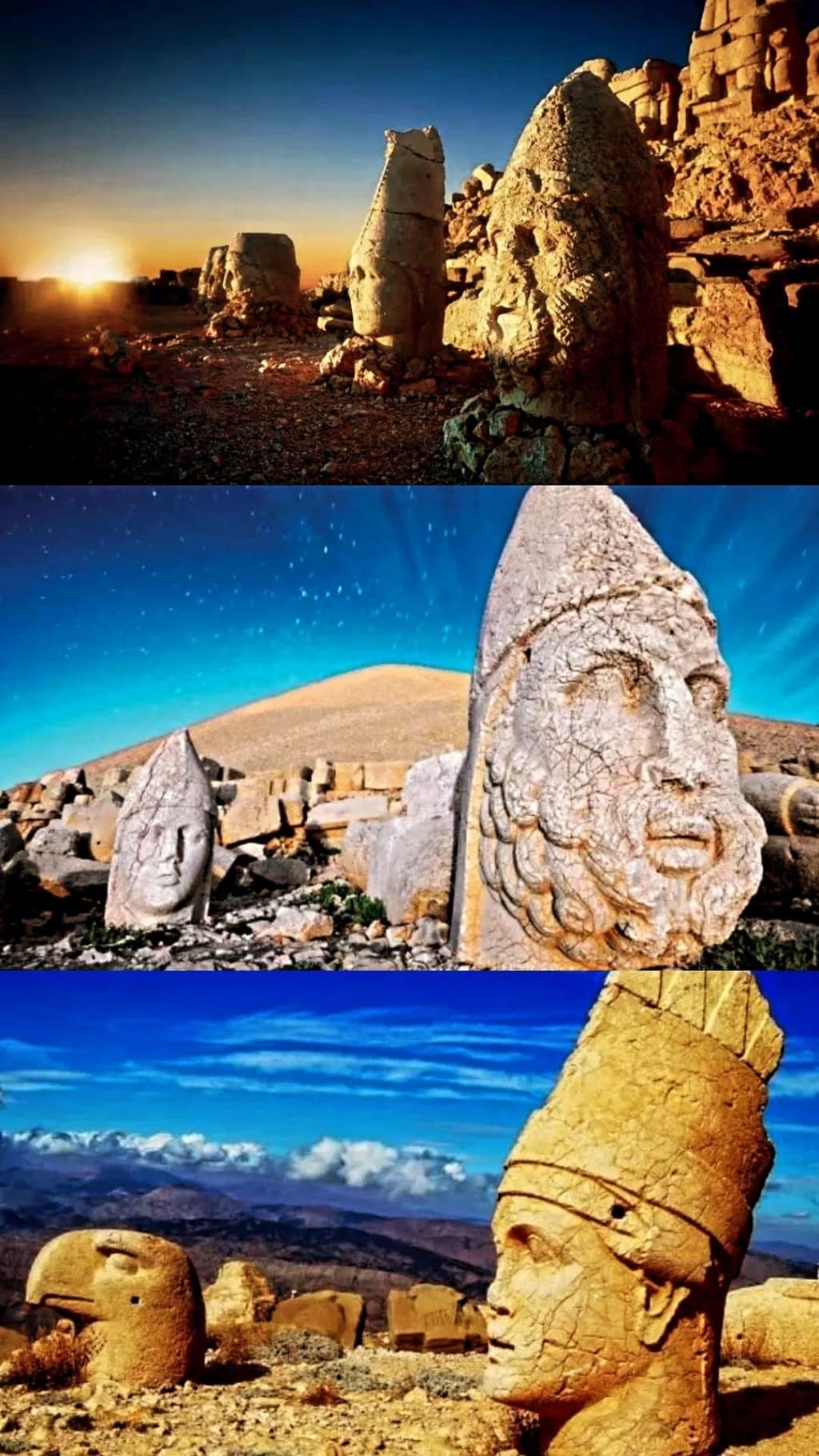
First, let's take a look at the legends about this magnificent mountain, which has been included in the world heritage list, and then let's look at the history, location and features of Mount Nemrut.
Mount Nemrut is steeped in legends and myths that have been passed down through generations. Many of these legends relate to the construction of the site and the mysterious disappearance of the Commagene kingdom. Here are some of the most popular legends associated with Mount Nemrut:
The Legend of King Antiochus I: According to this legend, King Antiochus I was obsessed with the idea of immortality and wanted to be remembered forever. He believed that by building a grandiose tomb on Mount Nemrut, he could achieve this goal. The site was designed to be a grand expression of the king's power and divine status, with colossal statues of gods and heroes that would awe future generations.
The Legend of the Disappearing Kingdom: The Commagene kingdom was a small but prosperous kingdom that was situated between the Roman and Parthian empires. Despite its strategic location, the kingdom mysteriously disappeared from history after the fall of the Commagene dynasty. According to legend, the kingdom was cursed by the gods, who were angered by the hubris of King Antiochus I. The gods supposedly caused the kingdom to disappear into thin air, leaving behind only the ruins of Mount Nemrut as a reminder of its former glory.
The Legend of the Sleeping Giants: Another popular legend associated with Mount Nemrut is the legend of the sleeping giants. According to this legend, the giant stone heads that adorn the summit of the mountain are actually the heads of sleeping giants who will one day awaken to bring about the end of the world. The legend has its roots in ancient myths about giants and the apocalypse, and it adds to the mystical and otherworldly atmosphere of the site.
These legends have been passed down through generations and continue to fascinate visitors to Mount Nemrut. While they may not be grounded in historical fact, they add to the sense of mystery and wonder that surrounds this ancient site.
Mount Nemrut is located in the Adiyaman province of southeastern Turkey and is situated at an altitude of 2,150 meters above sea level. The site is known for its monumental statues and rock carvings that were created during the reign of King Antiochus I of Commagene (69-34 BCE). Antiochus I was a powerful king who ruled over a small but prosperous kingdom that was situated between the Roman and Parthian empires. The kingdom was located in a region that is now part of Turkey and Syria, and it was known for its unique blend of Greek and Persian culture.
The site at Mount Nemrut was constructed as a royal tomb for King Antiochus I and his family. It was designed as a grandiose expression of the king's power and divine status, and it was filled with giant statues of gods, heroes, and mythological creatures. The site is centered around a large artificial mound that was built on top of the mountain. The mound is surrounded by terraces that contain rows of colossal statues of gods and heroes, each standing over 8 meters tall. The heads of the statues are particularly impressive, as they are intricately carved with detailed expressions and headdresses.
The site also contains a number of reliefs that depict scenes from Commagene's history and religion. The reliefs show the king engaging in rituals with the gods, and they also depict various mythological creatures and symbols. One of the most impressive reliefs is the Lion Horoscope, which shows the constellation of Leo above a lion that is being attacked by two bulls. This relief is believed to represent the king's claim to divine status and his link to the zodiac.
Mount Nemrut was abandoned after the fall of the Commagene kingdom and remained hidden under layers of soil and vegetation for centuries. It was rediscovered in the 19th century by European travelers, and since then, it has been excavated and restored. The site was designated as a UNESCO World Heritage site in 1987, in recognition of its exceptional cultural value and the unique insight it provides into the ancient culture of Commagene.
Today, Mount Nemrut is one of Turkey's most popular tourist destinations, attracting visitors from around the world who come to marvel at its impressive collection of ancient statues and stone slabs. Visitors can hike up to the summit of the mountain to explore the ruins and enjoy panoramic views of the surrounding landscape. The site is particularly popular at sunrise and sunset, as the light casts dramatic shadows across the statues and creates a surreal and otherworldly atmosphere.
About the Creator
Keep reading
More stories from Yusuf Pınar and writers in Wander and other communities.
Resources About How To Learn Romanian Language
Learning Romanian can be an exciting and rewarding experience. Whether you are interested in Romanian culture, planning to travel to Romania, or simply want to expand your language skills, there are many resources available to help you learn the language.
By Yusuf Pınar3 years ago in Education
The Ancient Wonder That Stole My Heart: My Journey Through the Angkor Archaeological Park
A Magical Trip of Temples, Sunrises, and Timeless Beauty in Siem Reap I’ve always been a traveler who seeks beauty, history, and unforgettable moments. But nothing in my life prepared me for the day I stepped into the Angkor Archaeological Park. This place is not just a group of temples—it’s a living story, a breathtaking world of stone and jungle, and a spiritual journey that changes you.
By Ahmed aldeabella4 days ago in Wander
Living on the Peninsula: An Overview of the Four Communities of Palos Verdes
A Drive To the Hill Along the Sea The scenery drastically changes when you drive north on Palos Verdes Boulevard toward its namesake. Immediately, the close knit collection of condos and housing tracts along the coast are replaced by green hills, tree-lined streets, Spanish-tiled mansions and a swath of eucalyptus groves.
By Dean Traylora day ago in Wander



Comments (1)
Bro thanks for all that info, I became highly interested in that site. I really appreciate the way you handle the case.