
The Festival That Only Happens
When the Moon Disappears A Journey to the Edge of Darkness and Light


The invitation came in the form of a photograph.
No words. No sender. Just a faded image of an unlit street lit only by rows of oil lamps, stretching into blackness. At the far end, I could just make out a figure—barefoot, carrying something on their head that looked like a crown of flames.
There was no return address, but there was a date scrawled on the back: "When the moon disappears."
I had no idea what that meant.
But it sat on my desk for weeks, pulling at me like a tide.
It wasn’t until a conversation with a linguistics professor in Lahore, of all places, that the mystery deepened.
“Ah,” she said, squinting at the photo. “That looks like Kothar. The Valley of the Vanishing Moon.”
I had never heard of it.
“Not many have. It’s not on most maps. And the only time anyone’s allowed in is… well… when the moon is gone.”
The professor explained it as if it were common knowledge in some circles: Once every few years, the valley holds a festival during a rare astronomical event—the complete disappearance of the moon from the night sky. Not an eclipse, not a new moon. Something rarer. A phenomenon called The Silent Dark, when Earth’s shadow and atmospheric conditions combine to erase the moon’s presence entirely for one night.
That night, the people of Kothar celebrated the Festival of the Vanished Light—a tradition dating back hundreds of years, born from legend, kept alive in secret.
No outsiders were invited.
No photographs were allowed.
And yet here I was, holding an invitation—if that’s what it was.
Getting to Kothar was like walking backward through time.
First, a day’s drive in a dented bus that coughed more than it roared, along cracked roads winding into the mountains. Then, a smaller jeep that left the roads entirely, following nothing more than goat trails through forests that seemed untouched since the beginning of the world.
By the third day, the path was so narrow that we abandoned all vehicles and walked. My guide, a wiry man named Rahim who spoke little English, carried everything in a cloth bundle slung over his shoulder. His pace was maddeningly calm.
We crossed rope bridges that swayed above icy rivers, climbed slopes where the wind tore at our clothes, and passed villages that had no electricity, no cars, no sign that the outside world even existed.
At sunset on the fourth day, we reached a ridge. Below it lay the valley—Kothar.
It was unlike anything I had seen before.
Dozens of small hamlets were scattered along a serpentine river, each lit not by electric bulbs but by hundreds of flickering lamps. They looked like constellations scattered across the earth.
And above them?
The sky was an empty, starless void.
I had expected to see stars. I had expected a silver sliver of moon. But there was nothing—just blackness so complete it felt like falling into a well.
“This is The Silent Dark,” Rahim whispered, as if speaking too loudly might shatter it. “Tonight, there is no moon.”
From the valley floor, I could hear the faint beating of drums. The sound rose and fell like a distant heartbeat, slow and steady.
We descended into Kothar as night thickened around us. The lamps along the path were not electric but oil, their flames dancing against the wind. The villagers—men, women, and children—were all dressed in deep indigo robes embroidered with silver threads that caught the light. They wore necklaces made from polished stones that glowed faintly, as if absorbing the firelight.
The air smelled of cedar smoke and something sweet—like honey mixed with herbs.
The heart of the festival was the procession.
It began when a group of elders emerged from a stone building at the edge of the largest hamlet, each carrying an object wrapped in black cloth. They walked in silence to the riverbank, where the entire village gathered.
One by one, they unwrapped the objects—revealing mirrors. But these were no ordinary mirrors; their surfaces were not reflective in the usual way. They shimmered faintly, like the surface of a pond disturbed by a single drop.
The crowd hummed, a sound low and resonant enough to be felt in the chest. The elders knelt, holding the mirrors up to the empty sky.
And then I saw it.
Reflected in the mirrors was the moon—clear, round, and impossibly bright. Yet when I looked up, the sky was still black.
The villagers gasped in unison, then began to chant words I didn’t understand. They moved through the hamlet in a slow, circular route, the mirrors held high, their reflections casting an unearthly silver glow on the cobblestones.
Later, an old woman explained the story to me in a mixture of her language and Rahim’s translations.
Long ago, the moon was a guardian spirit who watched over the valley, protecting it from famine and war. But one year, the people grew greedy—they hoarded grain, waged petty feuds, and forgot the rituals of gratitude.
In anger, the moon turned her face away, vowing never to look upon Kothar again. The valley fell into darkness, crops failed, and winter came early.
Desperate, the villagers gathered their brightest mirrors and climbed the highest ridge, hoping to catch the moon’s light from beyond the mountains. When they finally did, they swore an oath: to celebrate the night she vanished by bringing her light back themselves, if only for a few hours.
And so, every Silent Dark, they hold the Festival—not to banish the darkness, but to honor it, and to remember the cost of losing the light.
The festival wasn’t just processions and chants—it was a sensory tapestry.
There was Ash-Noor, a thick, sweet porridge made with honey, walnuts, and black rice that turned your tongue blue. There were skewers of spiced lamb grilled over cedar embers, their smoke curling into the cold night air. Women served cups of a hot, bitter drink brewed from wild herbs found only in the upper slopes—said to keep your soul anchored when the darkness felt too heavy.
Children darted through the crowd with small clay lanterns, their laughter ringing out like bells in the stillness. Musicians played drums and long flutes carved from animal bone, their notes echoing against the mountain walls.
Everything was illuminated only by firelight, casting long, shifting shadows that made it impossible to tell where the earth ended and the darkness began.
Just before midnight, the drums stopped. The chatter died away. Even the wind seemed to hold its breath.
Every lamp in the village was extinguished.
I was standing in the center of the crowd when the darkness became total—not the kind you experience in a city blackout, but something older, heavier, almost alive.
For one full hour, no one spoke. No one moved.
It was as if the entire valley had been swallowed whole.
In that silence, I became aware of things I normally missed—the rhythm of my own heartbeat, the faint crunch of frost forming on grass, the slow shift of the river’s current.
I don’t know if it was real or a trick of my mind, but I felt the darkness watching me—curious, patient, not unkind.
When the hour ended, a single drumbeat echoed through the valley. One by one, lamps were relit. The elders held their mirrors high again.
This time, the moon in the reflection was no longer full—it was a faint crescent, as if retreating.
The villagers sang as they carried the mirrors back to the stone building, sealing them away until the next Silent Dark. The festival ended not with a grand finale, but with a slow, deliberate fading, like the end of a dream.
At dawn, Rahim and I began the journey out of the valley. Behind us, the lamps were already being taken down, the indigo robes folded away. The people of Kothar would not speak of the festival again until the next Silent Dark.
As we climbed the ridge, I turned for one last look.
The valley was bathed in ordinary sunlight, the river glinting, children playing. It could have been any mountain village. But I knew—beneath that quiet exterior—an ancient pact still pulsed like a heartbeat, waiting for the moon to vanish once more.
Weeks later, back in my apartment, I took out the original photograph. I had half expected it to change somehow, to reveal more than before. But it was the same—the figure at the end of the lamplit street, the crown of flames.
And yet, for the first time, I understood it.
It wasn’t an invitation.
It was a reminder.
Some places can only be found in darkness.
And some lights only exist when the moon disappears.
About the Creator
Muhammad Sabeel
I write not for silence, but for the echo—where mystery lingers, hearts awaken, and every story dares to leave a mark
Keep reading
More stories from Muhammad Sabeel and writers in Wander and other communities.
The Best Places To Retire Abroad In 2025
During their 23 years together and 11 years of marriage, Jeff Hammerberg and Merlin Parker have moved from Colorado to California to Texas, working in real estate. Their last stop was in Austin, a liberal Lone Star State enclave that matched their personal politics. But after five years, as they prepared to retire, Hammerberg, 66, and Parker, 59, concluded it had become too expensive. Moreover, they didn’t like the political environment in the rest of the state, or even the U.S. “Being a gay couple, Texas was not very compatible,” Parker says. So in March they moved with Wally, their 12-year-old Corgie mix, to Lisbon, Portugal, on the western edge of Europe.
By Muhammad Sabeel7 months ago in Wander
The Kelpies and The Falkirk Wheel
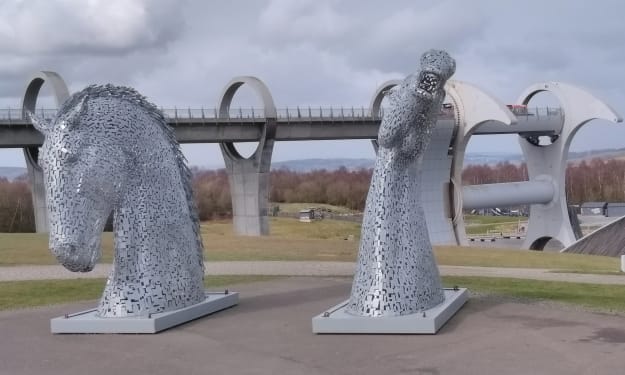
The Kelpies The Kelpies A few years ago I was driving up the M9 towards Dollar in Scotland, it was dark and raining and suddenly I nearly crashed the car when I saw two huge hundred-foot-high horses' heads to my left-hand side. I had to pull over. I am not sure if I tried to take a photograph but I was dumbfounded.
By Mike Singleton 💜 Mikeydred 3 days ago in Wander


Comments
There are no comments for this story
Be the first to respond and start the conversation.