
Owl Of The Secret Beach
The majestic island guardian

“Never cease to act because you fear you may fail,” Queen Liliuokalani once said, whose reign as Hawaii's first female ruler began in 1891.
Her story gives background and voice to the struggle of the Native Hawaiians.
Her country was overthrown and annexed to the United States when US businessmen forced Hawaii into a constitution that limited the power of the islands' royalty and native peoples.
Imprisoned in Iolani Palace, the queen spent the rest of her life petitioning to have the islands' sovereignty restored.
The following story of Nainani is a fictional tale of a Native Hawaiian girl that takes us back to a time before modern Hawaii and major influences from the outside world; the islands were forever impacted by outside influences, altering everything including their day to day lives, perspectives and culture.
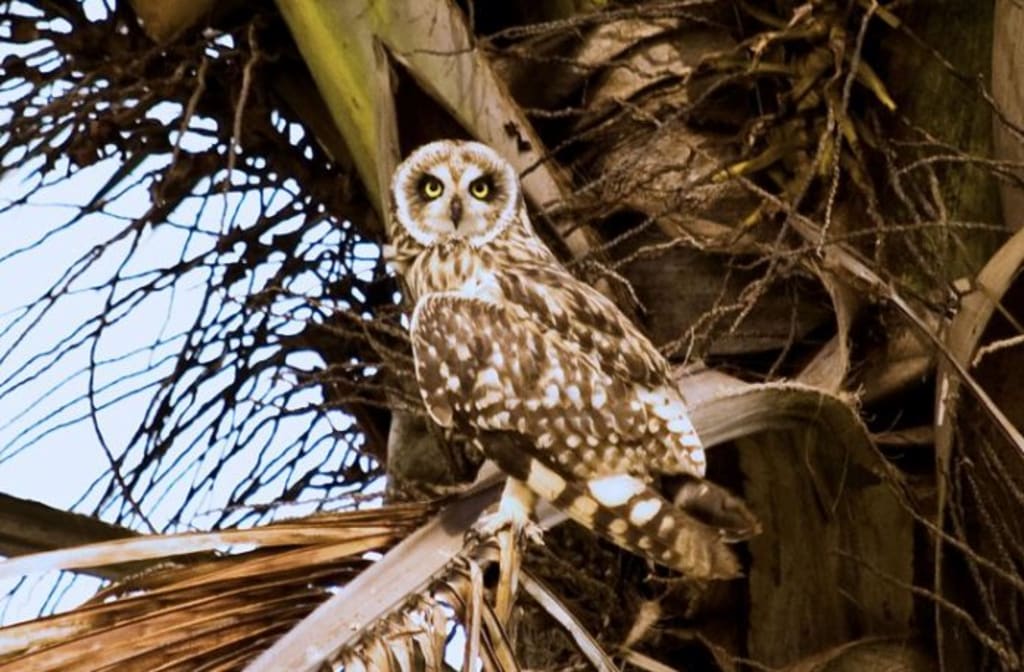
Also incorporated in this story is the significance of pueo or Hawaiian Short-eared Owls which are endemic to the Hawaiian islands and is a fascinating part of the island culture.
Nainani stirs on her lauhala mat underneath her tapa cloth blanket, enduring dreams that disrupt any possibility of restful sleep. In her dreams the words “Ka pueo kani kaua,” echo across her consciousness, a saying which invokes the protection of the pueo owl during battle. “What kind of protection do we need from the guardian?” Nainani wonders. The pueo is her aumakua, or family spirit animal. Nainani tries to interpret the meaning of the dream while lying there, half asleep.
Then the sounds of someone or something blowing conch shell horns and beating war drums can be heard. The eeriness of the shells and drums in the night are distant and quiet at first, but then grow louder and louder, and when they do she then can hear footsteps. Next she feels breath on her neck, sending chills down her spine, and Nainani wakes with a start.
Though they cannot be seen she can still feel their presence. She knows that there is a message behind their appearance here, there is a disruption beyond just lost sleep. Nainani has a feeling that there is more to the phantom warriors' discontent, or Night Marchers, than meets the eye. But first, she must do what she can to please the spirits. She curses, realizing that she has left the door to her hut partially open, and that one window was left uncovered. The two are directly across from one another, from one side of the hut to the other. She closes the window by unrolling the tapa cloth covering, so that the window is closed. Then she leaves the small structure made of dried grasses and closes the door behind her, dropping the tapa cloth as she exits.
At last the sound of the Night Marchers is fading. Strangely though, she realizes that the sound seems to be fading away into a certain direction, toward the ocean. It is no wonder though that they took passage through her hut due to her negligence to cover the openings of her home, as is commonly experienced when one encounters Night Marchers. Perhaps there is a purpose for their appearance, and there is something that she needs to do in order to appease them, she thinks to herself. Maybe they simply wanted to be heard, it would seem unfair that the frustrations of the warriors that fought so hard to protect her ancestors should go unheard. With this in mind Nainani walks to the beach, following the sound of the Night Marchers' war drums.
By the light of the moon she is able to navigate the rocky path that soon softens and turns to sand. She stands a moment and looks up and down the beach, her hand resting on a swaying palm tree.
Upon seeing the dark sea crashing upon the sand Nainani becomes sad at the sight of it, her ocean, her other home; it is a place of struggle nowadays. The sea that was once so plentiful with so much fish, which they catch during the hukilau or community fishing gatherings with the other villagers, now is all but completely stripped of fish.
She presses on, following the sound of the drums. Nainani knows she is going the right direction because she hears the sound of the conch shells again.
Nainani wanders across the sand and though she is afraid of where the Night Marchers are taking her, she continues her journey. Eventually she cannot hear the drums or the conch shells, but Nainani is determined to continue her night travels, as the Night Marchers must have a good reason for waking her. She finds it all the more curious that in her dreams that she could hear the pueo owl battle saying being spoken aloud, “Ka pueo kani kaua.”
If only her brothers and sisters knew that she was wandering across the beach following the sound of Night Marchers they would think her crazy. Were she to become lost they would blame her for straying from what she knows. They would tell her go back to husking coconuts and weaving lauhala mats. In truth it all she knows.
She stops and pray to the gods for a sign, any sign.
There is nothing but the sound of the waves to answer her for a long time.
Nainani looks up at the stars, admiring their beauty, so bright like beacons in the night sky. It is those beacons of light that beckoned her ancestors to this sacred paradise. She then wonders, how is it that the fair-skinned people who frequent their land and their waters now came upon her island? Did they follow the stars here too like the Hawaiians' ancestors did from French Polynesia?
Communication between her people and theirs has been difficult, but all that she knows is that now all upon the island foreign or no must compete for precious resources. Perhaps this is what upset the Night Marchers, knowing that her people are struggling to coexist with these people from afar, who though they mean well, have no idea how to farm and fish the island so that it may continue to feed them all for generations to come.
Nainani and her village, the other kanaka or natives on the island, know that as long as you do not take more than your village needs there will always be enough food. Yet, even as they seek to teach the newcomers these ideas they do not seem to understand. So much is harvested from the soil and caught from the sea. Though much is gathered and it fills their bellies, this seems to not be enough, as there is much that is sent away, onboard their ships to be taken to faraway destinations.
Nainani looks on with disdain each time she sees loads of coconuts, dried fish, pig and other goods placed upon the ships of the newcomers, to be shipped far away to villages of their homeland.
It does not bode well with so many of the people in the village. Unfortunately, there is no way to stop the great flow of goods from going to faraway lands, because a deal was struck between their chief and the foreigners' leaders. In exchange her village was gifted weapons, new foods and clothing by the newcomers. Many of the people are fascinated by these gifts, but Nainani's grandmother told her there is a price to pay for accepting such gifts.
Nainani agrees, especially when she looks into the empty waters surrounding her home.
Then it dawns on her, perhaps the Night Marchers were speaking to her in their dreams, and to the great Hawaiian owl. Whether it be a physical battle with clubs, spears, and fists or a battle of another form, such as between two different mindsets, those of her people and theirs; the owl surely can protect and guide them during such great times of conflict.
Nainani sings “Ka pueo kani kaua,” in repetition as an oli chant, calling out to the great pueo, calling out for protection and guidance. The owl is her family guardian and she is confident the ancestral spirit will answer.
Then she hears it, the cry of the pueo.
Dawn breaks and the sea turns from shades of deep blue-black to deep blue. Purple light outlines the mountains, then pink. The sky is pink and purple and she can see the clouds spilling over the mountain tops from the horizon.
First it is a distant figure in the sky gliding toward her, then she can make out the pueo's white and brown spotty form, its wings outstretched as it embraces the air thermals it rides on above her. It coasts downward as if riding invisible waves in the sky, effortless and free until it drifts into the treetops over a nearby ridge.
She runs as fast as her feet can carry her, and when she approaches towering lava rock cliffs between her and her destination, she fearlessly begins climbing.
Reaching the top of the cliff Nainani puts a hand over her eyes to shield them from the rising sun and searches for the owl. She spots it careening just over another thicket of trees by the edge of the sea before it dives down once again.
Nainani takes a deep breath and climbs down to a hidden beach. She runs over to the hillside that meets the beach and explores the section of jungle where she last saw her aumakua.
The pueo has a mouse in its claws. It is perched above in a kamani tree, its large rounded leaves blowing in the wind. It looks Nainani right in the eyes with its own brilliant glowing golden ones before it flies away. Nainani sees it turn a corner around the bend, past impassable cliffs beyond the small section of beach where she is.
She takes off after the bird, hoping to find a way to keep following it but there is no way. These other cliffs are much higher. She watches large ocean waves crash against the rock face, feeling hopeless. Nainani walks out into the water to get an idea of where the owl may be now, but there is no telling.
Nainani does see the dark shadow of a reef about a quarter mile away from the shore, though and that gets her thinking.
Finding a pathway up the nearby hillside, Nainani looks down at the water from a new perspective and gasps in awe at what she sees. Dark blue shadows darting in and around the reef below. That can only mean one thing. Fish!
“Auwe!” Nainani shouts with excitement.
Hope and happiness wells up inside her.
Then she thinks about how to share the news with her fellow villagers, and how she should caution them to not share this discovery with the newcomers.
Nainani begins to make the long trek back to her village, exhausted from a sleepless night and traversing miles of beach for so many hours.
She does her best for now, at least on the journey home, to dispel the clouds of concern hovering over her as she decides how to best share the news of this precious fishing spot she has discovered.
Should her village pack up their belongings and venture there, to live in the valley nearby this secret beach, tucked away from the foreigners? How else could they finally have enough fish for all of them to eat?
Together they would know how to sustainably care for and manage the ahupuaa or watershed there. It would only take care and listening to nature to know what to do so they could coexist with the land and sea peacefully once again.
She thanks the pueo for the blessing it gave her, of finding this new secret beach with a bounty of fish to feed her friends and family and hopes that it can stay a secret forever.
About the Creator
Keep reading
More stories from Monique Rowan and writers in Wander and other communities.
Royal Blood
Arms crossed over his chest, Raven´s eyes flutter open as the sound of breathing and footsteps fills his ears. He can hear a loud heartbeat, and the breathing is heavy. The heart beats quickly in a small chest cavity. The scent of her is really what gives her identity away and helps him to regain control over his hunting instincts. He jumps into a crouching position and leaps toward the entrance not unlike a panther prowling in the night. He lurks in the shadows, waiting for her to enter his lair.
By Monique Rowan5 years ago in Horror
Literary Heartbeats
Step through an unassuming storefront in Saratoga Springs, New York. Let the city’s familiar bustle fade behind you. Sink into the creak of hardwood floors as your gaze is drawn toward a labyrinth unfolding, room after room, swollen with stories. This is the Lyrical Ballad Bookstore—a place where literary ghosts linger, and generations of readers, writers, and dreamers have lost themselves amid 200,000 volumes of wonder.
By Kristen Barenthalera day ago in Wander
Away from the Crowds in Oklahoma
Imagine traveling in Catoosa and seeing the Blue Whale. This blue creature was built by Hugh Davis in 1972 as a 34th wedding anniversary gift for his wife. Since then, people driving down Route 66 have admired it. Another purpose for building the whale was so that it could serve as a swim dock for neighborhood children to dive and slide into a pond.
By Rasma Raisters3 days ago in Wander




Comments
There are no comments for this story
Be the first to respond and start the conversation.