


Aw, how cute, kitties basking in the sun and friendly too. Maybe indifferent is a better choice of words. Walk up to one of these furry creatures and it won’t scoot away. In fact, you may have to walk around or over it.
Here in the John F. Kennedy Park in Miraflores, a more affluent part of Lima, kitties have the run of the place. It’s supposed to be an urban retreat for hardworking locals but don’t tell the cats that. They think the Park belongs to them and, in a way, they’re right. They’ve made it their home. There are cats everywhere, around trees, sprawled out on the walkways or sleeping in the taller grasses. Originally feral, they’ve become used to humans and have lost their fear of people. It’s a great life.


It all started about twenty-five years ago when priests from the nearby church released cats into the neighborhood to deal with their rodent problem. It worked. The cats gobbled up the rats but, well, you know cats, they reproduced like crazy and found refuge in the inviting greenery of Kennedy Park. Naturally, Miraflores didn’t like its park overrun with so many homeless and unhealthy kitties.
Adding to the problem - midnight skulkers who dumped their unwanted pets into the park when nobody was looking.
Cats are not particularly liked in Peru. They’re considered pests. They spread disease and eat birds, all the more reason to abuse them.
Consider what used to go on at the annual Currunao Festival in nearby San Luis, a small town 87 miles south of Lima. San Luis REALLY didn’t like cats. Every September after much drinking and revelry, the locals would race their cats down the street by tossing firecrackers at them. The losing kitty ended up in the soup pot, the specialty of the day. Yep, cats were eaten. Hard to believe, but the citizens of San Luis bred their cats expressly for racing… and eating. The bizarre practice began in Ethiopia, came over to Peru with early immigration and was only stopped as recently as 2013 when the animal rights people got involved.
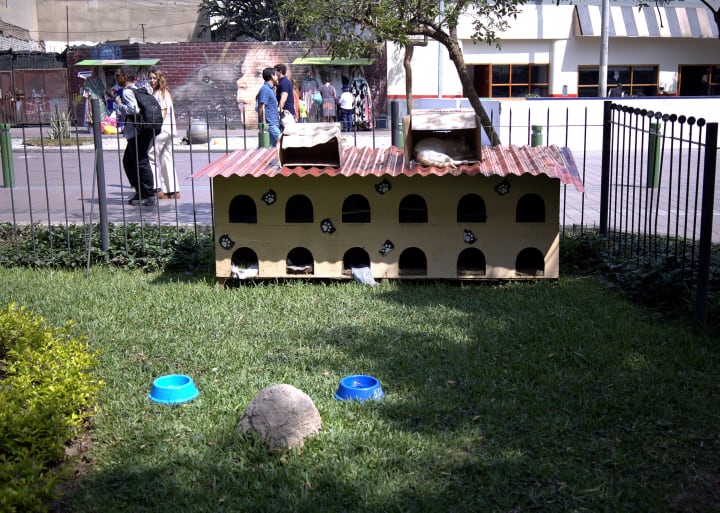
Fortunately, the Kennedy kitties fared better. Five years after running loose in the park, sympathetic locals came to their rescue and today, a non-profit association of cat-loving neighbors, the GVDF, or (in English) the Feline Protection Volunteer Group, looks after them. Rumor has it that up to a hundred cats populate the park at one given time. I only counted twenty but it's still a big job for the people that look after them. Volunteers fill their feed and water bowls and clean out their shelter and when the funds permit, a vet spays and neuters them. In addition, the Group sets up an adoption booth in the Park every weekend so people can take a clean and healthy cat home with them.
It's a demanding job. The cats are fed at night, not during park hours, and the Group has to administers different medicines at different times of the year. For instance, in the winter, cats are prone to eye infections and eye medicine is required. Moreover, Kennedy kitties have to be dewormed every six months and get a rabies shot every twelve. The vet has offered his services at a reduced rate.
And just to make life more difficult, some locals still think of the Park as a kitty dumping ground and volunteers have to deal with “new arrivals” which are often sick or malnourished.
Nevertheless, the Group has proven cats and humans can share the same public space when the cats are properly looked after and so the cats of Kennedy Park, which were initially but reluctantly tolerated, have become an entrenched tradition. The municipality is keen to have kitties attract tourist traffic but contributes nothing to their upkeep. As a result, the Group’s work is totally financed by donations to their Facebook page and from money raised from flea markets.
Lima’s feral cats are lucky to have someone to care look after them, certainly a far cry from the plight of their brethren in Kangaroo Island, a nature preserve 70 miles southwest of Adelaide, Australia. Kangaroo Island is populated by koalas, little penguins, kangaroos and other small animals, a community of sheep farmers, locals who work in the service industry, and lots and lots of feral cats. In addition to spreading disease throughout the sheep population, the cats kill the protected wildlife, especially the endangered Kangaroo Island Dunnart, a small marsupial which feeds on insects. Anxious to keep the Dunnart from disappearing altogether, authorities have instituted an aggressive eradication program intended to rid the Island of feral cats by 2030 by shooting and trapping them.
It's tough being a feral cat these days unless, of course, you live in Lima, Peru.
About the Creator
John Thomson
Former television news and current affairs producer now turned writer. Thanks Spell Check. Visit my web page at https://woodfall.journoportfolio.com
Keep reading
More stories from John Thomson and writers in Wander and other communities.
Exploring Basque Country
I love Spain. Barcelona, Madrid, Grenada, the white villages of Andalusia, all well-travelled tourist haunts I admit but well worth the aggravation. Until recently, I had never been to northern Spain and in particular to Basque country. As I soon discovered, Basque country is very different from the rest of Spain. The climate is more temperate, the scenery is greener and hillier and the area is officially bilingual.
By John Thomson2 years ago in Wander




Comments (2)
This is really interesting! Those kitties in the park look like they're having a lovely life. 😊
Wow! A lot of feral cats. Fascinating!