
Exploring Basque Country
Riding the rails from Bilbao to Bermeo

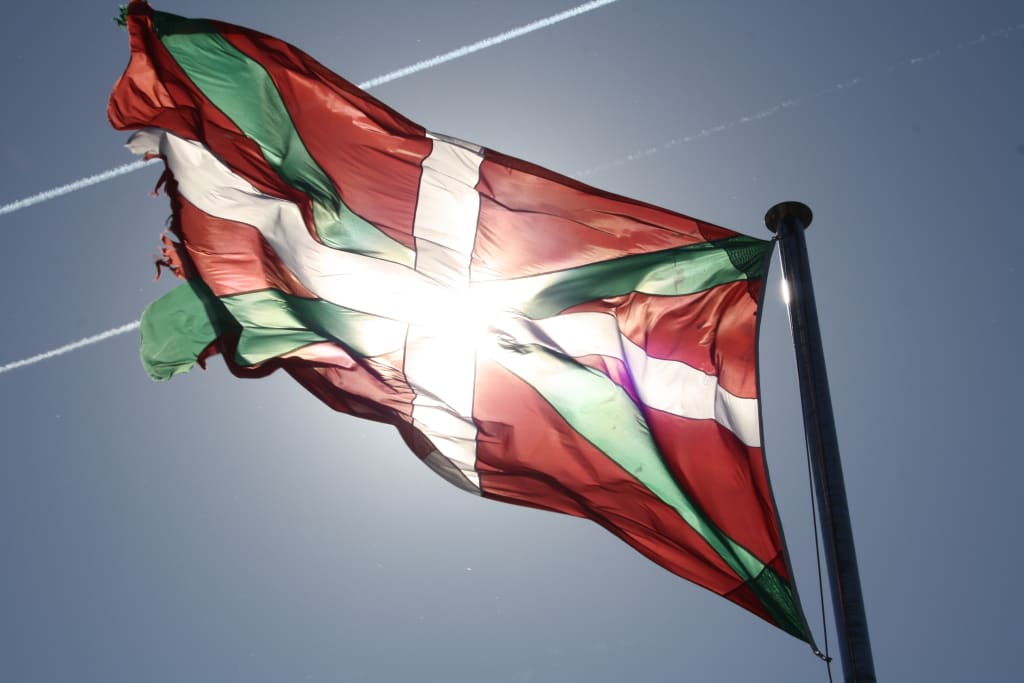
I love Spain. Barcelona, Madrid, Grenada, the white villages of Andalusia, all well-travelled tourist haunts I admit but well worth the aggravation. Until recently, I had never been to northern Spain and in particular to Basque country. As I soon discovered, Basque country is very different from the rest of Spain. The climate is more temperate, the scenery is greener and hillier and the area is officially bilingual.
Basques speak a different language than their southern neighbours largely because they’re tucked away in the north-eastern corner of the country in the shadow of the Pyrenees. There are Basque people on the other side of the mountains in France as well but the majority reside in Spain.
Geneticists believe the original inhabitants were neolithic farmers who and kept to themselves and largely survived the influx of the Romans and the Celts, happily isolated if you will. As a result, the Basques have always thought of themselves as distinct from others. Remember the Basque independence movement of the late twentieth century and early 2000’s, the bombings and the violence? It’s quiet now, Madrid eventually granted the Basque limited autonomy allowing them, among other things, to collect their own taxes and retain their own language but the region has not broken away and is still a part of the Spanish federation. Mind you, you won’t find too many red and yellow Spanish flags around here; the Basque fly their own, a red, green and white Union Jack instead.

Bilbao, the largest city in the region, is an interesting mix of the old and the new. The magnificent Guggenheim art gallery has put Bilbao on the map attracting tourists and money and transforming what was once an unremarkable port city into a 21st century metropolis. The Gran Via with its bars, cafes and huge department store El Corte Ingles, could pass for any main street in America while Casco Viejo or Old Town across the Nervion river retains its old-world vibe.
Quietly sipping a glass of cider in Old Town’s Plaza Nueva, I find it hard to imagine Basque’s turbulent past. The drive for independence seems so long ago. I ask for another glass of cider. Cider’s a big thing here and pouring it is an art form. Holding the glass with his left hand, my server slowly raises the bottle to shoulder height, pouring the liquid in a controlled and steady stream. This apparently oxidizes the cider and makes it taste better.
It has medicinal properties too. Thirteenth century Basque fishers took cider with them on those long cross-Atlantic trips to the Grand Banks of Newfoundland. Other sailors often succumbed to scurvy but not the Basques. The citrus properties in cider (after all, it’s really fermented apple juice) kept them healthy. These days, cider is accompanied by pintxos (pronounced pinchos), the Basque version of tapas but larger and more substantial. Flaked tuna topped with roasted red pepper and an anchovy on bite-sized crusty bread is a popular pintxo.

Anxious to see more of Basque Country, I leave Bilbao the next morning on a local commuter train enroute to the Bay of Biscay. I get off at Guernica. It’s a well-known story. Guernica was a Republican stronghold during the 1936-39 Spanish Civil War and was bombed by German and Italian air forces at the request of Franco’s Nationalists. Approximately 300 people were killed and the town destroyed, prompting Picasso to paint his monumental work which forever immortalized the community and the atrocity.
The Guernica Peace Center, a ten-minute walk from the train station recounts the attack with photographs and video interviews with the survivors but it also talks about peace and reconciliation as witnessed in Northern Ireland and South Africa.
And what of the painting that brought the attack to the world’s attention? The original is hanging in the Museo Rein Sofia in Madrid but as I walk a little further west and up a hill, I see a full-sized replica of Picasso’s famous painting cast in ceramic tile and embedded in a stone wall. I have trouble adjusting to the location. I’ve seen the original and the replica seems a little diminished surrounded by concrete benches and tourists taking pictures but who am I to judge. I take a couple of photographs myself.

My next stop is Mundaka, the surfing capital of Basque Country renowned for its sand and wave action. The train has deposited me well above sea level and I gingerly make my way down the steep and meandering pathways to the seawall. I pass a group of teens carrying their surfboards under their arms led by an older dude whom I presume to be their instructor. I figure the class has just ended.
Mundaka draws an international surfing crowd and there’s a definite beach vibe going on despite the medieval setting. It’s relaxed and unhurried. There are no cabanas, no beach umbrellas and no food trucks. Everyone is here on surfing business. Except for me of course, I’m a curious bystander just passing through. Unfortunately, I’m a long way from the beach. I only see one surfer in the water so I retire to an unpretentious hole-in-the-wall taverna and watch the passing parade.
Nursing a beer on this sun-dappled patio under a grove of trees is heaven. I’m close to three middle-aged ladies talking a mile a minute. It’s too fast and too complicated for me to figure out with my internet Spanish (thanks Duolingo) so I turn my attention to an animated couple at the next table deeply immersed in conversation, or maybe they’re arguing, before the boyfriend jumps on his motorbike and drives away. Yep, I’m feeling the pulse of the big city melt away being privy to small human dramas as opposed to trudging through crowds to see the sights.
I’m so relaxed I nearly forget to get back on the train. Spanish commuter trains are frequent and punctual which makes it easy to jump off and catch another. The entire run takes an hour and a half but I can make a day of it by getting on and off along the rout
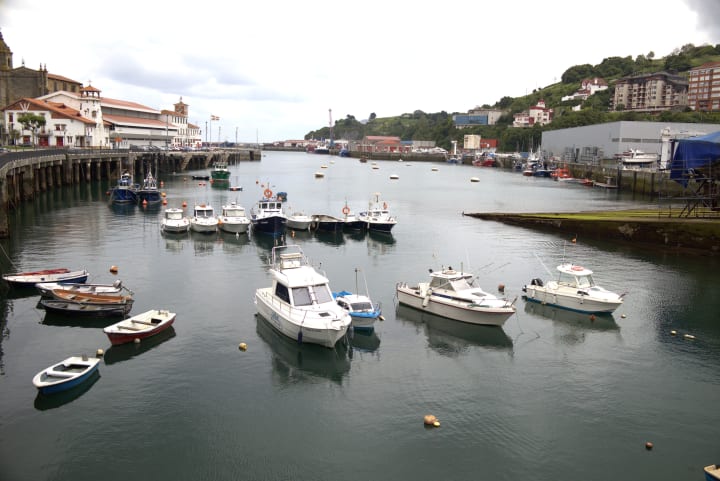
The fishing village of Bermeo is the end of the line. As I step outside the waterfront station I’m greeted by two towering wooden hulks, remnants from an earlier time when great whaling fleets left Bermeo for the North Atlantic in search of right whales and grays. The whaling industry around the Bay of Biscay collapsed over 500 years ago and the only vessels at anchor in the harbor these days are pleasure craft.
I want to know more about Bermeo and whales so I amble through the back streets in search to the Fisherman’s Museum which is reportedly located in a 15th century Ercilla tower, a former residence that overlooks the old port. The museum is closed. It’s tourist season and there’s no-one in sight. I guess not many tourists make it to Bermeo but that’s okay, it makes it easier for the rest of us to get around.
It’s very atmospheric wandering through the narrow cobblestone streets flanked by towering medieval structures until I find myself in a small park at the bottom of the hill. Fortunately, I’m surrounded by eateries of every description and I consider my choices until I notice an anomaly. An Irish pub among the tabernas? How strange. Intrigued, I climb the stairs only to discover it’s really a fries and hamburger joint, Irish means American in Bermeo I guess, and I move on embarrassed by my gullibility.
Returning to Bilbao by train with no stopovers this time, I think back on my time in Basque Country. Northern Spain has been a pleasant surprise. I’ve enjoyed the slower pace, the café culture and the sense of a distinct society. And the Basque people? They’re brusque but patient which is a good thing because it’s getting tough to be a tourist these days as locals everywhere else complain about litter, congestion and a strain on housing. Barcelona, Amsterdam, Prague, Florence and other major destinations are feeling the crush. Venice has imposed a tourist tax to discourage visitors and to pay for the problems they cause.
Not so in northern Spain. Basque Country is still relatively unknown, undiscovered, and accessible. I didn’t see any Tourist Go Home graffiti scrawled on the walls. So far anyway. The hordes have yet to descend on Basque country. Visit it while you still can. You’ll be glad you did.
About the Creator
John Thomson
Former television news and current affairs producer now turned writer. Thanks Spell Check. Visit my web page at https://woodfall.journoportfolio.com
Keep reading
More stories from John Thomson and writers in Wander and other communities.
Spanish Puppy Makes a Statement
Can’t say the good people of Bilbao, Spain don’t have a sense of humour. What better way to welcome the world to their magnificent art gallery, the Guggenheim Bilboa, than with a warm and endearing puppy and who doesn’t like puppies?
By John Thomson2 years ago in Wander
A Texas Homecoming
Greetings, Vocal readers and subscribers! Recently, I had the opportunity to visit a familiar place that I haven't been to in almost 15 years. I've expressed my love for my hometown of Arlington, Texas in numerous stories on Vocal. Fow two days, it was my time to do some sight-seeing and nothing more. This long overdue vacation was solely about me, not about visiting family, as I've been estranged from them since 2011. I'll share a collage of pictures from my two-day stay in Arlington throughout this story. Just for reference, I took over 200 photos, so not every one of them will be featured.
By Mark Wesley Pritchard 4 days ago in Wander


Comments (1)
Last month, I earned $21683 from home by working online part-time. Everyone should join this home job right now and start generating real money online by just following the instructions on this website......... Go Here------➤ https://www.Join.Paythome9.com