
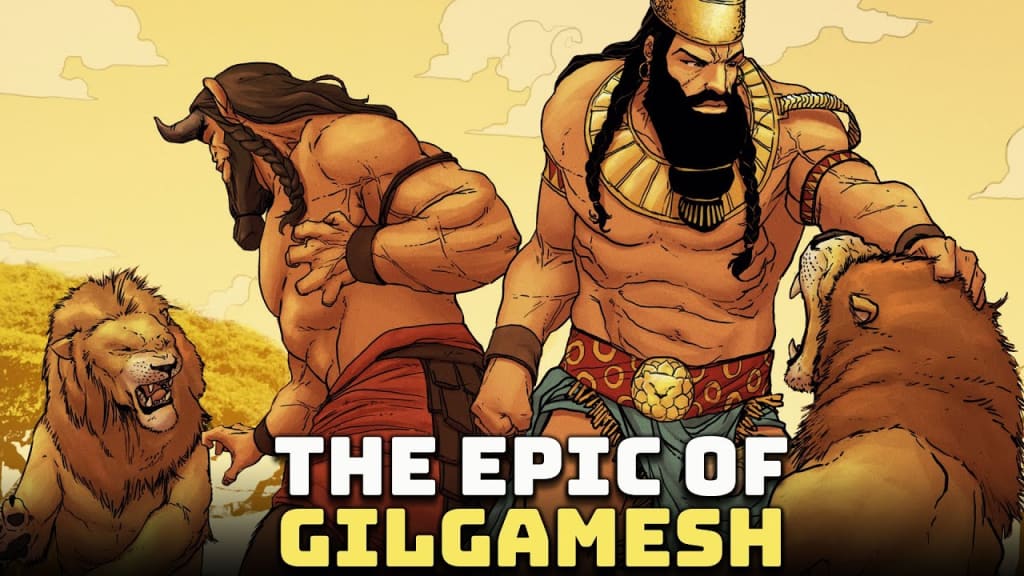
In the heart of ancient Mesopotamia, where civilization first flourished, a tale unfolds about a powerful king named Gilgamesh. He is a figure of strength and ambition, yet he is not alone. His companion, Enkidu, emerges from the wild—a hairy, man-like creature living outside the bounds of society. This epic story, inscribed on Sumerian tablets dating back to 1800 BC, hints at deeper mysteries. Some scholars propose that Enkidu may not just be a mythical wild man but a giant of extraterrestrial origin, a being crafted by the gods.
As the narrative of Gilgamesh and Enkidu unfolds, it draws parallels to the legendary Goliath from the biblical tale of David and Goliath. Goliath stands as a towering figure, intimidating and fierce, yet his existence raises questions. Is it possible that Goliath, too, represents an early encounter with extraterrestrial beings? The narrative suggests that Goliath might embody a terrifying hybrid—part human, part otherworldly—a creature so daunting that it prompts a young shepherd to take on the challenge of vanquishing him.
The story extends beyond Mesopotamia and biblical lands, reaching into the folklore of cultures worldwide. From the Americas to Europe, tales of giant, hairy beings populate the collective consciousness of humanity. These legends, emerging in diverse societies separated by vast oceans, hint at a shared memory of encounters with beings that defy conventional understanding. Were these giants remnants of a lost race, or perhaps witnesses to a time when extraterrestrial beings walked among humans?
Amidst these tales, the island of Sardinia emerges as a focal point of intrigue. For centuries, visitors to this Mediterranean paradise hear whispers of a race of giants who once inhabited its lands. Mysterious monolithic structures dot the landscape, sparking curiosity among archaeologists and ancient astronaut theorists alike. However, tangible evidence proving the existence of these giants remains elusive—until a series of archaeological excavations in the late 1970s. Reports surface of giant bones unearthed beneath ancient churches, only to mysteriously vanish overnight. This pattern of discovery and disappearance hints at a larger conspiracy, raising questions about what truths might be hidden beneath the surface.
As investigators dig deeper into Sardinia's past, they encounter a wall of silence. Why are these remains hidden? Who stands to gain from the suppression of such evidence? The quest for answers leads them to the intriguing hypothesis that ancient astronauts might have visited Sardinia, leaving behind remnants of their influence in the form of megalithic structures. The researchers speculate that these extraterrestrial beings could have interacted with early humans, potentially contributing to the genetic makeup of those who built monuments like Stonehenge.
The story takes a dramatic turn with a groundbreaking genetic study conducted by Harvard researchers in 2018. Their analysis reveals a shocking truth: shortly after the construction of Stonehenge, the population that built it almost entirely vanishes from the British Isles. What happened to them? Some ancient astronaut theorists suggest that this sudden disappearance may point to a deliberate cleansing of humanity's genetic line, echoing flood myths found in cultures worldwide.
Yet, the mysteries do not end there. In the late 1990s, researchers at Emory University uncover an enigmatic genetic lineage among Native American populations. Dubbed the "X lineage," this haplogroup appears in small percentages, with no clear connection to known genetic groups. Could this elusive lineage be tied to the giants of legend? Theories abound that these giants were once a formidable presence on Earth, possibly remnants of ancient extraterrestrial beings.
As the narrative unfolds, the documentary highlights the discoveries of oversized skeletons in the burial mounds of the Adena culture in West Virginia during the 1800s. These remains, measuring between seven and eight feet tall, send shockwaves through the archaeological community. Yet, despite the compelling evidence, many of these findings are downplayed or suppressed, raising further questions about why society has chosen to ignore such significant discoveries.
The tale culminates in a powerful reflection on humanity's quest for knowledge. Are the giants of our past simply figments of our imagination, or do they represent a lost chapter in human history? As the story intertwines mythology, archaeology, and genetic research, it invites us to consider the possibility that our ancestors may have encountered beings beyond our understanding, shaping the legends and beliefs that endure to this day.
In the end, the story leaves us with lingering questions and a sense of wonder about our place in the cosmos. The giants may be gone, but their legacy lives on in our collective memory, urging us to explore the mysteries that lie hidden in the shadows of history.
About the Creator
Keep reading
More stories from Faith Thandi and writers in Wander and other communities.
the mysteries of the universe
**Title: Beyond the Singularity** In a universe filled with enigmas, five cosmic mysteries loomed large, captivating the minds of dreamers and thinkers alike. Each question echoed through the corridors of time, probing the very essence of existence.
By Faith Thandiabout a year ago in Proof
UAE Exits Islamabad Airport Outsourcing Plan, Pakistan Moves Toward Privatisation
In a significant development, the United Arab Emirates (UAE) has pulled out of its planned outsourcing deal for Islamabad International Airport, paving the way for Pakistan to explore alternative options for privatisation and management of the national gateway. The decision marks a shift in Pakistan’s approach to modernizing its key infrastructure and reflects ongoing challenges in attracting international investors.
By Fiaz Ahmed 3 days ago in Wander
The Feel of Nagasaki
My sleep schedule is fixed! I went to bed at 23:00 on Sunday and woke up at 7:00 rested and energised. Unfortunately, I had a little cat sleeping on me who refused to be moved meaning I still had to lie in bed for half an hour until she allowed me to get up to shower.
By Max Brooksa day ago in Wander
The Path to Salvation
The late autumn evening air filled the monk's lungs, but it wasn't the season that chilled his bones. The heavy-handed presence of evil he had sensed upon entering the woods surrounding this mountain village had not bothered to conceal itself from him.
By Made in DNA4 days ago in Fiction


Comments
There are no comments for this story
Be the first to respond and start the conversation.