


The Osaka Aquarium Kaiyukan
One of the largest aquariums in the world, filled with whale sharks and all kinds of amazing fishes — this is how I learned about the Osaka Aquarium Kaiyukan, a world-famous aquarium in Japan.
Earlier this year, ever since two of my friends returned from a trip to Osaka, they couldn't stop telling me about this "undersea wonderland" of an aquarium. I was completely fascinated by all of the fantastic arrays of sea creatures described in their accounts of the place. And so, it was only reasonable for me to go there on a recent tour of Japan and see for myself what the Osaka Aquarium Kaiyukan had to offer.
The Tanks
When I first stepped foot inside the Osaka Aquarium Kaiyukan, I was immediately thunderstruck by how beautiful and breathtaking everything was. Everywhere I looked, there were fishes, thousands upon thousands of them, of every color and size imaginable, swimming here and there in huge, floor-to-ceiling tanks.

For me, someone who had only seen the ocean half a dozen times, that first glimpse of the fish tanks was quite an experience. The aquarium didn't need impressive facts or carefully designed decorations to amaze me, the sheer awe at seeing so much marine life before me was enough to render me speechless — I had never seen so many fishes before in my entire life.
The Dolphins
Amid all the cacophony, there was one display that stood out strikingly from the rest, and that was the dolphins.
The dolphin tank was situated in a fairly secluded area of the aquarium, just around a corner. From the moment I laid eyes upon it, I was completely hooked.
At first, what drew me was how the dolphins zoomed through the water with just a simple thrust from their thick tail. At the same time, the dolphins were elegant in their own way, twirling, pirouetting, and leaping all the while moving at superhuman speeds. Their black bodies, sleek build, and strong muscles — it was all incredibly beautiful and powerful at the same time.

The Dolphins I Was Really Seeing
But then, I looked around and saw the small box that the dolphins were trapped in, only a ten or so about ten meters in length and a handful of meters in width. The aquarium designers had tried to curve the tank to make it seem bigger, but it was still a children's playground for the dolphins.
At that moment, I was struck by how dull the dolphins' life must be, every day, swimming around and around the same confinement. I had recently read an article about how captive dolphins need sufficient swimming engagements every day for their bodies to stay healthy (dolphin pods frequently travel up to 100 kilometers a day in nature), and now, it came back to me in full force.
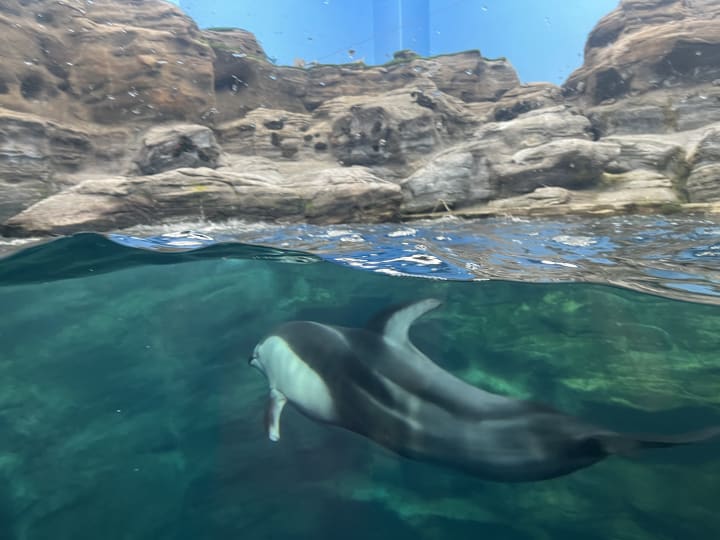
Swimming in that small tank over and over couldn't possibly be natural, or even comfortable for the dolphins. Just imagine you are a domesticated wild dolphin trapped in the aquarium tank. You wag your tail to speed up through the water. The water currents whistle past you, and suddenly, you are brought back to the days of swimming with your pod in the wide ocean, free to go wherever you want. But then, out of nowhere, the cold glass of the tank appears before you, and you are forced to turn away. How frustrating and miserable that must feel every time!
However, for the dolphins born in captivity who have only known the confines of the tank their whole life, it is even more sad. The dolphins — such beautiful and powerful creatures as they were — were meant to roam in the wild, but now, in this aquarium, they are trapped, isolated, and tamed. And for what? Just so that petty tourists can gawk at them and be entertained!
Of course, I am extremely grateful to the aquarium for bringing me face-to-face with such amazing creatures. However, the entire time, what I saw was not true dolphins - they were commercialized versions of dolphins that businesses exploit to make money. The tanks in the aquarium opened me up not to the best of the ocean, but to the worst of it, when it was degraded and subdued by humans.
The Whale Sharks
In the Osaka Aquarium Kaiyukan, after visiting the dolphin exhibition, I finally saw what I came here for : the whale sharks.
There was only one way to describe them: They were so HUGE! Those giants - each five or more meters long — occupied the biggest tank in the aquarium, right in the center of the whole building. They shared their space with tons of other fishes, from Indian mackerel to manta rays and hammerhead sharks.
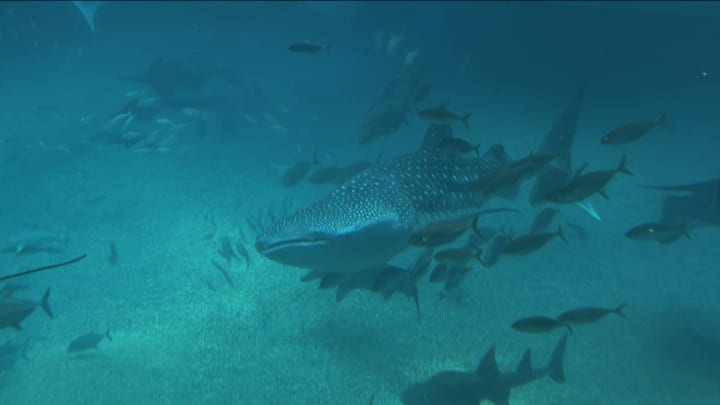
Some of the other fishes were quite impressive in themselves, but all of them paled in comparison to the sheer size of the two whale sharks. They were kings that presided over the aquarium — the stars of the show. Every other fish was like their sidekick — they were nature in its fullest majesty.
But even they, in all their glory, were, like the countless other fish under their rule, trapped in the same glass tank, subjected to the scrutiny of the tourists.
Seeing the whale sharks like that sparked an ancestral fear and admiration in me for those creatures who can kill me with a simple swipe of their fins, while making me sad for their pitiful life. It made my blood run cold thinking about how much control humans have over these clearly magnificent creatures.
Feeding
At around one o'clock, I saw a diver come into the tank to feed the whale shark and other fishes. It gave me perspective on just how mighty the whale shark actually is — the diver was absolutely tiny compared to the towering hulk of the whale shark he was feeding.

It sparked a new thought in me: How can we humans comfortably sit back and say, "Yeah, that's right. We've got creatures almost ten times the size of us trapped in cages and at our mercy?" We should be subordinating ourselves to whale sharks instead of being masters of them!
A long, long time ago, our ancestors lived harmoniously alongside nature. Animals such as the dolphins and whale sharks provided us with food, tools, and shelter, fueling our advancements. Today, we use the same power that those animals gave us gave us to trap them behind bars. We pollute natural resources, destroy key animals' habitats to make way for our cities and skyscrapers, and all the while, we comfort ourselves with the knowledge that those moments of nature have been "soundly preserved" in tanks and cages.
It shouldn't be like this. Has mankind fallen so much that when people say "I am going to spend time with nature," they go to aquariums and zoos to see pitiful animals that humans have tamed?
Surely not! What happened to going out in the wild and just being with nature in it's its most original form? Why do people choose to see dolphins behind the walls of glass tanks when they can actually go into the open sea and see dolphins in their natural habitat?
Indeed, these kinds of opportunities are growing ever rarer by the year. In a way, while allowing us to simulate and reproduce nature, technology has weakened the bond between humans and Mother Earth by giving people false impersonations.
Nara Park
However, not all is gone yet. In Nara Park, Japan, deers, in the tens of thousands, hang out with people by quiet streams, in sun-filled meadows, and on grassy knolls.
They seem perfectly content, happy to share their homes with natives & far-off travelers alike. Young deers approach older deers to be fed milk, and the older deer go to people who feed them "shika senbei" (deer crackers).
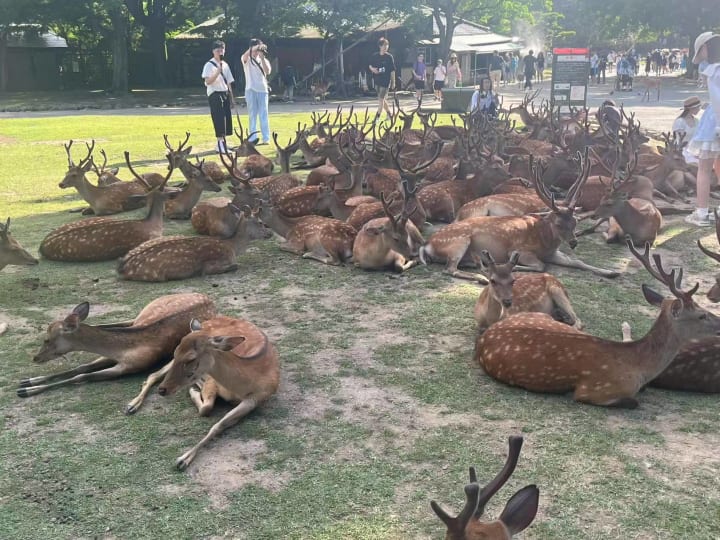
At that place, humans exist in perfect harmony with them, just like our ancestors had those centuries ago, though in a different way.
As I sat on a grass slope with the sunset setting in front of me, I felt perfectly at peace with not only nature but also myself. I shared that moment then, with Japanese natives, fellow tourists, and the deers.
It was absolutely incredible how, by just adding a whole lot of deers, people can transform an otherwise ordinary park into a magical Garden of Eden, filled with life and nature.

Final Thought
As I sat there, I reflected on the irony behind the whole situation. What are the chances that in perhaps one of the most technologically advanced countries in the world - Japan - there still exists places where nature and people are in one.
Maybe us humans are not so hopeless after all? Maybe technology can actually be used to transform our bond with nature? Maybe?
Note: All of the photos in this story (apart from the featured image) were taken by myself. I hope that together with my reflections, they have opened you to something unique. If you like this piece, please follow me for more stories like this. Thanks!
About the Creator
Keep reading
More stories from Matthew Yu and writers in Wander and other communities.




Comments
There are no comments for this story
Be the first to respond and start the conversation.