
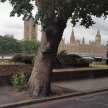

The first time I went to Westminster Hall was on a school trip as a Secondary School student (High School for my international friends). When you’re 14, you don’t care much for history, well, I didn’t. However, that’s all changed. These days, I can’t get enough of it.
Since then, I’ve been inside Westminster Palace many times, and each time, I’ve been like a kid in a sweetshop. All senses are ready for the visit. One particular area in the Palace worth exploring in detail is Westminster Hall
Westminster Hall
Westminster Hall was built in 1097 under William II (William Rufus), son of William the Conqueror. It was built as an Ego project to showcase royal power; it was the largest hall in England at the time, measuring 240 feet long and 68 feet wide.
Its size and history struck me as I entered the Hall. It's 1000 years old and has seen a lot in its time. It survived the World War Bombing in 1941.
The Ceiling is made of hammer beams and is very impressive. It is an engineering marvel of its time, defies gravity, and leaves visitors in awe within this Hall.

It’s Huge
Its original Norman design featured massive stone walls and a timber roof. However, the latter was replaced in 1393 by the magnificent hammerbeam roof, crafted under Richard II by carpenter Hugh Herland and mason Henry Yevele. This roof, a masterpiece of medieval engineering, allowed the hall to span its vast width without supporting columns, making it one of Europe’s most extensive unsupported timber roofs.

Kings and queens have been crowned, and royal feasts have been held in opulence. King Henry VIII was a notable resident. The last historical event was Queen Elizabeth II, who lay in State last September 2022.


It has also served as a place for trials. Notable figures like Sir Thomas More and Charles I faced judgment within the imposing space.
Today, it's been a crucible of passionate debates and fiery speeches that have shaped the course of British governance.

Historical Significance
The hall has been a stage for pivotal moments in British history:
Medieval Era
It hosted lavish coronation banquets, including those for Edward I and Richard II. It was also a judicial hub, where high-profile trials took place, such as that of William Wallace (1305) and Thomas More (1535) for treason.
Tudor and Stuart Periods
The hall saw the trials of Guy Fawkes (1606) after the Gunpowder Plot and King Charles I (1649), marking a dramatic clash between monarchy and Parliament during the English Civil War.
Modern Era
It became a ceremonial space for lying-in-state, including monarchs like Edward VII (1910), George VI (1952), and Queen Elizabeth II (2022), as well as politicians like Winston Churchill (1965). It has also welcomed global leaders for addresses, such as Charles de Gaulle (1960), Nelson Mandela (1996), and Barack Obama (2011).
The hall survived near-destruction in the 1834 fire that razed much of the Palace of Westminster, thanks to efforts to save it. It also endured WWII bombings, though a 1941 air raid damaged the roof. Restorations, particularly after 1834 and post-war, preserved its medieval character while integrating it into the rebuilt Gothic-style Palace by Charles Barry and Augustus Pugin.
Politically, it’s tied to the evolution of British governance. Initially a royal residence, it became the heart of Parliament, hosting the House of Commons until 1834 and the House of Lords during parts of the 19th and 20th centuries. Today, it’s used for state ceremonies, public addresses, and exhibitions, symbolising continuity between Britain’s medieval past and modern democracy.
Westminster Hall remains a living monument of the UNESCO World Heritage Site (designated in 1987). Its walls, some still original from the 11th century, bear witness to nearly a millennium of history. Public access is available through UK Parliament tours, which are bookable online and offer a glimpse into this enduring icon of British heritage.
Westminster Palace

The building is known for its impressive Gothic Revival architecture, including the iconic clock tower known as Big Ben.
The building is home to over 1,100 rooms, including the chambers of the House of Commons and the House of Lords, as well as numerous committee rooms, offices, and historic halls.
One of the most famous parts of the Palace of Westminster is the Elizabeth Tower, commonly known as Big Ben. Big Ben is the name of the bell housed inside the tower, but the term is often used to refer to the entire building. The tower is over 96 metres tall and is one of the most recognisable landmarks in the U.K.
Today, the Palace of Westminster remains a working building, with members of Parliament meeting regularly to debate and pass legislation. The building is open to the public for tours, which offer a unique insight into the history and workings of the U.K. Parliament.
Visiting The Palace
If you're interested in visiting the Palace of Westminster, there are several options available to you:
1. Public guided tours: Visitors can take a guided tour of the Palace of Westminster, which provides a fascinating insight into the history and workings of the U.K. Parliament. The tour takes around 75 minutes and includes visiting the House of Commons, the House of Lords, and other historic rooms and halls.
2. Audio tours: If you prefer to explore the Palace of Westminster at your own pace, you can take an audio tour. Audio guides are available in several languages and provide detailed commentary on the building's history and architecture.
3. Watch a debate: If you're interested in the workings of the U.K. Parliament, you can watch a debate in the House of Commons or the House of Lords. Visitors can apply for a free ticket to watch a discussion from the public gallery, although spaces are limited and demand is high.
4. Visit Westminster Hall: Westminster Hall is one of the oldest parts of the Palace of Westminster and is open to visitors for free. Over the centuries, it has hosted many historical events, including coronation banquets and trials of famous figures such as Guy Fawkes.
5. Attend a public event: The Palace of Westminster hosts various public events throughout the year, including lectures, exhibitions, and concerts. Check the U.K. Parliament website for details of upcoming events.
6. If you are a U.K. National, you can visit for free. Get in touch with your local M.P. and request tickets. Use this link to find the correct contact details for your Member of Parliament https://members.parliament.uk/?_ga=2.157190962.84468342.1679823960-1831784988.1679823960
It's worth noting that visitors to the Palace of Westminster are subject to security checks, including bag searches and metal detectors. Some building areas may also be closed to visitors during parliamentary sessions or events.
For more information, visit https://www.parliament.uk/about/living-heritage/building/palace/
If you enjoyed reading this article and want to support my work, you can now buy me a coffee ☕️.
https://www.buymeacoffee.com/TabbyLondon
Thank you for your attention.
Best wishes
Tabby
About the Creator
Tabby London
The London I've been discovering is usually off the well-beaten track.I love the nooks and crannies and walking along the streets steeped in centuries worth of history. I'm fond of Zone 1 because that's where it all began centuries ago.
Keep reading
More stories from Tabby London and writers in Wander and other communities.
One of The Expensive Streets In London
I was walking along the road a while ago and somebody came up to me and asked me if I knew which house belonged Robbie Williams. I was taken aback by the question. I repeated Robbie's name thinking the person had made a mistake.
By Tabby London8 months ago in Wander
A Historic Declaration
We the People of the Husbands of the United States of America, in Order to form a more perfect Union, and I mean you...with me...establish Justice, insure domestic Tranquility, provide for the common defence, promote the general Welfare, and secure the Blessings of Liberty to ourselves, after Puberty, do ordain and establish this Declaration of Co-Dependence.
By Gerard DiLeo5 days ago in Humans


Comments
There are no comments for this story
Be the first to respond and start the conversation.