
You're Going To Die Alone With Your Cats
Singlehood, cats, and the moral panic around women's happiness


In many dark corners of society, there's still a tired stereotype that paints single women with cats as lonely, pitiable and maybe even a little unhinged. It's a statement often thrown around like a dire warning, framing single life as something to pity or mock. But where did this trope come from, and what does it say about our views on women, cats, and independence?
The First Cat Lady
You may be surprised to learn that cat ladies weren't always a tired punchline. Long before the "crazy cat lady" stereotype reduced women with cats to figures of pity, ancient Egypt revered them.
Back then, cats weren't simply companions; they were sacred extensions of goddesses like Bastet.
Originally depicted as a lioness-headed warrior, Bastet embodied justice and ferocity, defending pharaohs and striking fear into enemies. Over time, her image softened into a cat-headed deity. She was domestic and graceful, but no less powerful.

More than just a goddess, Bastet was a cultural icon.
Women especially looked to Bastet for guidance and harmony. Amulets and statues of the goddess were worn or placed in the home as talismans of protection, fertility, and personal agency.
Bastet represented self-sufficiency, authority, and prosperity, thus transforming cats from rodent-catchers into sacred companions. To harm one, even by accident, could mean death. In those times, families grieving a cat shaved their eyebrows as a visible sign of mourning, and countless feline mummies have been discovered buried with their humans, honoured as family.
The Witch Hunt Years
Alas, all good things must come to an end, and by the time we stumbled into the Middle Ages, the very same qualities that Bastet embodied – autonomy, mystery, and female power – were no longer celebrated. They were feared.
Independent women, particularly midwives, healers, and herbalists, were frequently viewed as dangers to the patriarchal system. And instead of rightfully being worshipped, these women, especially if they lived with cats, found themselves recast as dangerous, untrustworthy, and eventually, as witches.

And the infamous Malleus Maleficarum, a circa 1486 witch-hunting manual, certainly didn't help matters! This manual specifically linked female autonomy, sexuality, and cat ownership with demonic power. Cats were no longer revered; they became symbols of supposed malice.
Did you know: The first woman to be put to death in England for witchcraft, Agnes Waterhouse, admitted in 1566 that she possessed a cat named Satan that her sister had given her. Thus, solidifying the unfavourable link between women and cats.
Cats, now viewed as vessels for the devil and symbols of vanity, witchcraft, and dangerously untamed female sexuality, predictably became the scapegoats for every fear a patriarchal society couldn't control.
Edward, Duke of York, summed it up in the 15th century: "… if any beast has the devil's spirit in him, without doubt it is the cat, both the wild and the tame."
And so, cats suffered because of this misplaced fear and suspicion. They were beaten, burnt alive, and thrown from towers during performances disguised as communal ceremonies. For instance, in Ypres, Belgium, townspeople threw cats from the belfry before setting them on fire, a practice that lasted until 1817.
These brutal rituals were believed to ward off evil, but they also decimated cat populations, ironically helping rats and the plague spread more freely.
From Broomsticks to Spinsterhood
By the time Victorian England rolled around, the feared witch had morphed into the equally feared "spinster."
Now, with the rise of the domestic ideal in the 19th century, women who remained unmarried and childless were no longer suspected of sorcery; instead, their independence was recast as a social deficiency rather than a personal choice.
And what about her cats? Well, they didn't fare much better. Once sacred companions and then sinister familiars, they now became the symbol of her perceived failure to secure a husband, a stand-in for the family she didn't have.

As the century progressed, the "cat lady" trope infiltrated popular culture. Literature, theatre, and later film and television often depicted single women with cats as reclusive, pitiable, or downright unstable.
For instance, television shows like The Simpsons introduced characters such as Eleanor Abernathy, the "Crazy Cat Lady," who was portrayed as a dishevelled woman surrounded by cats, often engaging in erratic behaviour.
Such portrayals were not just comedic but also reflected and perpetuated societal anxieties about female autonomy and the rejection of conventional family structures.
The Feminisation of Solitude
So I know you're asking, did men receive the same treatment throughout history? Of course fucking not!
When a man lives alone with a dog, he's seen as rugged, brooding, and emotionally complex. You're probably imagining him chopping wood in slow motion. Male solitude is romanticised, or at least accepted without judgment. Think Logan or Reacher.
But female solitude? Tragic. Pitiable. The woman who lives alone with her cat is probably drowning in Pinot Grigio and regret. Her choice is pathologised, treated as a flaw, a failure, or the setup for a cruel punchline.
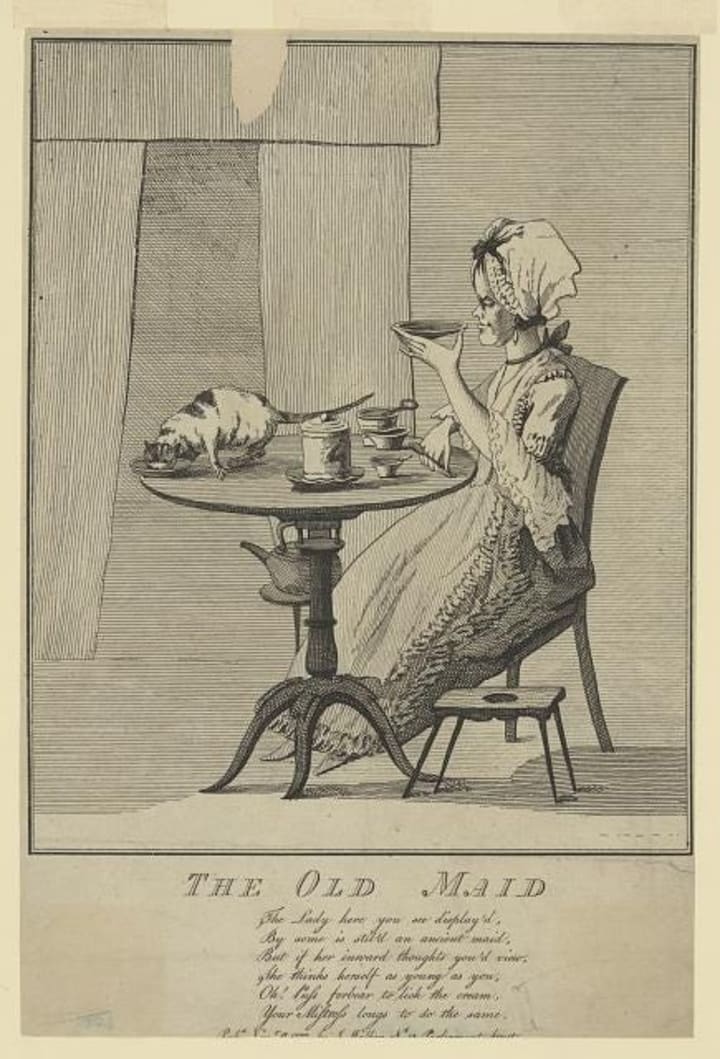
This double standard reveals a persistent discomfort with female autonomy. Independence in men is admired; in women, it is judged. Solitude, far from being a personal strength, becomes a societal critique.
Sociologist Arlie Hochschild explored this further in her 1989 book The Second Shift. Women are expected to not only work outside the home but also manage the emotional well-being of everyone around them: partners, children, friends, coworkers, and even the neighbour whose cat keeps escaping. When a woman opts out of that role: no partner, no kids, just vibes and maybe a very smug tabby, it's seen not as a lifestyle choice but as a dereliction of duty.
And yet, more women are choosing the tabby.
The number of never-married women in the U.S. has steadily declined since 1990, according to the 2019 U.S. Census. A 2022 Pew Research study found that single adults are on the rise, and women are more likely than men to say they're not even looking for a relationship.
According to the Office for National Statistics (ONS), the proportion of UK adults who have never married or entered a civil partnership rose from 26.3% in 1991 to 37.9% in 2021, with women aged 20–39 jumping from 37% to 65.7%. Basically, numerous studies are showing that more women are delaying or rejecting marriage and motherhood altogether.
And why shouldn't they? One of the many, many, many failures of this stereotype is that it glosses over the rich and varied forms of human connections that exist outside romantic partnerships. Friendship, community involvement, loving pets, and familial bonds provide deep sources of love and support that are just as valuable as those found in romantic relationships.

This isn't loneliness. It's liberation. It's a conscious, sometimes deeply practical response to wage gaps, unpaid domestic labour, and the still-broken promise of "having it all."
Women aren't rejecting connection; they're rejecting the expectation that they must be the ones holding everyone else's emotional world together. And honestly? That's not sad.
That's revolutionary.
About the Creator
Chelsea Rose
I never met a problem I couldn't make worst.
Keep reading
More stories from Chelsea Rose and writers in Viva and other communities.
The Smart Bride’s Guide: How to Master the 1ct Oval Engagement Ring Trend
In the world of fine jewelry, 2026 is officially the year of the "Intelligent Sparkle." Gone are the days when couples blindly followed the "three-month salary" rule. Today’s couples are looking for three things: aesthetic beauty, maximum value, and timeless style. At the intersection of these three desires sits one perfect choice: the 1ct oval engagement ring.
By Mohd Kaish6 days ago in Viva
Russia’s Oreshnik Hypersonic Missile Strike on Ukraine: Why It Matters
Russia’s war in Ukraine has entered another serious phase after Moscow confirmed it used its Oreshnik hypersonic missile in a recent strike. While missile attacks are not new in this conflict, the use of this advanced weapon has drawn strong reactions from Ukraine and Western countries. Many people are asking: Why does this matter so much? This article explains the issue in easy-to-understand English, step by step.
By sehzeen fatimaa day ago in Viva


Comments (1)
Curiously, I have met several single women with their home filled with cats (up to 5) 😁. But yes, patriarchal societies see independent women as a threat.