
Women in a Man’s World
Lee (2024) and Calamity Jane (1953)

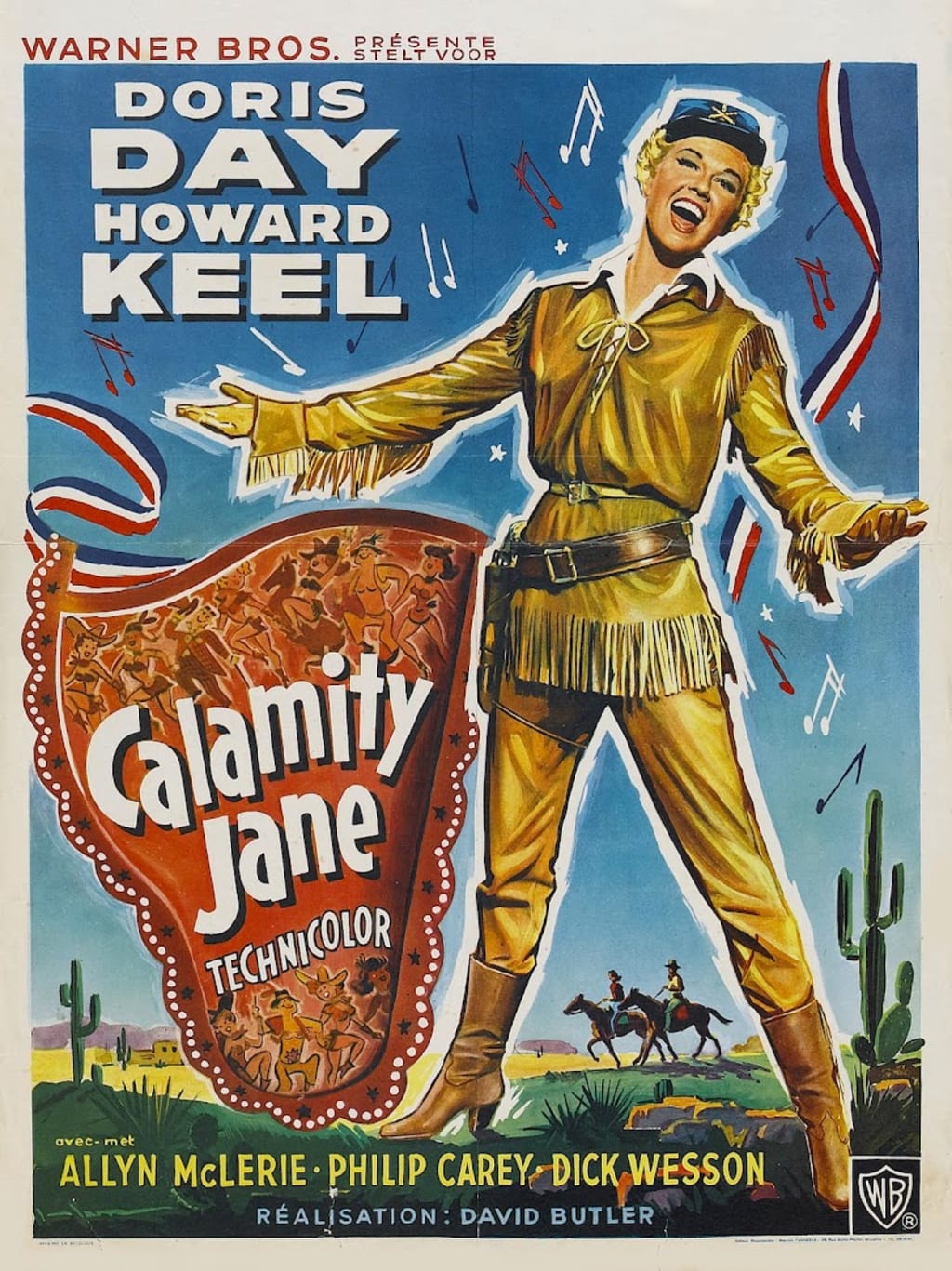
I had it planned for a couple of weeks. I was going to write my 100th Vocal piece on the film that ignited my love of classic film – Calamity Jane. It was showing at a local cinema and I was going to see it on the big screen for the first time. Then, I would write a breezy piece about Doris Day’s ability to pull faces and her fabulous voice.
However, my weekend didn’t pan out exactly as I planned and so this piece is going to be slightly different too.
First, on Saturday, I had tickets to see Midsummer Night’s Dream at Manchester’s Royal Exchange Theatre. However, the production was cancelled with “Technical issues” being the only explanation. So, instead of seeing some light Shakespearean comedy, I went to see Kate Winslet’s biopic of the war photographer, Lee Miller.
Then on Sunday, I was all ready to see Calamity Jane. I was on the tram. It was running a bit late, but with a good wind I was sure I would still be able to grab a bite to eat at the cinema before the showing. Everything was going to be fine. The tram was rammed, because the previous one had been cancelled. I was lucky enough to have a seat and everything was going to be fine. More people piled on at every stop. There was a guy having a panic attack needing to be near a door. He was talking incessantly and I felt his pain. He got off at the next station and everything was going to be fine.
And then the tram stopped.
It just stopped. It didn’t start again. It was fine. I would just have to watch the film without eating first. I wasn’t that hungry. Everything was going to be fine.
A driver announcement. Signals had failed at Victoria Station and there was a backlog of trams from Trafford Bar. But everything was going to be fine. They probably just needed to reboot and everything would be fine. Long minutes passed. Driver left his cabin.
“Sorry folks, I have no idea when we are going to be able to move again.”
A collective groan.
“I know you probably all have tickets to the tennis. I can’t guarantee that I’m going to get you there in time.”
Slowly people filed off. A couple of women asked me to repeat the message.
“Oh no, the tennis starts at 1pm we won’t be able to get there on time.”
“Tennis, pah!” I thought. I’ve been waiting to see this film on the big screen for over forty years.
I got off the tram and turned on Google maps to walk. My estimated time of arrival was 1.15.
So, I’ll miss the start, but I’ll get to see most of it. Everything is going to be fine. I didn’t feel fine. I was sweaty and the rain was falling and I needed to walk like a demon.
I walked. I walked real fast. I walked like I was Rachel, but twenty years ago. I arrived at 1.07. They were still showing trailers. I even had time to nip to the toilet before the main show started.
And then the big screen showed the Warner Brothers logo. Doris Day's name was in 10 foot high letters. And I was okay again.
It was fabulous to see Doris on the big screen.

Now, I’m sitting in a café and reflecting on my weekend’s viewing. A female war photographer in a gritty, sometimes terrifying biopic. And a woman in suede chaps singing about love. Wildly different, but both excellent in their own ways. Both to be recommended. And both gave me that slight clench of the stomach as I worried about the woman at their centres, and the way both were fighting to be heard in systems that didn’t really want them.
Wait a minute, Rachel, you’re not really going to compare a hard-hitting biopic of a war photo-journalist with the froth of Calamity Jane?
Erm, yes I am.
I’ll be honest I was hesitant to write this, but I couldn’t stop thinking about the “cross-over” – that bit of a very weird Venn Diagram where Calamity Jane and Lee Miller intersect.
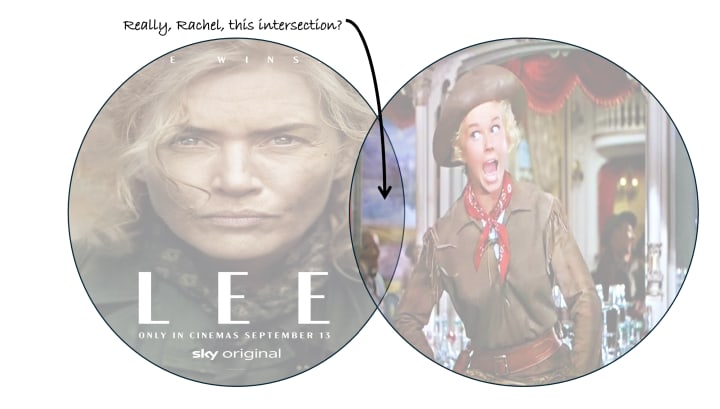
On the surface and indeed, probably deep down, they are very different films. Kate Winslet’s Lee is the gritty and disturbing take on the war photography years of Lee Miller. It opens in a war zone with Miller dodging bullets and explosions landing on sandbags. Courage, athleticism and trauma on show from the beginning. This is a tale about a woman who had been famed for being a muse and model, but who would rather take a photograph than be one. And to take photographs she has to negotiate the masculine spaces of photo-journalism and war zones. She becomes the woman who takes pictures no one else could take. She also performs an historical necessity in documenting the liberation of Dachau and the horrors and atrocities of the Nazi concentration camps.
Calamity Jane was a real woman – a frontier woman who was noted for wearing male attire, telling tall stories and taking risks in the latter part of the 19th century. However, Calamity Jane - the movie, bears no real relation to her story. It is a frothy, technicolour, musical romantic comedy, which follows the hard-talking, gun-toting Calamity Jane’s romantic life and induction into real femininity via her friend/rival, Katy Brown.

Both films have as a central theme the ‘trespass’ of women into ‘male’ domains.
In Lee, this is treated as an outrage. As an obstacle to be bargained away. The world men have constructed is brutal and arbitrary. Lee’s response is hard-headed courage that tackles the injustice head on. Lee understands the rules, but won’t play by them. The audience know that the world is wrong-headed. With the advantage of historical 20/20 vision, we know that the headbutting and strong-arming is a necessity for Lee Miller to get to the places she needs to be to produce her iconic, rebellious, humane photography.
In Calamity Jane it is just a fact that women and men have different roles and that to try and do it differently is ludicrous. There is no outrage, just laughter at a woman who apparently doesn’t understand the rules. We have to watch Calamity Jane learn how to wear her femininity in constraining, uncomfortable ways.
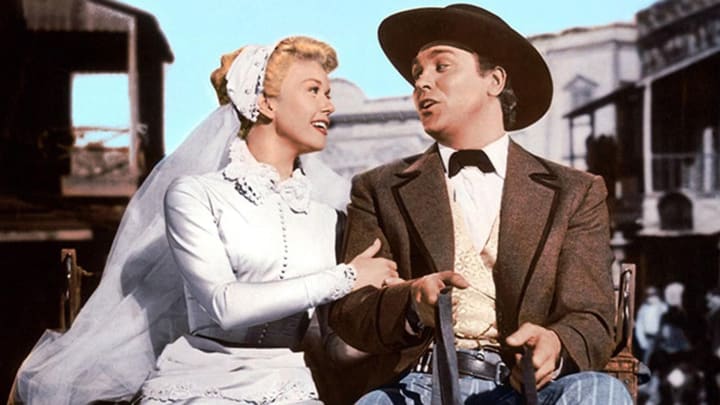
But both women are heroines. When I first watched Calamity Jane I was a youngster watching it on the small television in my parent’s lounge. I knew that she was beautiful before the transformation. In fact, I thought she looked better in suede chaps that allowed her to move. And I didn’t really like that she had to change everything she was to get a man. I liked her just the way she was. I saw something different to the story I was being fed. I saw female friendship being played out as unequivocal acceptance. I saw a leading woman who was a blur of energy and talent. I heard beautiful, heart-felt singing and watched dynamic dancing. I watched a woman pull silly faces, laugh at herself and spar with others. I saw a woman in the lead. And that is what I saw again at the weekend, but with the slight pull at my stomach, knowing she was going to have give up her gun in the end.
And with Lee, I knew she was going to get the photographs. I knew she was going to sit in Hitler’s bath. She was tough and fearless. But I also saw that it came at a cost. All that strength being exhausted by the constant need to bargain for her work to be taken seriously, simply because she was a woman.

The reason I am thinking all this is because I am a stand-up, and in the last week there has been a murmur in the press about the lack of women on stand-up bills. How women are not making it onto the stages of the biggest comedy clubs. And that this is justified in the same ways that Calamity Jane was ridiculed for riding a horse, or that Lee Miller was kept off the front line. It has nothing to do with talent. It has everything to do with a territorial mentality about where women should be.
Lee’s message is to keep fighting and keep your shape and form. Get the world to adjust to you.
Calamity’s message is to find a way to fit in to the world.
Both come at a cost.
Both are traumatising and exhausting.
So, there has to be a third option. In the world of comedy, as in other spheres of the world, women organise. We come together and forge our own spaces.
I spent last night improvising with a group of women and I laughed and felt lighter.
We were not ‘niche’. We weren’t oddities. We didn’t change our shape. We didn’t need to ‘fit in’.
Whilst the rest of the world catches up, we created our own worlds.
About the Creator
Rachel Robbins
Writer-Performer based in the North of England. A joyous, flawed mess.
Please read my stories and enjoy. And if you can, please leave a tip. Money raised will be used towards funding a one-woman story-telling, comedy show.
Keep reading
More stories from Rachel Robbins and writers in Viva and other communities.
My Hopes for the Women's Division at WrestleMania 42
It's that time again, fellow wrestling fans! The Elimination Chamber came and went, and now, it's the home stretch on the road to WrestleMania. As a sports fan, I can't help but compare this to home stretch periods in sports, especially in the NHL and NBA, mainly because WM will take place as both playoffs start. As always, I'm always thinking of the women's action, but before I talk about the subject at hand, I have to get this off my chest.
By Clyde E. Dawkins2 days ago in Viva


Comments (4)
Congrats on the TS. This is my fav sport https://driftbossgame.co
Compelling piece, not least because of the transport woes. Fantastic contrast between the two characters and their historical reference points, while drawing in the common threads to their respective lives and historical importance to feminine identity. Can't say I was ever a fan of Doris Day but Kate Winslet is just knock-out in all her post-Titanic work. Kate also demonstrated she could raise Titanic... from what could have been a mediocre period piece. I have yet to see her Lee Millar but now on my list of must-watch movies. Thanks for that and for a riveting read.
I am keen to watch Lee now! 😁
Great job! I love your narration, writing and analytical skills. This was thoroughly enjoyable and definitely deserves a Top Story.Go Rachel! 🤩