
Shifting the Narrative on Sexual Violence
Why are we still blaming the victims?


CW Sexual Violence, Sexual Harassment
I remember sitting in my kitchen at the age of nine or ten, the evening news on in the background. One story involved the sexual assault of a young woman. The focus of the report was not the attack itself, but comments made in court by the defendant’s lawyer.
He had implied that the victim was to blame for the assault because of the clothes she was wearing when it happened; perhaps her skirt was too short or her shoulders exposed, I can’t recall the specifics. What I do remember clearly is how I perceived the story. The lawyer’s remarks had sparked national debate, and I didn’t understand why. I doubt I even grasped what “sexual assault” was, and yet to me, his comments were both rational and acceptable.
The idea that a woman’s clothing can transform her from the victim of assault to instigator is utterly non-sensical, but it took me years to understand that. From an early age, we are immersed in a culture of victim blaming, encouraged to believe that as women, we are exclusively responsible for our own safety. We are warned not to walk alone, particularly at night. We are told to avoid secluded areas, to stay on highstreets and away from dark alleyways. Mini-skirts, crop tops and stilettos have morphed into emblems of consent.
When we’re assaulted or harassed our behaviour, decisions and actions are continuously thrust into the spotlight. The same questions are always asked. Had we left the house after dark? Were we alone? Were we intoxicated? What had we wearing at the time of the incident? Our answer to these questions affects how we are perceived by the media, public opinion and even in courts of law.
The irony is, of course, that violence against women is not confined to dimly lit streets and shadowy passageways, nor to particular types of clothing. Clothes donated by victims of sexual assault to the “What were you wearing?” exhibition in Brussels ranged from jumpers, to collared shirts, to dresses. One victim had been wearing a My Little Pony T-shirt.
Perpetrators aren’t always unknown assailants. A 2017 study from Glasgow University, in fact, suggests that over 90% of sexual assault victims in the UK knew their attacker. In the US, only two in ten perpetrators are strangers. Assault and incidents of harassment occur in nightclubs, workplaces, shops, restaurants and bars. Millions of women are at risk in their own homes. If we are to protect ourselves from sexual violence we will have to spend the remainder of our lives alone inside a locked room, the windows sealed and doors barred.
Victim blaming is illogical, incredible damaging and utterly futile, but it is so deeply ingrained within our collective conscious. News of Sarah Everard’s murder last week was accompanied by a barrage of articles advising women on how to protect themselves against attack. Police warned us to remain indoors, to leave our houses only when in the company of others. Heeding this advice may keep us safe temporarily, but it is utterly impractical as a long-term solution.
We exist in a world where, for many of us, sexual harassment begins before we’ve even left school. Men decades older than us lean out of cars and vans, wolf-whistling and cat-calling as we walk home in our uniforms. We are told to ignore them, to be flattered by the attention. If we complain of being groped in bars and nightclubs, we are told “boys will be boys” and asked if we might have implied consent with a courteous smile or a glance.
How many of us have walked home feeling frightened, cringing away from shadows and parked cars, our keys clutched so tightly in our hands that they leave a mark? How often have we glanced at our reflections in shop windows, frantically searching for potential assailants? We are exhausted, and we are angry.
When we share our experiences, men often respond by defending themselves. “It isn’t all men”, they protest. We know, of course, that it is not all men; but it is the vast majority of women. According to a recent poll, 97% of young women in the UK have faced sexual harassment at least once. 96% of these women had not reported being harassed to police.
Many of the women who were groped, followed or coerced into sexual activity did not consider their experiences serious enough to report. Sexual misconduct has become so normalised that many of us view it as an unpleasant but inevitable fact of life. Harassment and sexual violence are endemic in the UK. A small minority of men may be the perpetrators, but so many more allow it to continue.
To end sexual violence we need global, sustained, systemic change. We will not achieve this by blaming victims. Tangible educational reforms are essential, as are amendments to legislation. These things will not happen overnight. Campaigning for change is challenging, and the way ahead can seem daunting. Increasingly though, women are shifting the narrative on sexual assault and harassment, taking centre stage to fight for our safety and autonomy.
We need men to give us space to share our experiences, to absorb what we are saying and to amplify our voices. Protestations of innocence are not constructive, but open, candid conversations with your relatives and friends can be. We must stop talking about how women can make themselves safer in society, and start talking about how we can make society safer for women.
About the Creator
Keep reading
More stories from writers in Viva and other communities.
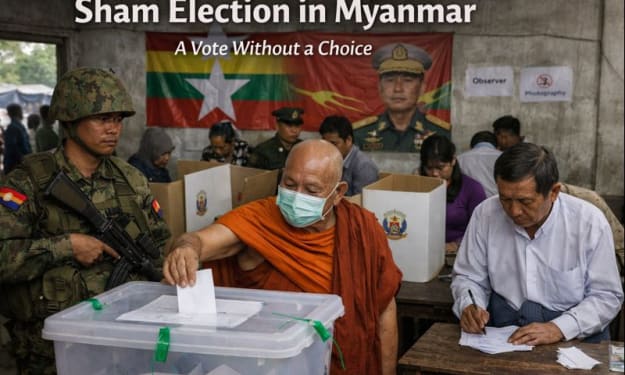
Myanmar’s Junta Election: A Vote Without a Choice
Myanmar’s military government has held the second phase of its planned election, but many people inside and outside the country say the vote is not real democracy. Critics describe it as a “sham election” designed to keep the generals in power, not to return the country to civilian rule. The election comes while Myanmar is still facing war, poverty, and deep political repression.
By dua fatima6 days ago in Viva
Why an Oval Diamond Engagement Ring Is Perfect for Valentine’s Day
Valentine’s Day is more than just a date on the calendar; it is a global celebration of devotion, passion, and the beautiful promise of a future together. For many couples, February 14th marks the most romantic milestone of their lives—the proposal. While the moment itself is unforgettable, the ring you choose serves as a lifelong symbol of that commitment.
By Mohd Kaish5 days ago in Viva
Wild Card Weekend Recap: What Happens Now?
I think I figured out why I love Wild Card Weekend so much. It's because it's the first playoff anything of the calendar year. The NFL season starts in the fall, and once upon a time, the champion was crowned either on or slightly before New Year's. The evolution of the NFL schedule has resulted in the playoffs starting just into the New Year, and currently, the final week of the season falls on the first weekend of the New Year, with Wild Card Weekend coming a week after that. So yes, chronologically, the NFL's Wild Card Weekend serves as the first playoff anything of the calendar year.
By Clyde E. Dawkins4 days ago in Unbalanced



Comments
There are no comments for this story
Be the first to respond and start the conversation.