
Myanmar’s Junta Election: A Vote Without a Choice
“When voting becomes fear, and democracy loses its meaning.”

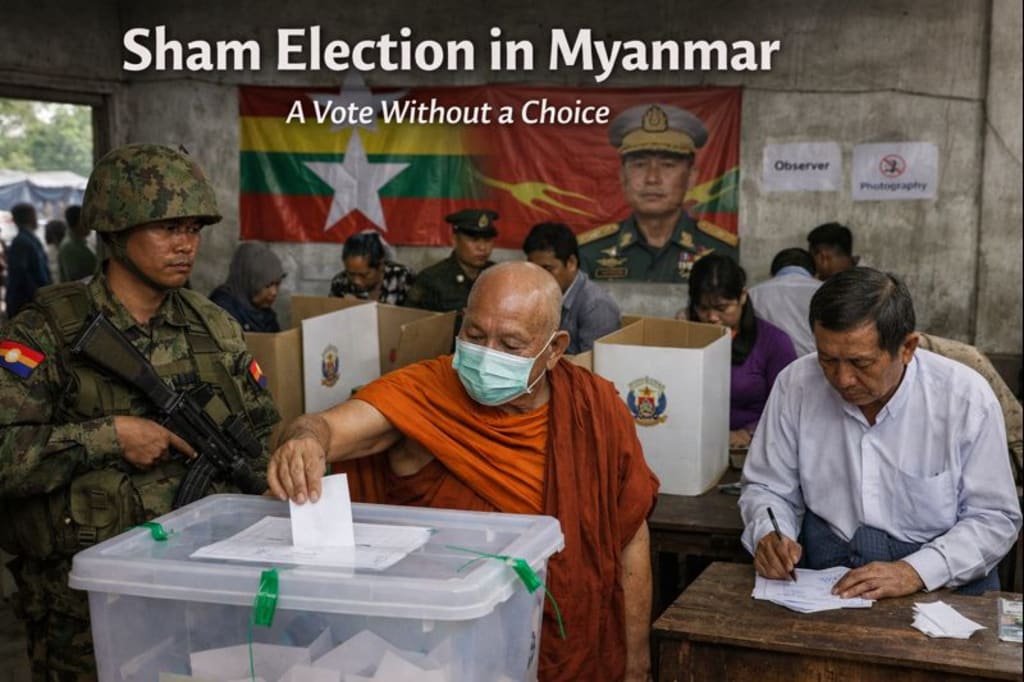
Myanmar’s military government has held the second phase of its planned election, but many people inside and outside the country say the vote is not real democracy. Critics describe it as a “sham election” designed to keep the generals in power, not to return the country to civilian rule. The election comes while Myanmar is still facing war, poverty, and deep political repression.
This article explains what the election is, why the military is holding it, and why so many people reject it.
Background: How Myanmar Reached This Point
Myanmar has been in crisis since February 2021. That year, the military, also known as the junta, overthrew the elected government led by Aung San Suu Kyi and her party, the National League for Democracy (NLD). The coup ended a decade-long experiment with democracy.
After the takeover, millions of people protested peacefully. The military responded with violence. Thousands of civilians were killed, and many more were arrested. Armed resistance groups formed across the country, leading to a civil war that is still ongoing today.
The military promised that it would eventually hold elections. However, many people feared that these elections would not be free or fair. Those fears have now become reality.
What Is the Second Phase Election?
The junta’s election is being held in several phases instead of one nationwide vote. The second phase took place in January 2026, following the first phase in December 2025. A final phase is expected later.
Voting did not happen everywhere. It only took place in selected townships, mostly in areas under military control. Large parts of the country, including regions controlled by resistance forces or affected by heavy fighting, were excluded.
The military says the phased approach is needed for “security reasons.” Critics say it is a way to control the outcome and avoid areas where people strongly oppose the junta.
Why Many Call It a “Sham Election”
There are several reasons why this election is widely rejected.
1. Major opposition parties are banned
The most popular political party in Myanmar, the NLD, was dissolved by the military. Many other opposition parties were also banned or chose to boycott the election. Without real opposition, voters have little or no real choice.
2. Political leaders are imprisoned
Aung San Suu Kyi and many other elected leaders remain in prison. Thousands of political prisoners are still detained. An election cannot be free if key leaders are behind bars.
3. Fear and repression remain widespread
People in Myanmar live under strict military rule. Free speech, free media, and freedom of assembly are heavily restricted. Many citizens fear punishment if they speak out or refuse to cooperate. This atmosphere makes genuine voting impossible.
4. Ongoing war and displacement
Myanmar is still experiencing widespread armed conflict. Millions of people have been displaced from their homes. In such conditions, it is very difficult to hold a fair and inclusive election.
Who Benefits From the Election?
The main winner so far is the military-backed Union Solidarity and Development Party (USDP). This party has close ties to the generals and is widely seen as a tool of the military.
Because most opposition groups are absent, the USDP is winning a large number of seats. This allows the junta to claim that it has public support, even though many people did not vote or were not allowed to vote at all.
The election helps the military present an image of legality and normality, especially to foreign governments. Critics say this is the real goal of the process.
International Reaction
The reaction from the international community has been largely negative.
The United Nations, Western governments, and human rights organizations have all stated that the election is not credible. They argue that it does not meet basic democratic standards and should not be recognized.
Some neighboring countries have taken a more cautious approach, avoiding strong criticism. However, even within the region, there is concern that the election will not bring peace or stability.
Voices Inside Myanmar
Inside the country, many people have rejected the election quietly or openly.
Some ignored the vote completely. Others say they were pressured to participate by local authorities. Resistance groups and pro-democracy activists have called on people not to legitimize the military’s process.
For many citizens, daily survival is a bigger concern than politics. With rising prices, job losses, and constant fear of violence, voting feels meaningless to them.
Does the Election Bring Stability?
The military claims that the election will restore order and move Myanmar forward. However, most observers believe the opposite.
Instead of ending the conflict, the election may deepen divisions. Resistance groups have already said they will not accept any government formed through this process. Fighting is likely to continue.
Without dialogue, inclusion, and real democracy, peace remains out of reach.
Conclusion: An Election Without Trust
Elections are meant to give people a voice. In Myanmar, this election does the opposite. It takes place in a country where opposition is crushed, leaders are jailed, and fear controls daily life.
That is why many people call it a sham. It may produce a parliament and a government on paper, but it does not reflect the will of the people.
Until Myanmar has freedom, justice, and true political choice, no election held under military rule can be called democratic.
About the Creator
Keep reading
More stories from dua fatima and writers in Viva and other communities.
A Historic Decision in Jersey: Choosing Dignity at the End of Life
In February 2026, the island of Jersey made history. Lawmakers voted to allow assisted dying for terminally ill adults. This decision has started important conversations about dignity, suffering, and the right to choose how life ends.
By dua fatima5 days ago in Viva
What Makes Colombo Special?
Wondering what makes Colombo stand out among the capitals in Asia? This stunning city blends colonial heritage, modern attractions, rich culture, and mouthwatering cuisine all within this amazing hotspot. From exploring colourful markets and serene temples and holy sites, to trying out some tasty street food and exquisite rooftop bars, Colombo has something for everyone! Here's how to experience its vibrant spirit and discover what truly makes it special.
By Aurora Gianna7 days ago in Viva




Comments
There are no comments for this story
Be the first to respond and start the conversation.