
Is She a Bitch, or is She Just your Boss?
How Misogyny Shapes Your Views of Successful Women.


When I sat down to write this, I had a lot of ideas on what I could focus on, but as I started to outline my talking points I realized that I had way too much to just focus on one thing. As a result, I am going to break this up into the two main points of divergence on how women in leadership roles or just women in traditionally male-dominated fields are perceived, and how we can flip the script and do better.
Before we get into it I would just like to make a few points very clear. First and foremost I am not a psychologist or mental health professional, everything that I am about to write is based on research and statistical data available to me, and my own lived and observed experience. In short, I am not the end-all be-all of this conversation and there may be things that I gloss over or miss entirely because no one is perfect. Least of all me.
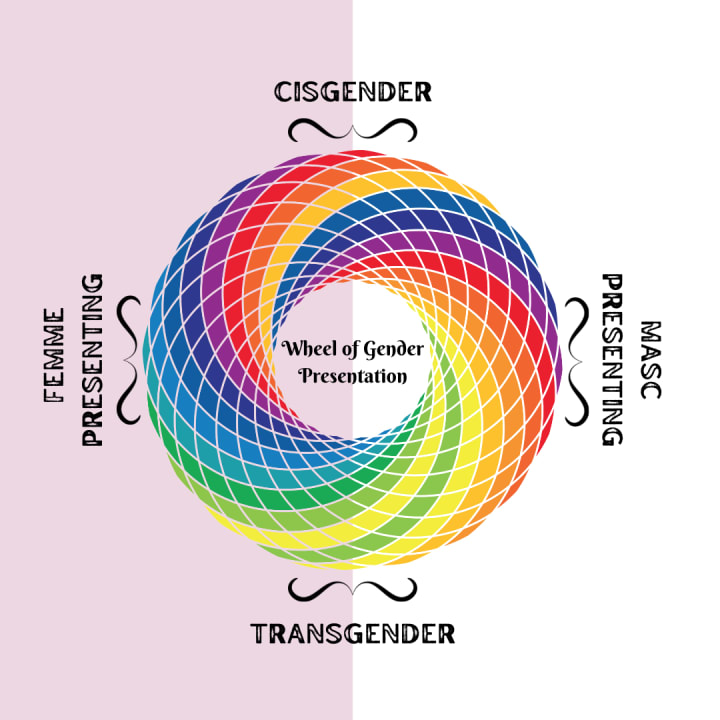
Secondly, I want to make sure that I am clearly defining "woman" as I will be using it a lot in this article. When I say "woman" or "women" I mean anyone who identifies on the femme quadrants of the Wheel of Gender Presentation. I am not going to spend a whole lot of time on this, but here's a brief lesson on what I mean:
Here is the Wheel of Gender Presentation (greatly simplified for brevity)

When I say "women" I am referring to anyone who falls into the pink box of the Wheel of Gender Presentation, as demonstrated below.
Now that we have that sorted out, let me address one final thing: I did not specifically bring race as a consideration in this discussion because while I have found that this is a ubiquitous experience across women in leadership, I also understand that race does play a large factor. That whatever woes I am about to spell out will be felt at different levels across race lines because of the other systemic issues that the world today is built upon. My lack of mention is not erasure. I am trying, and already failing to keep this simple. How these issues affect non-white women is different, and in order to give those issues the credit they deserve, I will likely have to write a follow-up. All of that being said, in order to find the stock image that I used for the header of this article, I had to look through well over 1000 images to find one of a non-white woman not smiling while working.
OK now that we have the baseline set and some elementary knowledge on the subject of gender, let's talk about these points of divergence. The two that we will be addressing today are Direct Action Output, and Perceived Action Output. Direct Action Output are the things that a person does consciously. The words we use, the emails sent, and our physical actions we take with our body while maneuvering in the world. Perceived Action Output, are the unconscious things that other people unconsciously pick up on. Things like facial expressions, eye contact, and body language. Both of these things get read differently depending on a lot of factors, but since we are talking about women today, we will start there.
Direct Action Input - Words Spoken.
You're new at your company, you've only been there a few weeks, and pretty early on you were handed a pretty big project with some ambiguous instructions. You've been working on it diligently the last couple of weeks, but it isn't anywhere close to done. The rumors around the office about your boss are all pretty uniform in that she is not to be crossed, makes no room for excuses, and will deliver feedback with an uncaring edge of a knife. In short, you are terrified as you walk into the meeting with her, your colleagues all look at you sympathetically as the door slams shut. It might as well be the door to the mausoleum you are going to be buried in, you're that terrified. You sweat, you pontificate, but at the end of your long explanation, you have to admit that the project is not complete. The boss is clearly displeased. She asks you questions that shoot into your soul like arrows, a barrage you barely make it through without crying. "If the instructions were not clear, why didn't you ask me or someone else for help?" "If you needed more time when didn't you address that at any point in the last few weeks instead of waiting until today?" "Why?" "Why?" "WHY?!" You go back to your desk, slumped over in what feels like a defeat in the worst way. Everything your colleagues have said about her is true, you think. She is ruthless.
Woo, what a meeting. That seems like a really tough time for you bud. Except... Why do you think she is mean? Is it because she didn't come to you? Is it because she asked you to be accountable for your own behavior? Is it because you need a mother, not a boss? Your boss in this situation did everything she was supposed to do. She isn't a mind reader, she asked you why you failed to take the steps necessary to do your job, including asking for help. But you didn't do any of those things. Her pointing those things out is not her fault. That's your fault for not addressing them sooner. She is not wrong or at fault. You are an adult, working at an adult job, for a grown-up company, if you can't be accountable for yourself then why should she be? If that feedback had been delivered by a man, you would probably have taken your licks, and gone back to your desk more determined to get it right in your next attempt. But because this feedback was delivered by a woman, and a woman that your coworkers have skewed your opinion of, you have taken it as personal criticism when it wasn't. It was a critique of your ability to do your job. Not your personality.
Perceived Action Output - Facial Expressions.
Oh no. You have to go to your Boss' office again, for a simple oversite on something. You have no idea why it is that big of a deal, I mean it's one missed thing on a litany of things you did right! Why should it matter so much? Besides she's the boss it's her job to catch your mistakes right? So why does she want to see you in her office? You push back from your desk and make your way to her office, already knowing this is going to be an absolute disaster. She isn't very forgiving, and you've made similar mistakes in the past. You knock at the door, she indicates that you should come in. She indicates that you should close the door behind you, with a nod of her head. she is typing, very quickly, not looking at you. The sound of her nails on the keyboard start grating on your soul like the screeching of ripping metal. You sit down in the chair and get ready for your punitive reprimand. She stops typing and turns her chair around to face you. Her back is straight, hands folded on the desk in front of her. She does not smile. She points out the thing you missed, she also reads off the other things you have missed in the last few weeks as though she were going through the reasons you won't be making the nice list for Santa this year. You sigh and nod your head, you give her the same empty apology that you gave her last time. She doesn't know anything. You have a life outside of here, she has no idea the kind of pressure you're under. She would never understand anyway. Why can't she at least smile at you so that you know that she isn't going to fire you on the spot. Her directness and formality of address have you on edge. When the meeting is over, she slides a write-up across the desk to you and asks you to sign it. You heave another heavy sigh and do so. You push back from her chair and do not tuck it back. You exit her office and slump back to your desk. She just doesn't get how unfair all of this is, she's never worked your job, how could she ever know?
That seems like the worst kind of one on one you could have with your boss. I do however have some questions. It seems like this wasn't the first time you had made these kinds of mistakes. It also seems like you have some stuff in your personal life going on, that may be affecting your job. While we should all try our best to keep that stuff separate, it isn't always possible. We're all still human, not robots. It seems to me like your boss gave you a lot of opportunity to resolve the mistakes, but you have just continued making them. It also seems like she prolonged writing you up until there was a behavior pattern. So why do you think she is the mean one? Is it because she was working when you entered? Is it that she remained formal during your meeting likely as a defense mechanism for an unpleasant task? Or is it that she didn't smile at you? Why should she smile? She was doing an unpleasant thing. The expectation that women should always smile is so incredibly toxic. If this had been a male boss would you expect him to grin at you every time you entered his office? That would be almost threatening. So why expect it from your boss, just because she is a woman? It seems to me like you haven't been transparent with your boss, that you are in fact slacking on your work, and that she has given you a lot of chances to improve all of which you have squandered. It sounds to me like she didn't want to write you up, but you left her no choice. It also looks like you took her feminine qualities and used them as a weapon to attack her character. Her nails on the keyboard are only agitating for you because you are not accustomed to the sound. Perhaps if you got some more diversity in your department... Oh well, I am sorry to say it doesn't look like you will be with the company much longer anyway.
These are too intentionally hyperbolic examples of the ways in which we apply our internalized misogyny to women in positions of leadership. Some other common things we judge women for but not men include:
When they use direct speech and don't kneecap their own sentences for the sake of trying not to be offensive. This is the difference between, "I want it the way I want it" and "I just would like it the way I specified please if it's not too much trouble"
When they interrupt what you are doing or saying. This is the difference between standing by meekly while you finish your conversation you seem to be having directly in front of the coffee pot and saying, "Excuse me." and going for it.
Dressing up or dressing down. When a man who usually comes into work in blue jeans and t-shirts suddenly comes into work in a suit, it always looks like he is going on to better things. When a woman does the same, she is trying to maximize sex appeal to unfairly get a promotion.
There are so many things that we apply this failed logic to, and the less we address it the more it is pervasive. If you didn't like an interaction with your boss, and your boss happens to be a woman, before you degrade her run it through this filter:
Is what she said true, even if it makes me look bad?
Is what she said aimed at directly helping me improve in the future?
Is there an arbitrary thing that would have made me take this feedback more positively?
If my boss were a man would I be so hurt?
There are right answers to these questions, and if you can be honest enough with yourself to ask them and also answer them, then I think your perception of your femme bosses will improve as you begin to deconstruct the implicit misogyny that is ground into us from birth.
About the Creator
Paige Graffunder
Paige is a published author and a project professional in the Seattle area. They are focused on interpersonal interactions, poetry, and social commentary.
Find me on Medium.com
Find my books on Amazon.com and at Barnes and Noble.
Keep reading
More stories from Paige Graffunder and writers in Viva and other communities.
J.K. Rowling is a Dirty Rotten TERF
First, let's get a few things out of the way. Feminism benefits everyone. If you think feminism's only goal is to serve cisgender women, then you're doing it wrong. The goals of feminism help everyone. If true equality and equity were achieved all the harmful structures set in place by the patriarchy would be dismantled. That means men could express their feelings, and wouldn't have to resort to violence as the only way to express themselves. It also means that the control construct could be dismantled, and the idea that the best way to gain power is to rip it from someone else. Ultimately this is a really good thing, but some people have a hard time with the idea that they are still privileged in comparison to someone else.
By Paige Graffunder5 years ago in Viva
The goddess of ten thousand names.
I wanted to write about the goddess Isis for some time now, but felt like my understanding of her is too limited, and my perspective won’t do this powerful archetype a justice. Mainly because, just like the title of this essay suggests, she was the embodiment of countless archetypes, and I haven’t studied them enough.
By Eva Smitteabout 16 hours ago in Viva



Comments
There are no comments for this story
Be the first to respond and start the conversation.