
"Bera Sum Na Ijaazat e Numay." (Only the permission to shoot is yours.)
A cry of defiance against false honor — from the mountains of Kohlu to the digital age, a woman's voice echoes across centuries.

Almost two hundred years ago it is Balochistan. And inside the mountains of Balochistan is a purely tribal area called Kohlu.
The interesting thing is that the year is also 1825. That is, exactly two hundred years ago from today.
In a house of Kohlu, a child is born. He is named “Lal Han”... Growing up, he becomes a shepherd.
It is the monsoon season (just like nowadays)... This shepherd is outside his area with his sheep and goats. A stormy rain begins. In the midst of those mountains, a house is seen. He goes toward that house to seek shelter. The men of the house are not there. According to the customs of that time, the woman of the house becomes the host. She is a newlywed bride. The woman tries to save her tent from the storm. The strong winds take away her dupatta. She is trying to save the belongings. Lightning flashes. In the thousandth part of a second, Lal Han's eyes fall on that woman whose hair is open and the storm has taken away her dupatta, but she, unaware of the world, is trying to save her shelter. In this thousandth part of a second, Lal Han’s life changes and he becomes “Mast Tawakali” and “Sammu Beli”. That woman is none other than “Sammu”.
Imagine that it is a purely tribal time from two hundred years ago. Mast Tawakali not only falls in love with a married woman, but also mentions her name in his poetry. He even calls himself “Sammu Beli” meaning friend of Sammu.
But no one’s “honor” awakens to go and kill that shepherd.
Rather what happens is that they are called “Hazrat Mast Tawakali”. After his death, people come to his grave with great respect and his grave becomes a spiritual center. No one knows the real meaning of the name “Sammu”, but even today thousands of women in Baloch society are named “Sammi”.
It is a time fourteen hundred years ago. In Makkah, a woman does business. She is independent. She sends her goods with a young man to Syria. She is impressed by his honesty. She initiates. Sends a proposal through her slave. Yes, fourteen hundred years ago, a woman is sending a marriage proposal. They both get married. That woman is Umm-ul-Momineen Hazrat Khadija (may Allah be pleased with her) and the young man is Hazrat Muhammad (peace be upon him).
Here, every year hundreds of women and men are killed in the name of “honor”.
These people derive the concept of this “so-called honor” either from tribal customs or from religion.
Both of these events negate this idea.
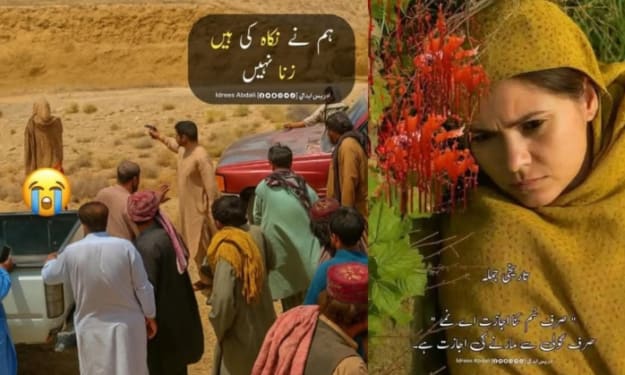
Fast forward. It is the developed era of 2025. It is the age of social media. A video is circulating on social media. The time and place of the video are unknown.
There is a group of so-called honorable men. A “Sammu” is brought. A Qur’an is in her hands. A wretched one takes the Qur’an from her hands. She is not scared. She is not panicked. She is not pleading or begging. She says one sentence. She makes an explosion.
“Bera sum na ijaazat e numay”
(Only the permission to shoot is yours.)
This is not just a sentence. It is a philosophy, a declaration, a rebellion. She is not asking for permission, she is giving permission. She is issuing an order. She is announcing a verdict. She is declaring that I am not anyone's property. I am not a domesticated animal. I am a living, breathing human. I have the right to live on my own terms, and the right to die on my own terms too.
She walks seven steps ahead. And then she becomes free.
With the rattling of bullets in the air, the echo of one sentence is heard:
“Bera sum na ijaazat e numay”
This one sentence is enough to shatter the walls of this so-called honor. There should be poetry written on this, stories should be written, books should be compiled, films and dramas should be made.
Bera sum na ijaazat e numay.
About the Creator
Keep reading
More stories from Ikram Ullah and writers in Viva and other communities.
Viral Video of Woman and Man's Killing in Balochistan: "Tribal Chief Ordered the Execution"
In Pakistan’s province of Balochistan, a video has gone viral showing a man and a woman being killed allegedly on the orders of a local tribal chief over accusations of Karo-Kari (a form of honor killing). Following this, the police have registered a case.
By Ikram Ullah8 months ago in Criminal
Why Kandy is a Top Destination for Luxury Hill Country Stays
Kandy draws people in quietly. It does not demand attention with spectacle or excess. Instead, it offers a slower pace, softer air, and a feeling that life has eased its grip, which is exactly why luxury feels so natural here.
By Daphne Olga3 days ago in Viva
Mikayla Matthews: Growing Up, Motherhood, and Public Life
Growing up is rarely simple. People make mistakes, learn difficult lessons, and slowly discover who they are. Most of these moments happen privately, shared only with close friends and family. For some individuals, however, life unfolds in front of a public audience. That reality can make ordinary experiences feel far more intense. Mikayla Matthews is one of those people whose personal journey became widely visible through television and social media. Viewers first noticed her as part of a group of young adults navigating relationships, friendship, and early adulthood. Over time, her story grew beyond entertainment. It became a portrait of motherhood, personal struggle, loyalty, and learning to grow while thousands of people watch every step.
By Muqadas khan4 days ago in Viva
Sometimes It's Like That and That'sThe Way It Is
It was the late 1960s, and ten-year-old Gloria Coleman was standing with her grandmother on the side of the highway waiting for the bus. As the Greyhound pulled up, it seemed monstrous and intimidating. Grandma Elizabeth grabbed Gloria's hand, holding it tightly as they boarded.
By Cheryl E Preston3 days ago in Fiction



Comments
There are no comments for this story
Be the first to respond and start the conversation.