
A Look at the 2003-04 Tampa Bay Lightning
The Tampa Bay Lightning's first Stanley Cup came at a very tough time for the National Hockey League

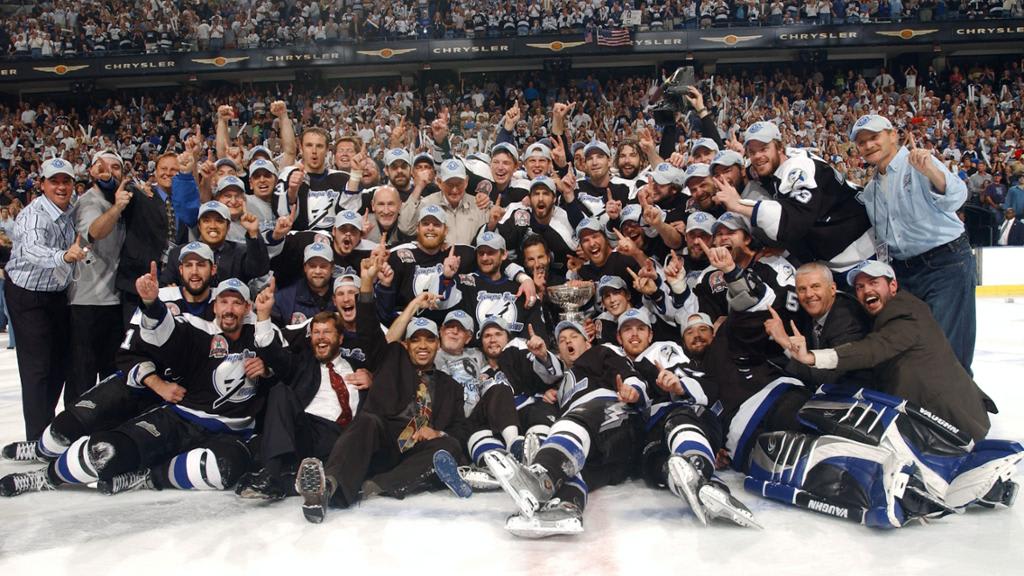
I remember the 2003-04 NHL season very vividly; for positive reasons and for a negative reason. The season started a few months after I graduated from high school, and I remember being elated and stunned when Paul Kariya and Teemu Selanne joined the Colorado Avalanche. As an Avalanche fan, I was salivating, but unfortunately, the acquisitions didn't help the team get over the hump and get back to that glory that they achieved three seasons prior. The negative reason was a big one, the dreaded "l" word was looming: lockout. There were talks of a lockout coming after that season, but I tried my best not to dwell on that. As I've done for my whole life, I focused on the positives, and one of them was the sudden rise of the Tampa Bay Lightning.
The Tampa Bay Lightning debuted in the NHL in the 1992-93 season, with their in-state rivals, the Florida Panthers, joining them a season later. It didn't take long for them to experience the playoffs for the first time, doing so in their fourth season, but it would be their only appearance in their first decade of play. Their second playoff appearance in 2002-03 saw Tampa Bay as division champions for the very first time, but while all that got them was an Elite Eight appearance, their third playoff berth would be the charm.
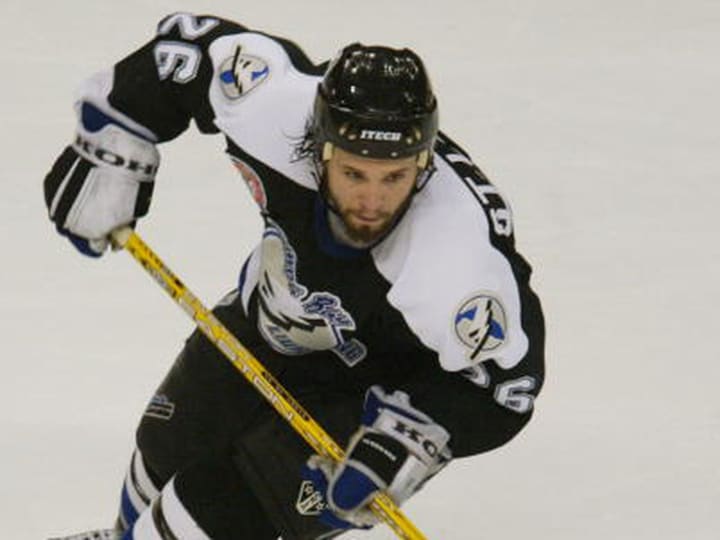
The Tampa Bay Lightning won the Southeast Division for the second straight year, going 46-22-8-6, totalling 106 points (this would be the final season that the ties were part of the standings; the Lightning had eight of them). They actually captured the #1 seed in the Eastern Conference, with their point total only trailing the Detroit Red Wings in the entire league. The team was led by Martin St. Louis, who led the team in goals (38), assists (56), and points (94) during the 2003-04 season. Cory Stillman (80 points) and Brad Richards (79 points) rounded up the top three, while Vincent Lecavalier (in his sixth season with Tampa Bay) scored 32 goals in the campaign. In net was the "Bulin Wall" himself, Nikolai Khabibulin, who went 28-19-7 and racked up a 2.33 GAA, a .910 SV%, and three shutouts.
The Lightning's run began with defeating the New York Islanders in a five game Eastern Conference Quarterfinal series that saw Khabibulin shut out the Isles three times! Khabibulin gave up only four goals in the entire series, giving him a sub-1.00 GAA. In the Eastern Conference Semifinals, the Lightning swept the Montréal Canadiens, with the "Bulin Wall" remaining strong--only surrendering four goals in four games, and because Game Three went to overtime, this was another series where Khabibulin had a sub-1.00 GAA. The Eastern Conference Final against the Philadelphia Flyers was the big test; the teams traded wins and losses in the first six games, and Philly really got to Khabibulin in the series, though he would stay strong in Game Seven, and the goals from Ruslan Fedotenko and Frederik Modin would be enough for the Lightning to win and reach the Stanley Cup Final for the first time in franchise history.
The Lightning faced off against the Calgary Flames, who were in the Cup Final for the first time since their victory in 1989, and served as the first Canadian team to reach the Cup Final since the Vancouver Canucks did it a decade prior. Calgary's run was quite amazing, as they beat nothing but division winners to get to the Final: the Canucks (seven games), the Presidents' Trophy winning Red Wings (six games), and the San Jose Sharks (also six games). The Lightning and Flames both had good runs, and I remember watching and enjoying them well. I also remember watching the Final and my worries about the lockout returning as well.
Surprisingly, the Lightning actually lost Game One, 4-1, but the Bolts evened it up with a 4-1 win of their own. The teams traded shutout wins in Calgary, with Game Four serving as Khabibulin's fifth shutout of the playoffs, while Brad Richards scored the only goal early in the first period. Tampa Bay's win gave them momentum, but when Game Five switched to their ice, it would be the Flames who would win it in overtime to move one win away from their second Stanley Cup, as well as Canada's first Cup win in 11 years.
And then there was Game Six in Calgary. The game was tied at two in the third, with all four combined goals scored in the second period. Late in the third, Martin Gelinas appeared to have scored a go-ahead and potential Cup clinching goal, but after a lengthy review, it was ruled "no goal," and to this day, it remains a topic of controversy, as Flames fans, even 18 years later, believe that they had the Cup and were robbed. 18 years later, and there's still no conclusive evidence that the puck actually went in, as the puck appears to be exactly parallel to the goal line. Had it went in, it would have been Gelinas' third series clinching goal of that year's playoffs. It would have been immensely joyous for Gelinas, as the game was played on June 5, 2004--his 34th birthday.
Instead, the game remained tied after 60, and after 80, but just 33 seconds into the second overtime, Martin St. Louis scored and forced Game Seven. In the final game, Fedotenko scored twice--once in the first and once in the second. Craig Conroy made it 2-1 nearly halfway into the third period, but they would never tie it. 2-1 ended up being the final score, and for the first time in franchise history, the Tampa Bay Lightning were Stanley Cup Champions.
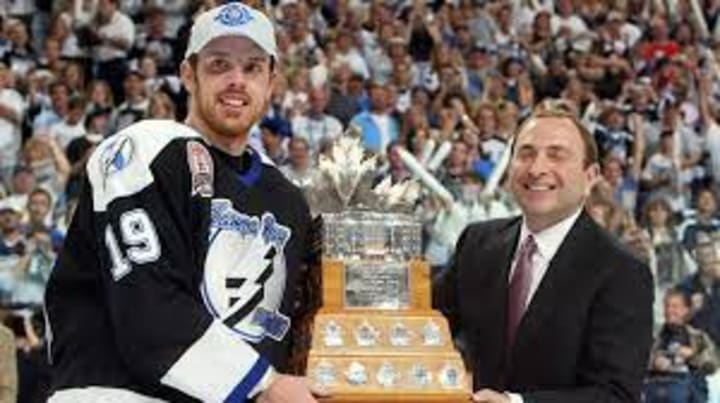
Nikolai Khabibulin went 16-7 in the 2004 playoffs, had five shutouts, a 1.71 GAA, and a .933 SV%. Despite this, the Conn Smythe Trophy went to Brad Richards, who had 26 points (12 G/14 A) in the 2004 playoffs. Richards' 12 goals tied him with Fedotenko for the team lead in the playoffs, while St. Louis had 24 points (9 G/15 A); the only other player to average a point a game during this run. A big story in that Cup run was Dave Andreychuk, who had played 22 seasons without hoisting the Cup (similar to Ray Bourque before 2001), but got off the schnide with the 2004 victory. The Lightning's Stanley Cup victory was the first of a string of three straight first-time champions crowned, and it continued a huge roll in sports in the state of Florida. The Tampa Bay Buccaneers won Super Bowl XXXVII a year prior, and in October 2003, the Florida Marlins won their second World Series. The Lightning became the third team who debuted in the 1990s or later to reach the Cup Final (following the 1995-96 Florida Panthers and the 2002-03 Mighty Ducks of Anaheim), but became the first such team to win the Stanley Cup.
The Lightning won their first Stanley Cup on June 7, 2004, and that would be the last NHL game played in over a year. The lockout became a reality after that, and it ended up completely cancelling the following season. A different NHL returned for the 2005-06 season; no ties, shootouts after overtime, and ESPN & ABC wouldn't air NHL games until the 2021-22 season. The Bolts were ousted in the first round of the 2006 playoffs, but currently serve as one of the juggernauts in the NHL, but that 2004 Stanley Cup was definitely one to remember, as it was the very first for the Lightning, and due to the many changes that came after the lockout, that season served as the end of an era.
About the Creator
Clyde E. Dawkins
I'm a big sports fan, especially hockey, and I've been a fan of villainesses since I was eight! My favorite shows are The Simpsons and Family Guy, etc.
Keep reading
More stories from Clyde E. Dawkins and writers in Unbalanced and other communities.
A Look at the 1995-96 and 2000-01 Colorado Avalanche
You know, I've been writing stories on Vocal for a little over a year, and it's hard to believe that this is my 500th story. What isn't hard to believe is the subject that #500 would be about. Something near and dear to me as a hockey fan: the Colorado Avalanche's first two Stanley Cups. First, a history lesson. Before playing in Denver, the Avalanche played their first 16 NHL seasons as the Quebec Nordiques, who were actually one of four teams who moved from the World Hockey Association to the NHL (the other three being the Edmonton Oilers, the Hartford Whalers, and the Winnipeg Jets). The Nordiques didn't have a lot of success in the NHL; in fact, they only reached the Conference Finals twice (1982 and 1985). Their only Adams Division championship came in the 1985-86 season, and in their final season in Quebec, the Nordiques would win the renamed Northeast Division, but both division titles resulted in first round exits.
By Clyde E. Dawkins12 months ago in Unbalanced
Rolland Courbis: A Defining Voice in French Football Management
Rolland Courbis is a name that evokes strong reactions in French football. To some, he is a sharp tactician and fearless leader; to others, a controversial figure whose career has been marked by both success and turbulence. Regardless of opinion, Courbis remains one of the most influential and recognizable personalities in France’s football landscape, known for his managerial stints, media presence, and uncompromising honesty.
By Asad Ali8 days ago in Unbalanced
China Asks Companies to Stop Using US and Israeli Cybersecurity Software
China has told many of its companies to stop using cybersecurity software made by firms from the United States and Israel, according to people familiar with the matter. This move shows how serious China is about protecting its data and reducing its reliance on foreign technology. It also highlights the growing technology and political tensions between China and Western countries.
By sehzeen fatima6 days ago in Unbalanced


Comments
There are no comments for this story
Be the first to respond and start the conversation.