
China Asks Companies to Stop Using US and Israeli Cybersecurity Software
Beijing moves to protect data security as tech tensions grow

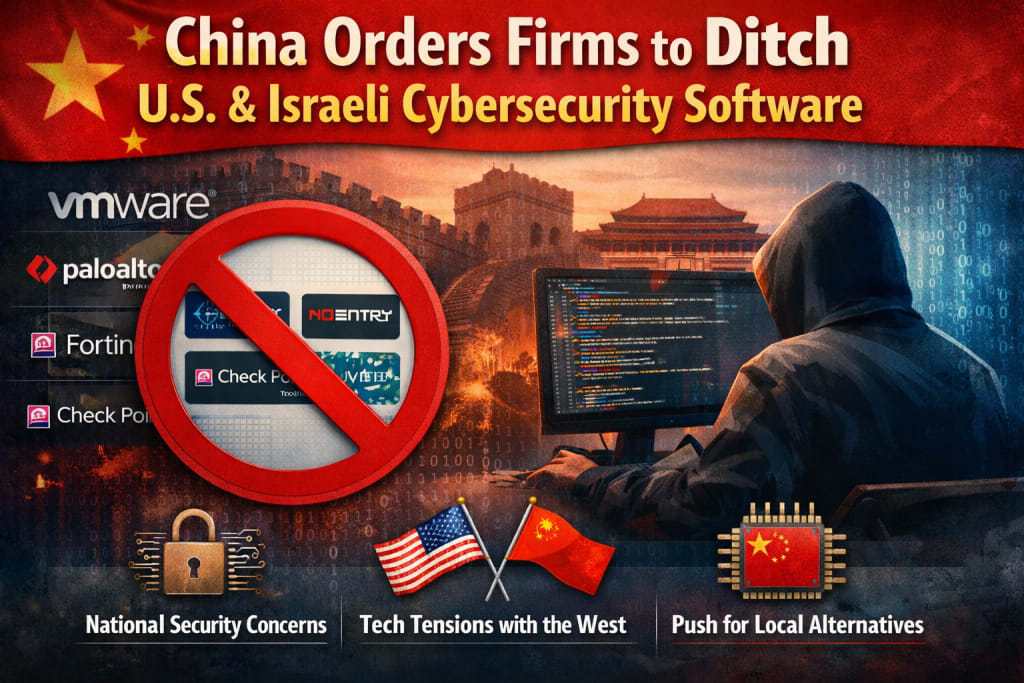
China has told many of its companies to stop using cybersecurity software made by firms from the United States and Israel, according to people familiar with the matter. This move shows how serious China is about protecting its data and reducing its reliance on foreign technology. It also highlights the growing technology and political tensions between China and Western countries.
Cybersecurity software is used to protect computer systems, networks, and data from hacking, spying, and cyberattacks. Many large companies, banks, factories, and government-linked organizations depend on this type of software to keep their information safe. By asking firms to stop using foreign products, China is making a major change in how it manages digital security.
Why China Made This Decision
The main reason behind this move is national security. Chinese authorities are worried that foreign-made cybersecurity software could collect sensitive data or allow access to China’s networks from outside the country. Even if companies say their products are safe, China believes there is still a risk that data could be shared with foreign governments or intelligence agencies.
China has long said that data security is as important as physical security. As more government services, factories, and financial systems move online, the risk of cyber threats increases. Beijing wants to make sure that critical information stays inside the country and is fully under Chinese control.
Another reason is China’s ongoing effort to become more independent in technology. Over the past few years, China has encouraged the use of domestic products in areas like semiconductors, operating systems, cloud computing, and cybersecurity. By reducing the use of foreign software, China hopes to support local tech companies and speed up the development of homegrown alternatives.
Which Companies Are Affected
The order reportedly affects cybersecurity software from about a dozen foreign companies. These include well-known firms from the United States and Israel, such as Palo Alto Networks, Fortinet, VMware, and Check Point Software Technologies. These companies provide products like firewalls, network protection tools, and threat detection systems.
The instruction is said to apply mainly to large Chinese companies, state-owned enterprises, and organizations linked to critical infrastructure. This includes sectors like energy, finance, transportation, and telecommunications. Smaller private companies may not be affected in the same way, but the overall message is clear: China wants less foreign technology in key digital systems.
So far, Chinese regulators have not made an official public announcement. The information comes from sources familiar with internal discussions. The affected foreign companies have also not made public statements about the situation.
Impact on Global Tech Companies
The news has already had an effect on financial markets. Shares of some U.S. cybersecurity firms reportedly fell after the report became public. Investors are concerned that losing access to the Chinese market could hurt future growth. China is one of the world’s largest technology markets, and many global firms see it as an important source of revenue.
However, some analysts say the direct financial impact may be limited. In recent years, many foreign cybersecurity companies have already faced restrictions in China. Some have reduced their presence or shifted focus to other regions. Still, the move adds more uncertainty for global tech firms operating in China.
For Israeli companies, the situation is also sensitive. Israel is known for its strong cybersecurity industry, and many of its firms sell products worldwide. Being excluded from China could reduce their global reach and influence.
A Part of a Bigger Tech Conflict
This decision is not happening in isolation. It is part of a broader technology conflict between China and the United States. Over the past decade, both sides have placed restrictions on each other’s tech companies. The U.S. has limited China’s access to advanced semiconductors and has banned or restricted Chinese firms over security concerns. China has responded by promoting local alternatives and tightening control over foreign technology.
Cybersecurity is a key area in this conflict because it sits at the center of data, privacy, and national defense. Whoever controls the software that protects networks also has influence over how data flows and how systems are monitored.
China has passed several laws in recent years to strengthen data control, including the Cybersecurity Law and the Data Security Law. These laws require companies to store certain data inside China and allow the government to review software used in sensitive areas.
What Happens Next
In the short term, Chinese companies affected by the directive will need to find replacements for foreign cybersecurity software. This could lead to higher costs and technical challenges, especially if local products are not as mature or widely tested. However, the government is likely to support domestic suppliers to ensure a smooth transition.
For Chinese cybersecurity firms, this move could create new opportunities. Demand for local products is expected to grow, and companies may receive more funding and policy support. Over time, this could help China build a stronger and more competitive cybersecurity industry.
For global tech companies, the message is clear: operating in China comes with increasing risks and limits. Firms may need to rethink their long-term strategies, including how much they rely on the Chinese market.
Conclusion
China’s decision to ask companies to stop using U.S. and Israeli cybersecurity software marks another important step in its push for digital sovereignty. While the move raises concerns for foreign tech firms, it reflects Beijing’s priority to control data and protect national security. As technology and politics become more closely linked, similar actions may become more common around the world.
About the Creator
sehzeen fatima
Sehzeeen Fatima is a writer with a Master’s in Science who shares inspiring stories about sports, life, and people. She writes in simple, clear language to connect with readers and spark meaningful thought.
Keep reading
More stories from sehzeen fatima and writers in Unbalanced and other communities.
Mets vs. Orioles: A Game of Surprises and Second Chances
Baseball is a game full of excitement, and sometimes, it gives us moments we never forget. One of those moments happened on July 8, 2025, when the New York Mets played against the Baltimore Orioles. What looked like a sure win for the Orioles turned into a shocking comeback for the Mets. Then, to add more drama, the next day’s game was postponed because of bad weather. Now, fans are getting ready for a doubleheader — two games in one day — on July 10.
By sehzeen fatima6 months ago in Unbalanced
Wild Card Weekend Recap: What Happens Now?
I think I figured out why I love Wild Card Weekend so much. It's because it's the first playoff anything of the calendar year. The NFL season starts in the fall, and once upon a time, the champion was crowned either on or slightly before New Year's. The evolution of the NFL schedule has resulted in the playoffs starting just into the New Year, and currently, the final week of the season falls on the first weekend of the New Year, with Wild Card Weekend coming a week after that. So yes, chronologically, the NFL's Wild Card Weekend serves as the first playoff anything of the calendar year.
By Clyde E. Dawkins3 days ago in Unbalanced
Rolland Courbis: A Defining Voice in French Football Management
Rolland Courbis is a name that evokes strong reactions in French football. To some, he is a sharp tactician and fearless leader; to others, a controversial figure whose career has been marked by both success and turbulence. Regardless of opinion, Courbis remains one of the most influential and recognizable personalities in France’s football landscape, known for his managerial stints, media presence, and uncompromising honesty.
By Asad Ali3 days ago in Unbalanced
A Dart at Dusk
Seconds ago, the sullen sun set on the two of us… my exuberant furry companion and me. A fresh breeze embraces us, delivering welcome relief from the day’s oppressive heat. His typical stumbling and staggering along — apace with a sloth — has turned into trip-trapping, high-stepping, almost skipping along.
By Angie the Archivist 📚🪶a day ago in Petlife




Comments
There are no comments for this story
Be the first to respond and start the conversation.