
United States Medical Tapes and Bandages Market Size and Forecast 2025–2033
From Hospitals to Home Care: Why Advanced Wound Care Is Becoming a Cornerstone of U.S. Healthcare

Introduction: Small Products, Big Impact
At first glance, medical tapes and bandages might seem like some of the simplest tools in modern healthcare. Yet behind these everyday essentials lies a rapidly evolving market driven by complex clinical needs, demographic shifts, and technological innovation. In the United States, where healthcare systems manage everything from routine surgeries to chronic wound care, these products play a critical role in patient safety, recovery speed, and overall treatment outcomes.
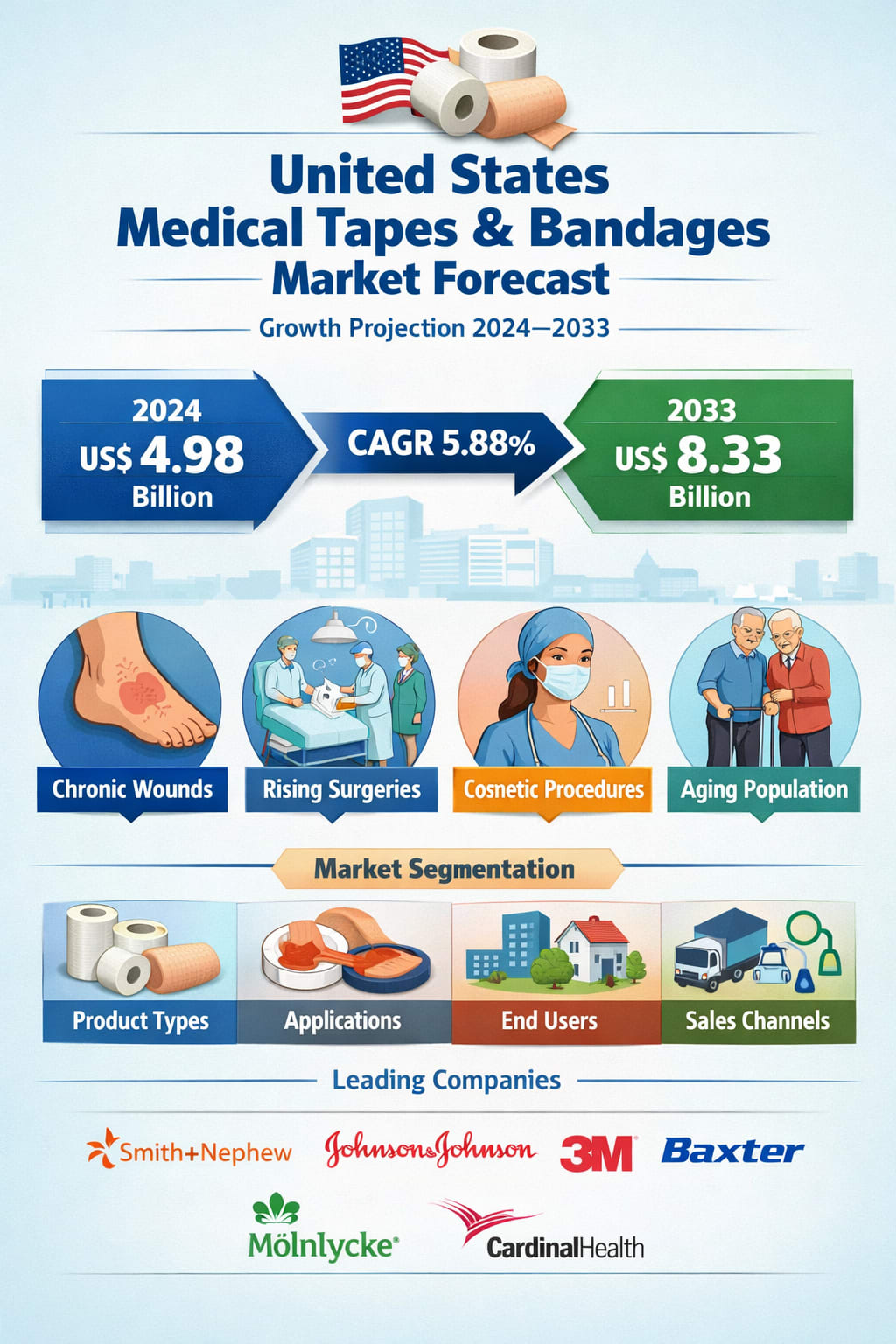
According to Renub Research, the United States Medical Tapes and Bandages Market is expected to reach US$ 8.33 billion by 2033, up from US$ 4.98 billion in 2024, growing at a CAGR of 5.88% from 2025 to 2033. This steady expansion reflects more than just rising consumption—it signals a broader transformation in how wounds are treated, monitored, and managed across hospitals, clinics, and home care settings.
The market is being propelled by the growing prevalence of wound infections, rising patient safety concerns, and the increasing burden of diabetic foot ulcers and pressure ulcers. Together, these factors are reshaping demand for more advanced, more comfortable, and more effective wound care solutions.
Market Overview: A Sector Built on Clinical Necessity
The U.S. medical tapes and bandages market is expanding steadily due to the rising need for wound care products across hospitals, clinics, ambulatory surgical centers, and home healthcare environments. The growing incidence of chronic illnesses, an increase in surgical procedures, and a higher rate of sports-related and traumatic injuries are all contributing to stronger demand for reliable wound management solutions.
What makes today’s market different from the past is innovation in product design. Modern medical tapes and bandages now include antibacterial coatings, waterproof layers, breathable materials, and hypoallergenic adhesives, all aimed at improving patient comfort while reducing the risk of complications. These advancements are particularly important for patients who require long-term wound care, such as the elderly or those living with chronic diseases.
Hospitals continue to represent the largest end-user segment, largely due to high patient volumes and the need for post-surgical wound management. However, home healthcare is emerging as a fast-growing segment, driven by the desire for convenient, personalized, and cost-effective treatment options. As more patients recover at home after surgeries or manage chronic wounds outside clinical settings, demand for easy-to-use, high-performance tapes and bandages is rising.
The Growing Burden of Chronic Wounds
One of the most powerful drivers of this market is the increasing prevalence of chronic wounds in the United States. A May 2023 article from Southwestern Medical Center highlighted that older Americans account for nearly 85% of all chronic wound cases, with estimates suggesting that 8.2 million people aged 65 and above are likely to develop a chronic wound.
Diabetic foot ulcers are a particularly serious concern. According to research released by the American Medical Association in November 2023, around 34% of people with diabetes will develop a foot ulcer at some point in their lives, and approximately 1.6 million Americans are affected each year. Another report from Trios Health in October 2023 estimated that nearly 2.0 million Americans develop diabetic foot ulcers annually.
These wounds are not only difficult to heal but also expensive to treat and potentially life-threatening if infections occur. As a result, healthcare providers increasingly rely on specialized medical tapes, advanced bandages, and modern dressings—including hydrocolloid and antimicrobial products—to improve healing outcomes and reduce complications.
Surgical Volume: A Major Demand Engine
The rising number of surgical procedures performed across the United States is another major force driving the market. According to data released by the American College of Rheumatology in February 2024, the U.S. performs approximately 544,000 hip replacements and 790,000 total knee replacements every year. Each of these procedures requires extensive post-operative wound care, including the use of surgical tapes and specialized bandages.
Beyond orthopedic surgery, growth in general surgery, cardiovascular procedures, and minimally invasive interventions continues to add to demand. Medical tapes are essential for securing dressings, closing wounds, and stabilizing medical devices, while bandages are critical for protecting surgical sites and promoting healing.
As surgical techniques evolve and patient expectations rise, healthcare providers are increasingly choosing high-performance, skin-friendly, and infection-resistant products, further boosting the value of the market.
Cosmetic and Reconstructive Surgery: A Fast-Growing Niche
Another important growth driver is the rise in cosmetic and reconstructive procedures. Statistics released by Discovery ABA in February 2024 show that about 26.2 million surgical and minimally invasive cosmetic and reconstructive procedures were performed in the United States in 2022—a 19% increase compared to 2019.
In this segment, silicone medical tapes and advanced scar-management bandages are becoming increasingly popular. These products are designed not only to protect wounds but also to improve scar appearance and optimize healing outcomes. As cosmetic procedures become more mainstream, the demand for premium, specialized wound care products is expected to continue rising.
Key Growth Drivers
1. Rising Incidence of Chronic Wounds
Chronic wounds such as diabetic foot ulcers, venous leg ulcers, and pressure ulcers are becoming more common due to the growing prevalence of diabetes, obesity, and cardiovascular disease. These conditions often require long-term, specialized wound care, creating sustained demand for medical tapes and bandages. Healthcare providers are under increasing pressure to adopt products that promote faster healing, prevent infection, and reduce hospital stays.
2. Advancements in Wound Care Technology
Technological innovation is transforming the wound care landscape. Manufacturers are introducing hypoallergenic adhesives, antimicrobial dressings, waterproof bandages, and breathable materials that enhance comfort and clinical performance. Some next-generation products even incorporate smart technologies capable of monitoring wound conditions in real time. These advancements are encouraging wider adoption across hospitals, clinics, and home care settings.
3. Increasing Aging Population
The aging U.S. population is another major driver. Older adults are more susceptible to skin tears, pressure ulcers, surgical wounds, and slow-healing injuries. They also undergo a higher number of surgical procedures, further increasing the need for effective wound care solutions. As healthcare systems adapt to this demographic shift, demand for senior-friendly, skin-safe, and easy-to-use tapes and bandages is expected to rise steadily.
Challenges Facing the Market
Skin Irritation and Allergic Reactions
Despite technological improvements, skin irritation and allergic reactions remain significant challenges. Many patients—especially the elderly and those with sensitive skin—experience adverse reactions to adhesives used in medical tapes and bandages. While hypoallergenic alternatives exist, they are often more expensive and not always widely available, particularly in budget-constrained healthcare settings. These issues can slow healing, reduce patient comfort, and increase the risk of secondary complications.
Pricing Pressure and Reimbursement Issues
The market also faces pricing and reimbursement challenges. Hospitals and clinics often operate under tight budgets, making it difficult to adopt premium wound care products even when they offer better outcomes. Reimbursement policies for advanced tapes and bandages can be inconsistent or insufficient, discouraging healthcare providers from switching to newer technologies. This creates a delicate balance for manufacturers between innovation and affordability.
Recent Developments Shaping the Industry
The industry has seen several notable developments that highlight its innovative direction:
October 2024: Mölnlycke Health Care AB partnered with Transdiagen (TDG), a precision medicine company focused on tissue regeneration and chronic wound healing. The collaboration aims to use TDG’s wound gene signatures to better understand and enhance Mölnlycke’s wound care products.
September 2024: Solventum (3M) introduced the V.A.C. Peel and Place Dressing, a next-generation negative pressure wound therapy dressing that can be applied in under two minutes and worn for up to seven days. Its all-in-one design simplifies application and reduces patient discomfort during removal.
June 2024: Researchers from Caltech and the USC Keck School of Medicine announced progress on smart bandages capable of detecting changes in wound conditions and delivering real-time treatment. These innovations point toward a future where wound care becomes more responsive, data-driven, and personalized.
Market Segmentation Overview
By Product:
Medical Tapes
Medical Bandages
By Application:
Surgical Wound
Burn Injury
Sports Injury
Traumatic Wound
Other Applications
By End Use:
Hospitals
Ambulatory Surgery Centers
Clinics
Others
By Sales Channel:
Distributors
Group Purchasing Organizations
Integrated Delivery Networks
Competitive Landscape
The U.S. medical tapes and bandages market is highly competitive, with key players focusing on product innovation, strategic partnerships, and portfolio expansion. Major companies analyzed from four viewpoints—Overview, Key Persons, Recent Developments & Strategies, and Revenue Analysis—include:
Smith & Nephew plc
Johnson & Johnson
Baxter International Inc.
3M
DuPont de Nemours, Inc.
Cardinal Health Inc.
Mölnlycke Health Care AB
McKesson Medical-Surgical Inc.
These companies are investing heavily in R&D, advanced materials, and smarter wound care solutions to differentiate themselves in a crowded market.
Final Thoughts: A Market Built on Care, Comfort, and Innovation
The United States Medical Tapes and Bandages Market is no longer just about basic wound coverage—it is about improving healing outcomes, enhancing patient comfort, and reducing healthcare costs through smarter products. With the market projected to grow from US$ 4.98 billion in 2024 to US$ 8.33 billion by 2033, the sector is set for a decade of steady, innovation-driven expansion.
Rising chronic disease rates, an aging population, increasing surgical volumes, and rapid technological advancements will continue to reshape the landscape. While challenges such as skin sensitivity and reimbursement pressures remain, the overall direction is clear: wound care is becoming more advanced, more personalized, and more essential than ever before.
About the Creator
Sakshi Sharma
Content Writer with 7+ years of experience crafting SEO-driven blogs, web copy & research reports. Skilled in creating engaging, audience-focused content across diverse industries.
Keep reading
More stories from Sakshi Sharma and writers in Trader and other communities.
Prostate Cancer Biomarkers Market Size and Forecast 2025–2033
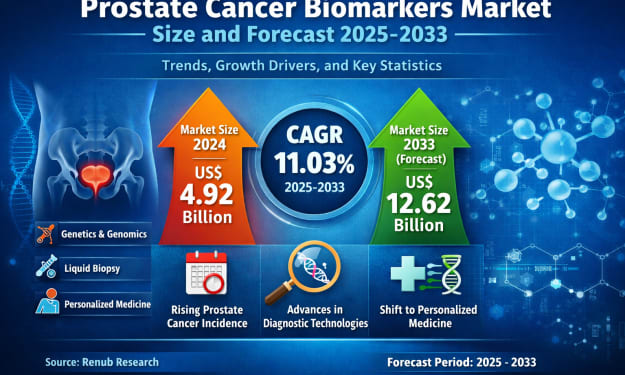
Global Prostate Cancer Biomarkers Market Overview The global healthcare industry is witnessing a profound transformation as precision medicine moves from promise to practice, and few areas illustrate this shift better than the prostate cancer biomarkers market. According to Renub Research, the Prostate Cancer Biomarkers Market is expected to reach US$ 12.62 billion by 2033, up from US$ 4.92 billion in 2024, growing at a robust CAGR of 11.03% from 2025 to 2033. This impressive expansion reflects not only the rising burden of prostate cancer worldwide, but also a fundamental change in how the disease is detected, classified, and treated.
By Sakshi Sharma2 days ago in Trader
Mexico Wearable Medical Devices Industry: Key Drivers and Growth Rate | CAGR 18.20%
Overview Report- Wearable medical devices are electronic health-monitoring tools worn on the body to track vital parameters such as heart rate, blood glucose, oxygen levels, sleep patterns, and physical activity. In Mexico, the growing burden of chronic diseases such as diabetes, cardiovascular disorders, and obesity is driving demand for continuous monitoring solutions.
By Ashutosh Srivastava2 days ago in Trader


Comments
There are no comments for this story
Be the first to respond and start the conversation.