
Prostate Cancer Biomarkers Market Size and Forecast 2025–2033
How Precision Diagnostics and Personalized Medicine Are Reshaping Global Prostate Cancer Care

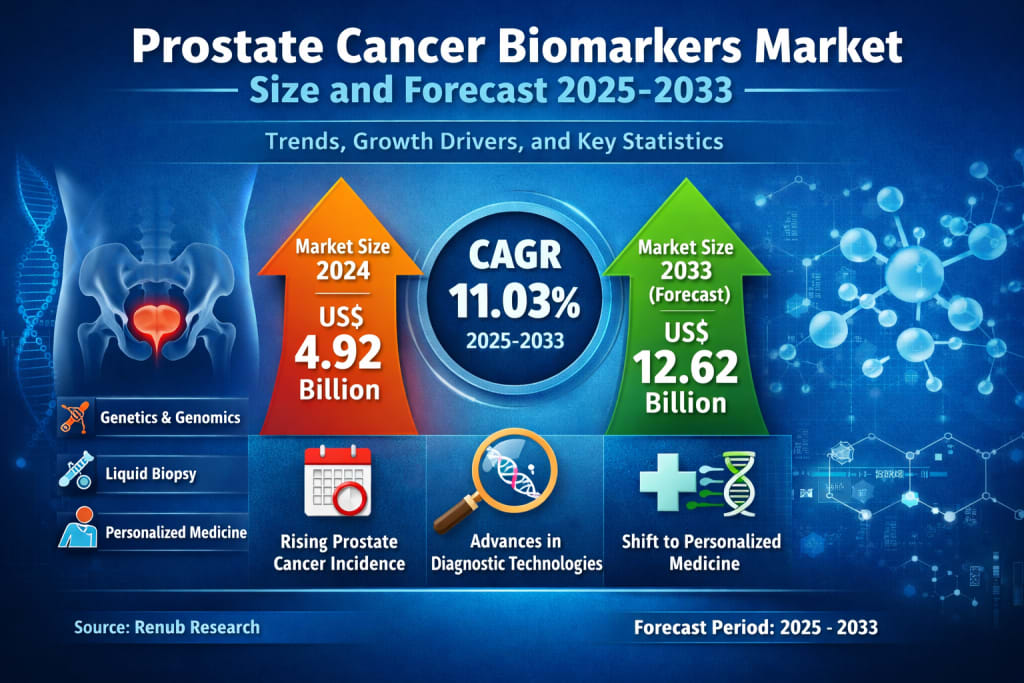
Global Prostate Cancer Biomarkers Market Overview
The global healthcare industry is witnessing a profound transformation as precision medicine moves from promise to practice, and few areas illustrate this shift better than the prostate cancer biomarkers market. According to Renub Research, the Prostate Cancer Biomarkers Market is expected to reach US$ 12.62 billion by 2033, up from US$ 4.92 billion in 2024, growing at a robust CAGR of 11.03% from 2025 to 2033. This impressive expansion reflects not only the rising burden of prostate cancer worldwide, but also a fundamental change in how the disease is detected, classified, and treated.
Prostate cancer remains one of the most commonly diagnosed cancers among men, particularly in aging populations. Traditionally, diagnosis and monitoring relied heavily on prostate-specific antigen (PSA) testing and tissue biopsies. While these methods remain important, they are increasingly complemented—and in some cases challenged—by a new generation of biomarkers that promise greater accuracy, earlier detection, and more personalized treatment strategies.
Prostate cancer biomarkers include genetic markers, cell-based biomarkers, and metabolomic indicators that help clinicians identify high-risk patients, predict disease progression, and monitor treatment response. These tools are becoming indispensable in modern oncology, where the goal is not only to treat cancer, but to treat the right patient with the right therapy at the right time. As healthcare systems worldwide place greater emphasis on outcomes, efficiency, and patient quality of life, biomarker-driven diagnostics are steadily moving from specialized research settings into routine clinical practice.
The market’s growth is also being fueled by the increasing adoption of non-invasive or minimally invasive testing approaches, such as liquid biopsies, which analyze tumor-derived material from blood samples. Compared to traditional tissue biopsies, these methods offer faster turnaround times, lower patient risk, and the ability to track disease evolution in real time. Combined with advances in next-generation sequencing (NGS) and artificial intelligence (AI)-powered data analysis, the prostate cancer biomarkers landscape is entering a new era of precision and scalability.
Market Size and Growth Outlook (Renub Research)
Renub Research estimates highlight just how dynamic this market has become. With revenues projected to climb from US$ 4.92 billion in 2024 to US$ 12.62 billion by 2033, the sector is on track to more than double in size within a decade. A CAGR of 11.03% signals sustained investment, strong clinical adoption, and growing confidence among healthcare providers in biomarker-based decision-making.
Several structural factors underpin this growth. First is the rising global prevalence of prostate cancer, driven largely by aging populations and improved screening coverage. Second is the shift toward personalized medicine, which relies heavily on biomarkers to stratify patients and guide therapy choices. Third is the rapid pace of technological innovation in genomics, proteomics, and data analytics, which is continuously expanding the range and reliability of available biomarkers.
Taken together, these forces are transforming prostate cancer care from a largely one-size-fits-all approach into a more nuanced, data-driven discipline—one where biomarkers sit at the center of diagnosis, prognosis, and treatment planning.
Key Growth Drivers Shaping the Market
Rising Incidence of Prostate Cancer
The increasing global burden of prostate cancer is one of the most powerful drivers of demand for advanced diagnostic tools. In many countries, prostate cancer is among the top cancers affecting men, particularly those over the age of 60. As life expectancy rises and screening programs expand, more cases are being detected—often at earlier stages of the disease.
Early detection is critical because prostate cancer can remain asymptomatic for long periods before progressing to more aggressive forms. Biomarkers play a crucial role here by helping clinicians identify which patients are at higher risk and which tumors are likely to behave more aggressively. This allows for more informed decisions about whether to pursue active surveillance, surgery, radiation, or systemic therapies. As the patient pool continues to grow, so too does the need for reliable, scalable biomarker solutions.
Advancements in Diagnostic Technologies
Technological progress is fundamentally reshaping the prostate cancer biomarkers market. Next-generation sequencing (NGS) has made it possible to analyze genetic alterations associated with prostate cancer at unprecedented speed and depth. This has opened the door to multi-gene panels and comprehensive molecular profiling that can guide both diagnosis and treatment selection.
At the same time, liquid biopsy technologies are gaining momentum as a less invasive alternative to tissue biopsies. By detecting circulating tumor DNA, RNA, or cells in the bloodstream, these tests enable clinicians to monitor disease progression and treatment response over time without repeated surgical procedures. Molecular imaging techniques further enhance clinicians’ ability to visualize tumor spread and assess treatment effectiveness.
Together, these innovations are not only improving diagnostic accuracy but also reducing patient burden and enabling more dynamic, real-time disease management—key factors driving widespread adoption of biomarker-based approaches.
Shift Toward Personalized Medicine
Personalized medicine has moved from a conceptual ideal to a practical reality in oncology, and prostate cancer is no exception. Biomarkers are central to this transformation because they help identify which patients are most likely to benefit from specific therapies and which are at risk of adverse effects or treatment resistance.
By analyzing genetic mutations, protein expression patterns, and other molecular signals, clinicians can classify prostate cancer into more precise subtypes. This stratification supports the selection of targeted therapies, immunotherapies, or hormone-based treatments tailored to each patient’s unique disease profile. The result is a more efficient use of healthcare resources, fewer unnecessary treatments, and better overall outcomes—benefits that continue to drive investment and adoption across the market.
Challenges Facing the Prostate Cancer Biomarkers Market
Regulatory and Approval Barriers
Despite strong growth prospects, the prostate cancer biomarkers market faces significant regulatory hurdles. New biomarkers must undergo rigorous clinical validation to demonstrate safety, accuracy, and clinical utility before receiving approval from regulatory bodies such as the U.S. Food and Drug Administration (FDA) or European authorities. This process can be lengthy, complex, and costly, often delaying patient access to promising new diagnostic tools.
Moreover, regulatory requirements vary across regions, complicating global commercialization strategies for biomarker developers. Smaller companies, in particular, may struggle to navigate these pathways, potentially slowing the pace of innovation and limiting market diversity.
High Development Costs
Developing, validating, and commercializing new biomarkers requires substantial investment in research, clinical trials, and specialized infrastructure. The costs associated with advanced genomic technologies, data analysis platforms, and large-scale validation studies can be prohibitive—especially for startups and smaller biotechnology firms.
These high barriers to entry can reduce competition and concentrate market power among larger players with deeper financial resources. They can also impact pricing, potentially limiting access to advanced biomarker tests in cost-sensitive healthcare systems or emerging markets.
Regional Market Perspectives
United States Prostate Cancer Biomarkers Market
The United States represents one of the most dynamic and influential markets for prostate cancer biomarkers. High disease prevalence, strong research funding, and rapid adoption of advanced diagnostic technologies all contribute to robust market growth. The U.S. healthcare system has been at the forefront of integrating NGS, liquid biopsies, and AI-driven analytics into clinical practice, particularly in oncology.
The country’s strong focus on personalized medicine further accelerates biomarker adoption, as clinicians increasingly rely on molecular data to guide treatment decisions. Combined with a supportive innovation ecosystem and active participation from leading diagnostics and biotechnology companies, the U.S. market is expected to remain a key growth engine throughout the forecast period.
Germany Prostate Cancer Biomarkers Market
Germany’s prostate cancer biomarkers market benefits from a well-developed healthcare infrastructure and a strong emphasis on early detection and precision diagnostics. The country has been proactive in adopting advanced screening and molecular testing technologies, supported by a robust network of academic and research institutions.
The growing focus on personalized treatment strategies is further driving demand for biomarker-based diagnostics. As awareness of the clinical and economic benefits of targeted therapies increases, Germany is likely to see continued expansion in the use of sophisticated biomarker tests across both hospital and outpatient settings.
India Prostate Cancer Biomarkers Market
In India, the prostate cancer biomarkers market is gaining momentum as awareness of prostate health increases and healthcare infrastructure continues to improve. While historically underdiagnosed, prostate cancer is now being detected more frequently due to better screening and diagnostic capabilities.
The adoption of technologies such as NGS and liquid biopsy is helping bridge gaps in diagnostic accuracy and enabling more effective, less invasive monitoring of treatment outcomes. Government initiatives aimed at strengthening healthcare access and promoting advanced diagnostics are expected to further support market growth in the coming years.
Saudi Arabia Prostate Cancer Biomarkers Market
Saudi Arabia’s market is expanding steadily, driven by rising prostate cancer incidence and increased investment in modern healthcare infrastructure. The country has been actively working to enhance access to advanced diagnostic technologies, including molecular testing platforms.
As personalized medicine gains traction in the region, biomarkers are playing a growing role in tailoring treatment strategies and improving patient outcomes. Continued healthcare modernization efforts are likely to create a supportive environment for further market development.
Recent Developments in the Prostate Cancer Biomarkers Industry
The industry has seen a wave of strategic partnerships and technology-driven innovations aimed at improving diagnostic accuracy and clinical utility.
In February 2025, Myriad Genetics and PATHOMIQ announced an exclusive U.S. licensing agreement for the AI-driven prostate cancer platform PATHOMIQ_PRAD. This collaboration integrates AI-enabled diagnostics into Myriad’s oncology portfolio, enhancing decision-making before and during treatment and reflecting the growing role of artificial intelligence in biomarker analysis.
Earlier, in February 2024, DiaCarta and OncoAssure Ltd. entered a strategic partnership to commercialize a six-gene expression test designed to assess the risk of aggressive disease and predict biochemical recurrence within five years after surgery. This test supports more precise risk stratification and reinforces the trend toward biomarker-driven, personalized treatment pathways.
Additionally, in January 2025, OncoAssure Ltd. announced the clinical validation of OncoAssure Prostate, a biopsy-based test aimed at improving risk assessment for prostate cancer recurrence. Published in BJUI Compass, the study demonstrated the test’s ability to differentiate between aggressive and low-risk tumors, underscoring the clinical value of advanced biomarker solutions.
Prostate Cancer Biomarkers Market Segmentation
By Type:
Genetic Biomarker
Cell-based Biomarkers
Metabolomic Biomarkers
By Application:
Screening and Early Detection
Diagnostic and Risk Stratification
Prognosis and Treatment Monitoring
Companion Diagnostics
By End Use:
Hospitals & Diagnostic Laboratories
Academic & Research Institutes
Biopharmaceutical Companies
By Country/Region:
North America: United States, Canada
Europe: France, Germany, Italy, Spain, United Kingdom, Belgium, Netherlands, Turkey
Asia Pacific: China, Japan, India, Australia, South Korea, Thailand, Malaysia, Indonesia, New Zealand
Latin America: Brazil, Mexico, Argentina
Middle East & Africa: South Africa, Saudi Arabia, United Arab Emirates
Competitive Landscape and Key Companies
The global prostate cancer biomarkers market features a mix of established diagnostics leaders and innovative biotechnology firms. Key players include:
Exact Sciences Corp
Myriad Genetics Inc
BIO-TECHNE Corp
OPKO Health, Inc.
MDxHealth SA
Veracyte Inc
Roche Diagnostic Ltd.
Pfizer Inc.
These companies compete across multiple dimensions, including test accuracy, clinical validation, technology platforms, and strategic partnerships. Their activities—ranging from AI integration to multi-gene panel development—are shaping the future direction of the market.
Final Thoughts
The prostate cancer biomarkers market is entering a decisive growth phase, driven by rising disease prevalence, rapid technological innovation, and the global shift toward personalized medicine. With Renub Research projecting the market to grow from US$ 4.92 billion in 2024 to US$ 12.62 billion by 2033 at a CAGR of 11.03%, the sector is poised to become an even more central pillar of modern oncology care.
While challenges such as regulatory complexity and high development costs remain, the clinical and economic benefits of biomarker-driven diagnostics are becoming increasingly clear. As healthcare systems worldwide strive for earlier detection, more precise risk stratification, and better treatment outcomes, prostate cancer biomarkers will continue to play a critical—and expanding—role in shaping the future of cancer care.
About the Creator
Sakshi Sharma
Content Writer with 7+ years of experience crafting SEO-driven blogs, web copy & research reports. Skilled in creating engaging, audience-focused content across diverse industries.
Keep reading
More stories from Sakshi Sharma and writers in Trader and other communities.
Asia Pacific Non-Lethal Weapons Market Trends & Summary
Introduction: A Region Rethinking the Use of Force Across the Asia Pacific region, the conversation around public safety, law enforcement, and internal security is changing. Governments are under growing pressure to manage civil unrest, protests, and large public gatherings while minimizing casualties and long-term harm. This shift has brought non-lethal weapons into sharper focus as a practical and politically acceptable alternative to conventional firearms.
By Sakshi Sharmaa day ago in Trader
Lloyds Bank Closures 2026: How to Stay Ahead if Your Branch Is Closing
lloyds bank closures 2026 are affecting customers across the UK. Many people worry about losing access to their local branch, especially those who prefer in-person banking. Branch closures impact daily routines, small businesses, and communities that rely on face-to-face support. This article explains why lloyds bank closures 2026 are happening, which areas are most at risk, and steps you can take to stay prepared and maintain easy access to banking services.
By John.doe7985 days ago in Trader
McDonald’s Stock Analysis: Can McDonald’s Sustain Growth in the Global Fast-Food Industry?
Introduction McDonald’s stock has long been considered a stable and growth-oriented investment in the consumer sector. McDonald’s Corporation operates one of the largest global restaurant networks, serving millions of customers daily. With a recognizable brand, a franchising model, and innovative menu strategies, McDonald’s remains a dominant player in the fast-food industry. For investors, McDonald’s stock provides exposure to both steady cash flows and global growth potential.
By Hammad Nawaza day ago in Trader



Comments
There are no comments for this story
Be the first to respond and start the conversation.