
United States Hydroponics Market Trends & Summary (2025–2033)
How Soilless Farming Is Reshaping America’s Food Future

Introduction: A New Era of Farming Without Soil
The United States hydroponics market is entering a transformative phase as agriculture adapts to climate uncertainty, urbanization, and rising food security concerns. Hydroponics—an advanced method of growing plants without soil using nutrient-rich water solutions—has shifted from being a niche innovation to a mainstream agricultural solution.
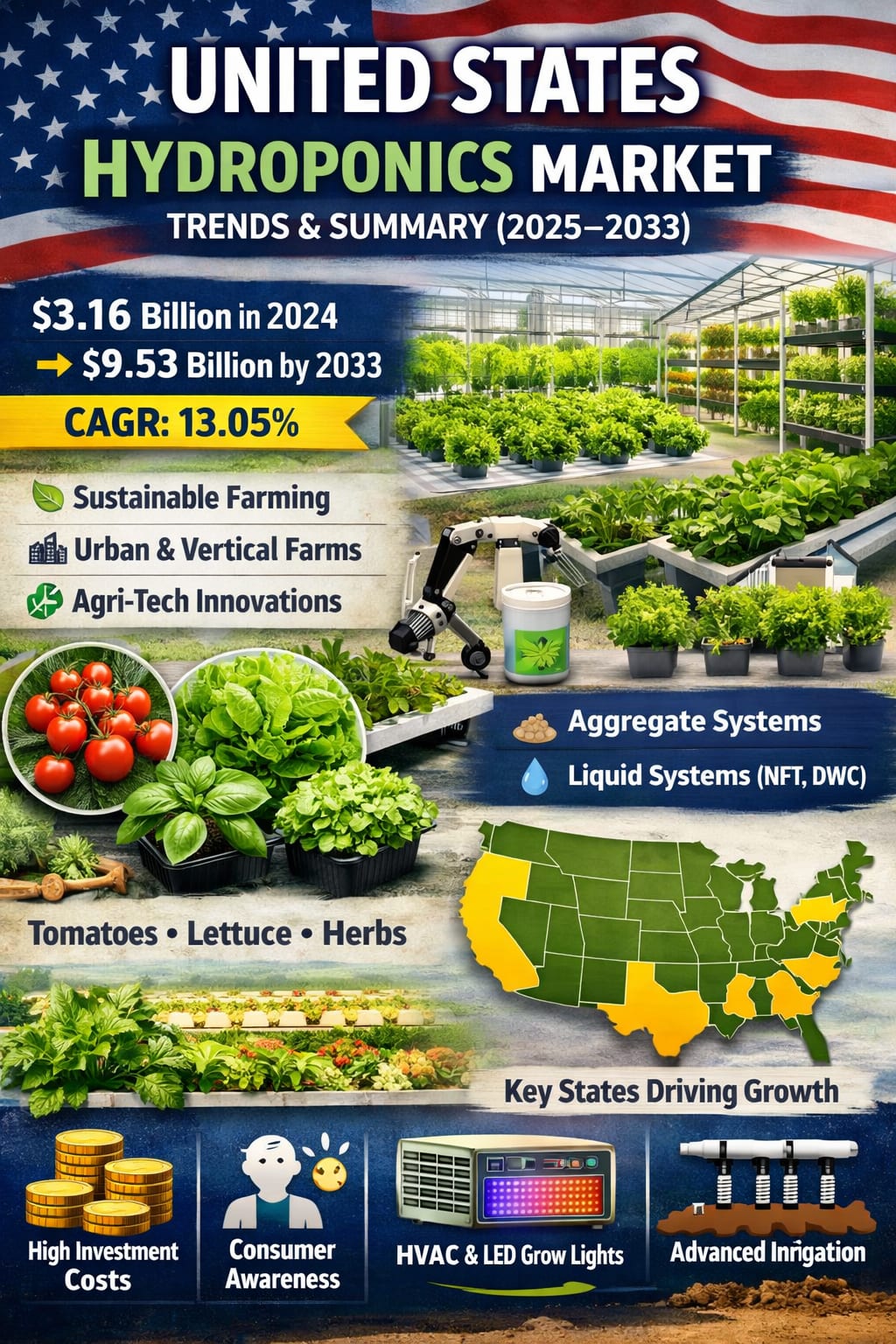
According to Renub Research, the United States Hydroponics Market accounted for USD 3.16 billion in 2024 and is expected to reach USD 9.53 billion by 2033, expanding at a robust CAGR of 13.05% from 2025 to 2033. This impressive growth reflects the increasing demand for sustainable farming practices, the expansion of controlled environment agriculture, and the need for efficient, resource-saving food production systems.
From high-tech vertical farms in urban centers to large commercial greenhouses in agricultural states, hydroponics is steadily redefining how food is grown, distributed, and consumed across the country.
Understanding Hydroponics: Farming Beyond Traditional Limits
Hydroponics is a method of cultivating plants using water-based, nutrient-rich solutions instead of soil. In these systems, plant roots receive essential minerals directly, enabling faster growth, higher yields, and more efficient use of resources. Popular techniques include Nutrient Film Technique (NFT), Deep Water Culture (DWC), and aeroponics, each designed to optimize nutrient delivery and oxygen exposure.
One of the biggest advantages of hydroponics is its ability to function in controlled environments. This makes it ideal for urban farming, vertical farms, and commercial greenhouses where space, water, and climate conditions can be carefully managed. Crops such as leafy greens, tomatoes, cucumbers, and herbs thrive in these systems, often with better consistency and quality than traditional field-grown produce.
In the United States, hydroponics is increasingly seen not just as an alternative farming method, but as a strategic solution to land scarcity, water stress, and the growing demand for fresh, locally produced food.
Market Outlook: Why the U.S. Hydroponics Sector Is Accelerating
The rapid growth of the U.S. hydroponics market is closely linked to shifting consumer preferences and structural changes in agriculture. As urban populations grow and arable land becomes more limited, hydroponic farming offers a scalable and efficient way to produce food closer to consumers.
Moreover, the rise of health-conscious eating habits and demand for pesticide-free produce has strengthened the appeal of hydroponically grown crops. Supermarkets, restaurants, and food service companies are increasingly sourcing produce from controlled environment farms to ensure consistent quality and year-round supply.
Government initiatives and private investments are also playing a critical role. The U.S. Department of Agriculture has expanded support for conservation, sustainable agriculture, and regional food systems, creating a favorable environment for advanced farming technologies, including hydroponics and vertical farming.
Key Growth Drivers of the United States Hydroponics Market
1. Rising Demand for Sustainable Agriculture
Sustainability has become a central theme in modern agriculture, and hydroponics fits perfectly into this narrative. Traditional farming consumes large amounts of water and often depends heavily on chemical pesticides and fertilizers. In contrast, hydroponic systems use significantly less water, reduce chemical usage, and minimize land requirements while delivering higher yields.
With climate change affecting crop productivity and weather patterns becoming increasingly unpredictable, hydroponics offers a reliable, year-round production model. It also aligns with broader sustainability goals set by government bodies and private corporations focused on reducing environmental impact and building resilient food supply chains.
2. Growth of Urban and Vertical Farming
Urbanization continues to reduce the availability of traditional farmland, especially near major population centers. Hydroponics has emerged as a practical solution for urban agriculture, enabling food production in warehouses, rooftops, and vertical farming facilities.
Vertical farms using hydroponic systems are becoming increasingly common in cities, helping shorten supply chains and reduce transportation costs. These farms provide fresh, locally grown produce while using minimal space and resources. Public and private investments in regional agricultural development programs are further accelerating this trend, strengthening the commercial potential of hydroponic farming across the U.S.
3. Technological Advancements in Hydroponic Systems
The U.S. is a global leader in agricultural technology, and innovation is a major catalyst for hydroponics market growth. The integration of automation, artificial intelligence, IoT sensors, and smart monitoring systems has significantly improved efficiency in nutrient delivery, lighting, temperature control, and humidity management.
These technologies reduce labor costs, increase consistency, and enhance overall productivity, making large-scale hydroponic operations more commercially viable. Partnerships between agri-tech startups and established hydroponic system providers are further accelerating the development of all-in-one farm optimization platforms, helping growers overcome operational challenges and scale faster.
Challenges Facing the U.S. Hydroponics Market
High Initial Investment Costs
Despite its long-term benefits, hydroponic farming requires substantial upfront investment. The cost of advanced infrastructure—including LED grow lights, climate control systems, nutrient delivery equipment, and automation technologies—can be prohibitive, especially for small and medium-sized farmers.
While operational savings in water, pesticides, and land use can offset these costs over time, access to capital remains a major barrier to wider adoption. Without sufficient financial support or incentives, many potential growers may hesitate to enter the market.
Limited Consumer Awareness and Market Penetration
Although hydroponics is gaining traction, a significant portion of consumers still prefer traditionally grown or organic produce. Hydroponically grown crops are sometimes perceived as more expensive or less “natural,” even though they are often cleaner, safer, and more resource-efficient.
Educating consumers about the benefits of hydroponic produce—such as reduced pesticide use, consistent quality, and environmental sustainability—will be crucial for expanding market acceptance and driving long-term demand.
Market Segmentation Insights
By Type: Aggregate Systems vs. Liquid Systems
Aggregate systems, which use media such as perlite, coconut coir, and rock wool, are widely adopted due to their stability, ease of use, and versatility. These systems provide strong root support while allowing efficient nutrient absorption, making them popular in commercial greenhouses and vertical farms.
Liquid systems, including NFT and DWC, circulate nutrient-rich water directly around plant roots. These systems are highly space-efficient and particularly well-suited for urban and commercial-scale operations. With the addition of advanced automation and monitoring tools, liquid hydroponic systems are becoming increasingly attractive for high-output farming.
By Crop Type: Tomatoes, Herbs, and Leafy Greens Lead the Way
Tomatoes are among the most widely cultivated hydroponic crops in the U.S., benefiting from controlled environments that enable year-round production, higher yields, and improved quality. Hydroponically grown tomatoes also have longer shelf life and fewer soil-borne disease issues.
Herbs such as basil, mint, and cilantro are another major segment, driven by strong demand from restaurants, supermarkets, and health-conscious consumers. Their short growth cycles and high market value make them ideal for hydroponic cultivation.
Other important crops include lettuce, cucumbers, peppers, and a range of specialty greens, all of which benefit from the consistency and efficiency of controlled environment agriculture.
By Equipment: The Role of HVAC, Lighting, and Irrigation
HVAC systems are essential for maintaining optimal temperature and humidity levels, directly impacting crop quality and yield. Modern, energy-efficient HVAC solutions integrated with IoT technology are helping farms reduce operating costs while improving productivity.
LED grow lights have revolutionized indoor farming by providing energy-efficient, spectrum-optimized lighting tailored to different crop needs.
Irrigation systems, including drip irrigation and aeroponics, ensure precise water and nutrient delivery, minimizing waste and maximizing efficiency.
Control systems and material handling equipment further enhance automation, scalability, and operational consistency in large hydroponic facilities.
Regional Landscape: Key States Driving Growth
California
California remains a major hub for hydroponic farming due to its massive agricultural industry and chronic water scarcity. Hydroponics offers a water-efficient alternative for growing high-value crops such as leafy greens, strawberries, and tomatoes, making it an increasingly attractive option for the state’s farmers.
New York
New York’s dense urban environment has fueled the rise of rooftop farms and vertical farming projects. The strong demand for locally grown, pesticide-free produce and the popularity of farm-to-table dining have made hydroponics a vital part of the state’s urban food ecosystem.
Florida
Florida’s tourism-driven economy and subtropical climate support strong demand for fresh, locally grown produce. Hydroponic farming is also being adopted to mitigate climate-related risks such as hurricanes and soil degradation, with a focus on crops like tomatoes, lettuce, and strawberries.
Georgia
Georgia is emerging as an important player in the hydroponics market, supported by its strong agricultural base and growing adoption of indoor farming techniques. Both commercial-scale and urban hydroponic projects are contributing to the state’s sustainable agriculture efforts.
Competitive Landscape and Company Analysis
The U.S. hydroponics market features a mix of established players and innovative startups. Key companies profiled from multiple perspectives—overview, leadership, recent developments, product portfolios, and revenue—include:
AeroFarms
AmHydro
Freight Farms
Green Sense Farms Holdings, Inc.
LumiGrow
Unrivaled Brands Inc
BrightFarms
The Scotts Company LLC
Hydrodynamics International
Signify Holding
These companies are investing heavily in technology, automation, and scalable farming solutions, shaping the future of controlled environment agriculture in the United States.
Final Thoughts: Hydroponics as the Future of American Agriculture
The United States hydroponics market is no longer an experimental niche—it is rapidly becoming a cornerstone of modern, sustainable agriculture. With the market projected to grow from USD 3.16 billion in 2024 to USD 9.53 billion by 2033, the sector is set to play a critical role in addressing food security, resource efficiency, and urbanization challenges.
While high initial investment costs and limited consumer awareness remain obstacles, ongoing technological innovation, supportive policies, and shifting consumer preferences are steadily reshaping the landscape. As controlled environment agriculture continues to evolve, hydroponics is poised to become one of the most important tools in building a resilient, efficient, and sustainable food system for the United States.
About the Creator
Sanitary Napkin Market Insight, Size, Share, Growth & Trends
Overview – Global Sanitary Napkin Market The global sanitary napkin market refers to the industry involved in the production, distribution, and sale of menstrual hygiene products — primarily sanitary napkins or menstrual pads designed to absorb menstrual flow and ensure comfort and hygiene. These products are widely used by menstruating individuals across diverse demographic and geographic segments. Growth in this market is driven by increasing awareness of menstrual hygiene, rising disposable incomes, expanding retail and e-commerce channels, and ongoing product innovations such as ultra-thin, biodegradable, and organic variants.
By James Smith7 days ago in Trader
The Light Turns
It's Tuesday 7:13 a.m. A cold and clear November morning awaits Ray on his morning commute. Ray rubs his hands together in the front seat of his Subaru. He turns the air temperature up, but keeps the air on low until the air warms up. He looks at the backup camera screen and reverses the Subaru out of his driveway onto Trimble Road.
By John R. Godwin6 days ago in Fiction



Comments
There are no comments for this story
Be the first to respond and start the conversation.