
United States Communication Equipment Market Size and Forecast 2025
5G, Cloud, and IoT Drive the Next Growth Wave in America’s Communication Infrastructure

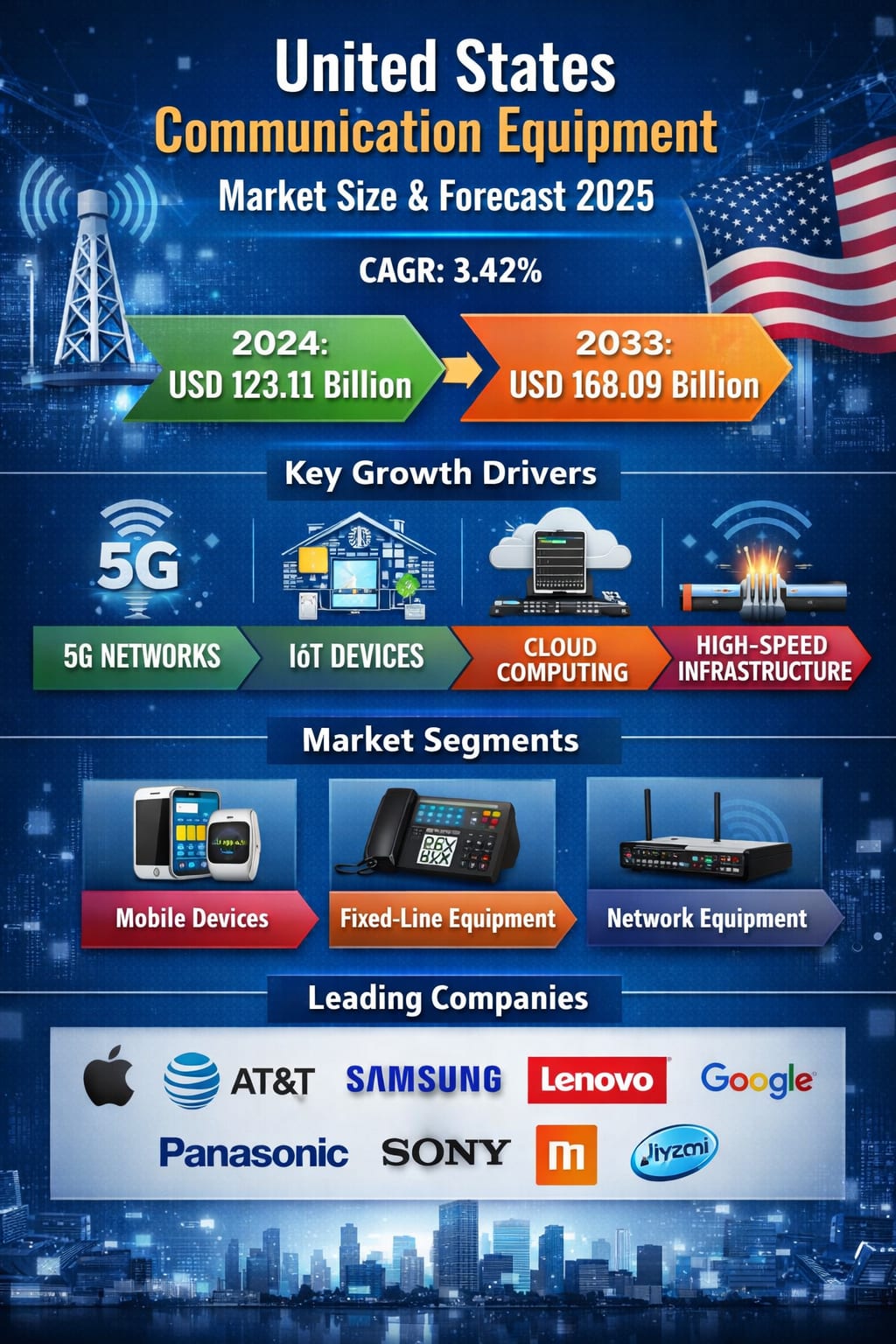
United States Communication Equipment Market Overview
The United States communication equipment market stands as one of the most critical pillars of the nation’s digital economy. Valued at US$ 123.11 billion in 2024, the market is projected to expand steadily at a CAGR of 3.42% from 2025 to 2033, reaching approximately US$ 168.09 billion by 2033. This growth is being driven by rapid advancements in 5G networks, cloud computing, Internet of Things (IoT) devices, and the ever-increasing demand for high-speed, reliable communication infrastructure across industries.
Communication equipment refers to a wide range of devices and systems that transmit, receive, and process voice, data, and video signals. These include telecommunications networks, fiber-optic systems, routers, switches, satellite communication equipment, smartphones, radios, and broadcasting tools. In today’s interconnected world, such equipment forms the backbone of modern business operations, public services, and everyday consumer life.
In the United States, communication equipment is extensively used across telecommunications, defense, healthcare, transportation, finance, education, and enterprise sectors. The accelerated rollout of 5G networks has significantly boosted demand for next-generation hardware, enabling faster internet speeds, lower latency, and more reliable connectivity. Businesses increasingly depend on advanced communication systems for video conferencing, remote work, cloud collaboration, and secure data transfer, while the healthcare sector leverages these technologies for telemedicine, remote monitoring, and emergency response systems.
The defense and government sectors also rely heavily on secure and encrypted communication networks to support national security and public safety operations. As technological innovation continues at a rapid pace, communication equipment remains a foundational element of productivity, economic growth, and digital transformation in the United States.
Growth Drivers in the United States Communication Equipment Market
1. 5G Network Expansion
The aggressive rollout of 5G technology is one of the most powerful growth engines for the U.S. communication equipment market. Telecom operators are making massive investments in fiber optics, small cells, base stations, and network upgrades to support ultra-fast data transmission and low-latency connectivity.
As consumer and enterprise demand for faster and more reliable internet continues to rise, organizations are upgrading both their infrastructure and end-user devices. 5G is not just about faster smartphones—it enables smart cities, autonomous vehicles, industrial automation, augmented reality, and massive IoT deployments, all of which require sophisticated communication hardware.
Government initiatives and private-sector funding are accelerating this transformation. For instance, in February 2025, Aduna, in collaboration with AT&T, T-Mobile, Verizon, and Ericsson, launched advanced network APIs for SIM Swap and Number Verification in the United States. This move is strengthening the mobile ecosystem by providing standardized, carrier-grade network capabilities to developers and enterprises, further boosting demand for advanced communication equipment.
2. Rising Demand for Cloud-Based Communication Solutions
Cloud-based communication is reshaping how organizations operate in the United States. The adoption of VoIP (Voice over Internet Protocol), cloud PBX systems, and unified communications platforms is accelerating as businesses move away from traditional, hardware-heavy systems.
The rise of hybrid and remote work models has made reliable digital communication infrastructure a necessity rather than a luxury. Companies are investing heavily in software-defined networking (SDN), cloud security, and scalable communication platforms to ensure seamless collaboration across distributed teams.
Cloud-based solutions offer clear advantages, including lower operational costs, better scalability, improved reliability, and easier integration with enterprise software. In January 2025, Granicus, a customer experience solutions provider for government, announced a major update to its service portfolio to better address the evolving needs of public institutions and communities—highlighting how cloud-driven communication platforms are becoming central to both public and private sector operations.
3. Growing Penetration of IoT and Smart Devices
The rapid expansion of the Internet of Things (IoT) ecosystem is another major driver of demand for advanced communication equipment. Smart homes, industrial automation systems, connected healthcare devices, and intelligent transportation networks all rely on high-speed, low-latency, and highly reliable communication networks.
In the consumer segment alone, the growth of smart homes is remarkable. According to Oberlo, the number of smart homes in the United States reached 69.91 million in 2024 and is expected to rise to 77.05 million in 2025, 84.92 million in 2026, and 93.59 million by 2027. Each of these connected environments depends on routers, gateways, sensors, and network equipment capable of handling massive data traffic securely and efficiently.
In industrial and enterprise settings, IoT is driving demand for edge computing platforms, high-performance networking gear, and robust wireless communication systems, ensuring real-time data processing and uninterrupted connectivity. This ongoing shift toward a connected ecosystem is set to fuel long-term growth in the communication equipment market.
Key Challenges in the U.S. Communication Equipment Market
1. High Infrastructure Costs
Building and maintaining modern communication infrastructure in the United States requires substantial capital investment. The deployment of 5G networks, expansion of fiber-optic connectivity, and development of satellite communication systems involve high costs related to network towers, data centers, spectrum licensing, and security systems.
These financial barriers make it difficult for small and medium-sized enterprises (SMEs) to compete with established telecom giants. Additionally, regulatory requirements and compliance costs further increase the overall investment burden, potentially slowing down infrastructure expansion in less profitable or rural regions.
2. Cybersecurity Threats and Data Privacy Concerns
As communication networks become more advanced and interconnected, cybersecurity risks grow in both scale and complexity. The widespread use of cloud communication platforms, IoT devices, and mobile networks has increased exposure to cyberattacks, data breaches, and network intrusions.
Hackers often target vulnerabilities in routers, wireless networks, and VoIP systems, which can result in service disruptions, financial losses, and reputational damage. To counter these threats, companies must invest in encryption technologies, AI-driven threat detection, zero-trust architectures, and multi-factor authentication systems.
Moreover, regulatory frameworks such as CCPA and other data protection laws impose strict compliance requirements, further increasing operational costs for communication equipment providers and service operators.
United States Mobile Communication Equipment Market
The U.S. mobile communication equipment market is experiencing strong growth, driven by rising demand for smartphones, tablets, mobile routers, and wireless accessories. The expansion of 5G networks has encouraged telecom providers to upgrade infrastructure, enabling faster, more secure, and more reliable mobile communication services.
Consumers and enterprises alike rely heavily on mobile communication for work, entertainment, e-commerce, digital payments, and remote collaboration. The continued popularity of AI-powered smartphones, foldable devices, and improved battery technologies is reshaping product innovation and boosting replacement cycles.
In March 2025, Telness Tech introduced its MVNO services for the T-Mobile network, enabling integration of its BSS/OSS platform with T-Mobile’s 5G infrastructure. This development is helping U.S. MVNOs deploy and scale their services more efficiently, further stimulating demand for mobile communication equipment.
United States Fixed-Line Communication Equipment Market
Despite the rapid rise of mobile technologies, the fixed-line communication equipment market remains highly relevant in the United States. Sectors such as government, healthcare, finance, and large enterprises continue to depend on landline telephony, PBX systems, and fiber-optic networks for secure, stable, and high-capacity communication.
Fixed-line networks offer advantages in terms of reliability, consistent performance, and enhanced data security, making them essential for mission-critical operations. The ongoing deployment of fiber-to-the-home (FTTH) and high-speed broadband services is further supporting demand in this segment.
Many companies are also modernizing their legacy fixed-line systems by integrating VoIP and cloud-based communication solutions, ensuring they remain competitive in an increasingly digital environment.
United States Mobile Communication Device Market
The U.S. mobile communication device market includes smartphones, tablets, smartwatches, and wearable communication devices. Consumer demand is increasingly shaped by expectations for faster connectivity, better cameras, AI-powered features, and seamless integration with digital ecosystems.
The widespread adoption of 5G smartphones has accelerated device upgrade cycles, while wearables such as smart earbuds and fitness bands are gaining popularity due to their health-tracking capabilities and hands-free convenience. In enterprise environments, demand is also rising for rugged and secure mobile devices designed for industrial, logistics, and field operations.
United States Network Communication Equipment Market
The network communication equipment segment includes routers, switches, fiber-optic equipment, modems, and Wi-Fi systems. Growth in this market is being fueled by rising demand for high-speed broadband, data centers, cloud computing, and enterprise networking solutions.
Organizations across industries require robust and scalable network infrastructure to support remote work, digital transformation initiatives, AI workloads, and edge computing applications. Innovations such as software-defined networking (SDN), AI-based network management, and automated security systems are reshaping how networks are designed and operated.
At the same time, enterprises are placing greater emphasis on cybersecurity, network resilience, and performance optimization, further driving investment in advanced networking equipment.
Regional Outlook of the U.S. Communication Equipment Market
West United States
The western United States, including California, Washington, and Nevada, serves as a global hub for technology and innovation. The presence of Silicon Valley drives strong demand for data centers, cloud infrastructure, advanced networking equipment, and high-speed broadband solutions. The entertainment, gaming, aerospace, and defense sectors further contribute to regional growth, while ongoing 5G and fiber deployments continue to expand connectivity.
East United States
The eastern U.S., home to major cities such as New York, Washington D.C., and Boston, is a key center for financial services, government operations, media, and enterprise communications. Demand is high for secure VoIP systems, cloud collaboration platforms, and encrypted communication networks, particularly in government and financial institutions that prioritize data security and compliance.
North United States
Northern states such as Illinois, Michigan, and Minnesota are seeing growing investment in industrial communication systems, IoT connectivity, and broadband expansion. Manufacturing, automotive, and logistics sectors rely heavily on advanced networks for automation, monitoring, and supply chain optimization, while rural broadband initiatives are helping extend connectivity to underserved areas.
United States Communication Equipment Market Segmentation
By Product:
Mobile
Fixed-line
By Type:
Mobile Communication Device
Optical Communication Equipment
Network Communication Equipment
By Region:
East
West
North
South
Company Analysis Covers:
Overview
Key Persons
Recent Developments
Revenue
Key Players:
Apple Inc.
LG Electronics
Lenovo
Xiaomi
AT&T Intellectual Property
Google Inc.
Panasonic Corporation
Sony Corporation
OnePlus
Final Thoughts
The United States communication equipment market is entering a new phase of steady, technology-driven expansion. With a projected rise from US$ 123.11 billion in 2024 to US$ 168.09 billion by 2033, the market reflects the nation’s growing reliance on 5G, cloud computing, IoT, and high-speed digital infrastructure.
While challenges such as high infrastructure costs and cybersecurity risks remain, continuous innovation, strong investment momentum, and supportive digital transformation initiatives are expected to keep the industry on a positive growth trajectory. As businesses, governments, and consumers demand faster, safer, and more reliable connectivity, communication equipment will remain a cornerstone of America’s digital future.
About the Creator
Sakshi Sharma
Content Writer with 7+ years of experience crafting SEO-driven blogs, web copy & research reports. Skilled in creating engaging, audience-focused content across diverse industries.
Keep reading
More stories from Sakshi Sharma and writers in Trader and other communities.
Asia Pacific Powder Dietary Supplements Market Size and Forecast 2025: A Region Powering the Future of Preventive Nutrition
Asia Pacific Powder Dietary Supplements Market: A Fast-Growing Wellness Powerhouse The Asia Pacific powder dietary supplements market is entering a golden era of growth, driven by rising health awareness, changing lifestyles, and a strong shift toward preventive healthcare. According to Renub Research, the market was valued at USD 8.89 billion in 2024 and is projected to surge to USD 27.81 billion by 2033, expanding at a robust CAGR of 13.53% during the forecast period from 2024 to 2033.
By Sakshi Sharmaa day ago in Trader
Are You Investing With Conviction - Or Mimicking Strangers on the Internet?
Let me ask you something uncomfortable. That ETF you bought - why did you buy it? That stock in your portfolio - can you explain the business model? The competitive advantage? Why it's worth what you paid?
By Destiny S. Harrisabout 5 hours ago in Trader



Comments
There are no comments for this story
Be the first to respond and start the conversation.