
Are You Investing With Conviction - Or Mimicking Strangers on the Internet?
The difference between building wealth and just having a portfolio.


Let me ask you something uncomfortable.
That ETF you bought - why did you buy it?
That stock in your portfolio - can you explain the business model? The competitive advantage? Why it's worth what you paid?
That allocation you're running - 60/40, or three-fund, or whatever it is - did you arrive at it through analysis? Or did someone on Reddit tell you it was the way?
If you're being honest, most of what's in your portfolio is there because someone else said it should be.
A YouTuber. A blogger. A Reddit thread. A coworker. A "Top 10 ETFs for 2024" article you skimmed.
You didn't research it. You didn't develop conviction. You just… copied.
And that's why your returns will be average at best.
The Mimicry Portfolio
Here's what a mimicry portfolio looks like:
VTI because "total market is the way"
VXUS because "you need international exposure"
BND because "bonds balance your risk"
A little SCHD because "dividends are passive income"
Maybe some QQQM because "tech is the future"
A random stock or two someone mentioned on a podcast
Ask the owner of this portfolio why they own any of it, and they'll repeat slogans:
"Diversification is important."
"You can't time the market."
"Set it and forget it."
"This is what Bogleheads recommend."
None of that is conviction. That's mimicry dressed up as strategy.
What Conviction Actually Looks Like
Conviction isn't a feeling. It's knowledge that creates confidence.
When you invest with conviction, you can answer these questions:
For an individual stock:
What does this company actually do?
How does it make money?
What's its competitive advantage?
Who are the competitors and why will this company win?
What's a reasonable valuation?
What would make me sell?
For an ETF or fund:
What's the investment thesis behind this fund?
What are the top holdings and do I understand them?
What's the expense ratio and is it justified?
How does this fit my overall strategy?
In what scenario does this underperform, and am I okay with that?
For your allocation:
Why this percentage in stocks vs. bonds vs. alternatives?
What's my actual time horizon and risk tolerance?
How will I behave when this drops 30%?
What's the expected return and am I satisfied with it?
If you can't answer these questions, you don't have conviction. You have hope.
Why Mimicry Feels Safe
I get why people copy. It feels responsible.
If you buy what everyone recommends, you can't be wrong in an embarrassing way. If it fails, you fail alongside millions of others. There's safety in the crowd.
And the crowd isn't totally wrong. A diversified index portfolio will probably return 7–10% over the long run. You'll be fine. You'll retire okay.
But "fine" and "okay" aren't wealth.
The crowd gets crowd returns. The crowd builds crowd wealth. The crowd retires at the crowd age.
If that's enough for you - genuinely, no judgment - then mimicry works.
But if you want more? You need to think differently than the crowd thinks.
The Math of Conviction vs. Mimicry
Let me show you why conviction matters numerically.
The Mimicry Approach:
You spread $100,000 across 10 positions equally. $10,000 each.
One of them turns out to be a huge winner - up 100% in three years.
Your gain on that position: $10,000 (doubled from $10,000 to $20,000)
Impact on total portfolio: 10% gain from that position
The Conviction Approach:
You research deeply and put $40,000 into your highest-conviction idea. The rest goes into 3–4 other positions.
That same investment goes up 100% in three years.
Your gain on that position: $40,000 (doubled from $40,000 to $80,000)
Impact on total portfolio: 40% gain from that position
Same insight. Same winner. 4x different outcome.
The mimicry investor found the winner but barely benefited. The conviction investor found the same winner and it changed their wealth trajectory.
"But What If I'm Wrong?"
This is the fear that keeps people diversified into mediocrity.
What if I concentrate and I'm wrong?
Here's the thing: if you don't have the knowledge to be confident, you SHOULD diversify. Diversification is appropriate when you don't know what you're doing.
But that's not a permanent state. You can learn.
You can read annual reports. You can study industries. You can understand business models. You can develop genuine insight.
And once you have insight - once you actually know something - diversifying that knowledge away is leaving money on the table.
The goal isn't to gamble with concentration. The goal is to EARN THE RIGHT to concentrate through research and understanding.
How to Build Real Conviction
Conviction isn't born from watching YouTube videos. It's built through work.
Step 1: Pick one company or sector and go deep.
Not surface-level deep. Actually deep. Read the annual report. Read the 10-K. Listen to earnings calls. Understand the competitive landscape. Know the numbers.
Step 2: Write down your thesis.
If you can't write it down clearly, you don't understand it. Your thesis should explain:
Why this investment will outperform
What the risks are
What would prove you wrong
Step 3: Stress test your thesis.
Find the best arguments against your investment. Read the bear case. Try to poke holes in your own logic. If your conviction survives the stress test, it's real.
Step 4: Size according to conviction.
Your highest-conviction ideas should be your largest positions. If everything is equal-weighted, nothing has conviction.
Step 5: Set review points.
Conviction isn't "buy and forget forever." It's "buy with reasons and check if those reasons still hold." Review your thesis quarterly. Update it. If it breaks, sell.
The Difference In Behavior
Here's how you can tell the difference between conviction and mimicry:
When the investment drops 20%:
Mimicry investor: Panics. Googles "should I sell [x investment]?" Looks for validation. Either panic sells or white-knuckles through without understanding why they're holding.
Conviction investor: Revisits thesis. Asks: "Has anything changed about the business?" If no - buys more. If yes - re-evaluates. Either way, the decision is based on understanding, not emotion.
When someone criticizes the investment:
Mimicry investor: Gets defensive or immediately doubts their decision. Can't articulate a counterargument.
Conviction investor: Engages with the criticism. Either refutes it with specific knowledge or incorporates valid points into their thesis.
When the investment is up 50%:
Mimicry investor: Asks Reddit whether to sell. Has no framework for the decision.
Conviction investor: Compares current price to estimated value. If still undervalued, holds. If fully valued, trims. The framework exists before the question arises.
The Investors Who Build Wealth
Look at people who've built serious wealth through investing - not luck, not inheritance, actual investing.
They didn't do it with 47 ETFs and a "diversified" allocation.
Warren Buffett concentrated in insurance, banks, and consumer brands he understood deeply.
Peter Lynch invested in companies he could explain with a crayon.
Cathie Wood - whether you agree with her or not - bets big on her convictions.
Even the Boglehead index approach, when done properly, is a conviction bet: "I believe I can't beat the market, so I'll own all of it cheaply." That's a thesis. That's a conviction. It's just a different one.
The point isn't that concentrated beats diversified always. The point is that KNOWING beats COPYING always.
A Practical Middle Ground
I'm not saying put 100% of your money into one stock. That's gambling, not conviction.
Here's a practical approach:
Core (60–70%): Broad market index funds. Your "I don't know" money. The base that grows with the economy.
Conviction (30–40%): 3–5 positions where you've done the work. Individual stocks, sector ETFs, or specific themes where you have genuine insight.
This structure lets you benefit from conviction without betting everything on being right.
Your core keeps you in the game. Your conviction positions are where you actually build differentiated wealth.
The Question to Ask Yourself
Here's the honest question:
Can you explain - without looking anything up - why every investment in your portfolio is there?
Not "someone recommended it." Not "it's popular." Not "it's diversified."
An actual reason. A thesis. A belief based on understanding.
If you can't, you're not investing. You're copying.
And copying will get you copied results.
There are two types of investors:
Type 1: Does the work, develops conviction, sizes positions according to confidence, and earns the returns that come from being right with size.
Type 2: Copies what strangers recommend, spreads money thin to feel safe, and earns the average returns that come from average decisions.
Most people are Type 2 and think they're being responsible.
They're not being responsible. They're being lazy and calling it prudence.
Diversification isn't a strategy. It's an admission that you haven't done the work.
If you're willing to do the work - if you're willing to actually understand what you own - you don't need to be diversified.
You need to be right. And then you need to act like it.
→ Continue the financial insights.
---
This article is for informational purposes only. It should not be considered financial or legal advice. Consult a financial professional before making any significant financial decisions.
About the Creator
Destiny S. Harris
Writing since 11. Investing and Lifting since 14.
destinyh.com
Keep reading
More stories from Destiny S. Harris and writers in Trader and other communities.
6 Pieces of "Good" Financial Advice That Are Keeping You Broke
There's a certain type of financial advice that gets repeated so often it becomes gospel. Diversify everything. Save 6 months of expenses. Buy a home as soon as possible. Avoid debt at all costs. Max out your 401k. Don't invest until you're debt-free.
By Destiny S. Harrisa day ago in Trader
United States Communication Equipment Market Size and Forecast 2025
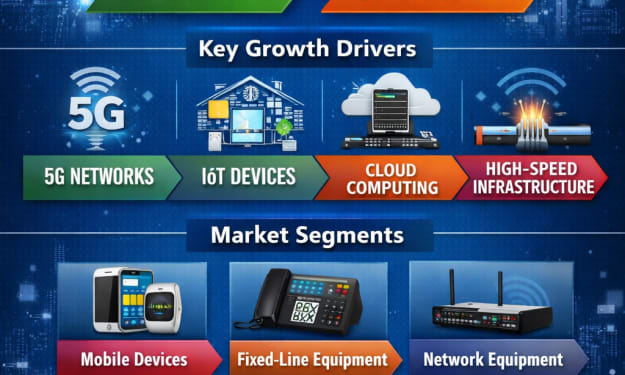
United States Communication Equipment Market Overview The United States communication equipment market stands as one of the most critical pillars of the nation’s digital economy. Valued at US$ 123.11 billion in 2024, the market is projected to expand steadily at a CAGR of 3.42% from 2025 to 2033, reaching approximately US$ 168.09 billion by 2033. This growth is being driven by rapid advancements in 5G networks, cloud computing, Internet of Things (IoT) devices, and the ever-increasing demand for high-speed, reliable communication infrastructure across industries.
By Sakshi Sharmaabout 20 hours ago in Trader
Analyse this!
Wanna know how to improve your writing? There is a simple, quick, tried and tested method. Tried and tested by who? By me, as it happens, and I can guarantee that it will work for you. I know what I am talking about. Not always, of course, but certainly in this case.
By Raymond G. Taylor3 days ago in Writers



Comments
There are no comments for this story
Be the first to respond and start the conversation.