
Australia Payments Market: USD 1.34 Trillion by 2033—A Cashless Future in Motion
Digital transformation, innovative fintech, and evolving consumer behaviour fuel Australia’s payments revolution

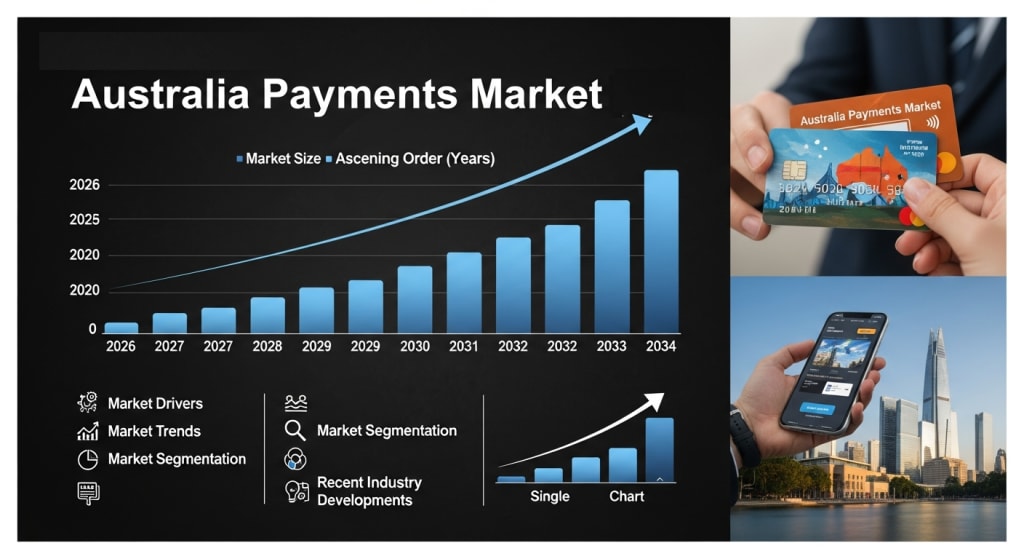
The Australia payments market is undergoing a profound shift as digital transaction technologies replace traditional cash and reshape how businesses and consumers exchange value. According to IMARC Group’s latest analysis, the market reached USD 806.4 billion in 2024 and is projected to grow to USD 1,341.7 billion by 2033, exhibiting a CAGR of 5.3% over 2025–2033.
This expansive growth reflects broader macroeconomic and technological trends — from rising mobile wallet usage to innovations in secure payments infrastructure. Australia’s payments ecosystem now encompasses point-of-sale (POS) transactions, online sales, digital wallets, and modern settlement rails, all underpinned by strong regulatory support and evolving consumer expectations.
Why the Market Is Growing So Rapidly
1. Digital Adoption and Consumer Preferences
One of the central drivers of market expansion is the widespread adoption of digital payments among Australian consumers. Digital wallets, mobile payments, and contactless card transactions have surged in popularity due to convenience, speed, and enhanced security. The ongoing decline in cash usage — which fell from around 69% of consumer transactions in 2007 to approximately 13% in 2022 — underscores this shift.
Australians now increasingly prefer digital payments for everyday purchases, supported by high smartphone penetration and user familiarity with mobile banking and fintech interfaces. The result is not only volume growth in transactions, but also increased diversity in payment modes, from digital wallets to app-based solutions integrated with retail and service ecosystems.
2. Technological Innovation and Security Enhancements
Technological progress in secure transaction technologies and fraud prevention capabilities has boosted consumer confidence in electronic payments. Artificial intelligence (AI), biometric authentication, tokenisation, and machine learning-based fraud detection are becoming standard features, strengthening trust in digital transactions.
These advancements not only improve security but also enhance the overall payment experience — reducing friction and enabling faster settlement, greater transparency, and richer analytics for both businesses and consumers.
3. E-commerce and Omnichannel Growth
E-commerce continues to be a major engine of payments growth in Australia. As consumers shift toward online shopping — spanning retail, entertainment, healthcare, hospitality, and other sectors — online payments and digital wallets have become integral to the checkout experience.
Retailers and service providers are responding with omnichannel solutions that seamlessly bridge in-store, mobile, and online transactions, further accelerating digital payment volumes and innovation across the value chain.
4. Regulatory Support and Financial Infrastructure
Australia’s regulatory framework has played a pivotal role in nurturing payments innovation. Initiatives such as Open Banking, the Consumer Data Right (CDR), and enhancements to the New Payments Platform (NPP) have introduced real-time settlement capabilities, improved interoperability, and fostered competition among fintechs and legacy institutions.
The Reserve Bank of Australia (RBA) and other regulatory bodies have supported a competitive and resilient payments ecosystem, enabling alternative payment methods (like buy-now-pay-later) and encouraging digital inclusion while maintaining systemic stability.
5. Business Demand for Seamless Payments
From small enterprises to large corporations, businesses increasingly prioritise payment systems that reduce transaction friction, enhance customer convenience, and integrate directly with point-of-sale and financial systems. Advanced payment platforms that support loyalty programmes, analytics, and customer data integration have become strategic assets for competitive differentiation.
What the Opportunities Are
1. Expansion of Digital Wallet and Mobile Payments
Growth opportunities remain strong for mobile wallet providers and mobile payment solutions that capitalise on user convenience and security features. Services like Apple Pay and Google Pay, when paired with local innovations, can further deepen market penetration.
2. Real-Time Payments and API-Driven Solutions
Platforms leveraging APIs and real-time payments infrastructure — especially via the NPP — can unlock new use cases for peer-to-peer transactions, merchant settlement, and instant business-to-business payments.
3. Fintech Disruption in BNPL and Embedded Finance
Buy-now-pay-later (BNPL) offerings and embedded financial services in retail ecosystems present lucrative opportunities. These models drive customer engagement while expanding the scope of digital transactions beyond traditional credit and debit networks.
4. Secure Cross-Border Transactions
As cross-border e-commerce grows, demand rises for payment solutions that seamlessly handle multiple currencies, compliance requirements, and international settlements — creating a premium niche for advanced gateway and settlement providers.
5. Data Analytics and Fraud Prevention Services
With increased transaction volumes, security and analytics services that provide real-time fraud detection, customer insights, and predictive modelling will become vital differentiators for payment processors and enterprise clients.
6. SME and Micro-Merchant Payment Solutions
Tailored payment platforms that address the specific needs of small and micro-businesses — with low fees, easy onboarding, and robust support — can unlock substantial untapped market segments.
7. Integration with Retail and Loyalty Ecosystems
Payment ecosystems that integrate with loyalty programmes, customer reward schemes, and bespoke retail analytics offer differentiated value propositions that enhance customer retention and business revenue.
• March 2025: Government Regulatory Action: Australia’s federal treasury announced a phased reduction in bank card surcharges starting in 2026, including potential elimination of debit card transaction fees to improve consumer fairness and reduce costs for small businesses. This regulatory move aims to support digital payments adoption and lower operational costs for merchants nationwide.
• May 2025: Company Expansion & Technology Launches: Payments ecosystem providers, including Australian Payments Plus and fintech partners, successfully piloted an enhanced confirmation of payee system slated for broader roll-out. The system, covering around 90% of personal accounts initially, is designed to reduce fraud and transaction errors in digital transfers, strengthening trust in real-time payments infrastructure.
• September 2025: Market Adoption & Consumer Metrics: Independent industry data showed fintech companies now control more than 56% of the merchant acquiring market, with digital wallets, BNPL services, and alternative payment methods rapidly gaining share. This shift has prompted discussions on updated legislative frameworks to ensure consumer protection and data governance across emerging payment modalities.
Why Should You Know About the Australia Payments Market?
For investors, the Australia payments market represents a resilient and expanding digital ecosystem, projected to grow from USD 806.4 billion to USD 1,341.7 billion by 2033. The steady CAGR of 5.3% reflects broad adoption across consumer, retail, and enterprise segments.
For business leaders, payments innovation is no longer a back-end utility — it’s a strategic enabler of customer experience, operational efficiency, and competitive differentiation. Embracing digital payment solutions can unlock revenue streams and enhance loyalty across channels.
For policymakers, the ongoing digital transformation highlights the importance of inclusive regulation that balances innovation with security and accessibility, ensuring that all population segments can participate fully in the digital economy.
About the Creator
Rashi Sharma
I am a market researcher.
Keep reading
More stories from Rashi Sharma and writers in Trader and other communities.
Australia Plant-Based Food Market Set for Triple-Digit Expansion as Health, Sustainability and Innovation Align
The Australia plant-based food market is transforming from a niche segment into a mainstream pillar of the country’s food and beverage ecosystem. According to the latest research by IMARC Group, the market reached USD 330.4 million in 2024 and is expected to expand significantly to USD 981.3 million by 2033, growing at a compound annual growth rate (CAGR) of 11.50% during 2025–2033.
By Rashi Sharma3 days ago in Trader
Australia Automotive Market: Electrification, Consumer Demand & Industrial Momentum
Australia Automotive Market Overview The Australia automotive market continues to evolve rapidly as changing consumer preferences, emerging technologies and regulatory shifts redefine mobility and vehicle ownership patterns. Spanning passenger vehicles, commercial vehicles, electric vehicles (EVs), hybrid models and automotive services, the sector remains a critical driver of economic activity, employment and industrial innovation. According to IMARC Group, The Australia automotive market size was valued at 1.22 Million Units in 2024. Looking forward, the market is expected to reach 2.50 Million Units by 2033, exhibiting a CAGR of 7.60% from 2025-2033. This growth reflects rising vehicle demand, electrification trends, expanded financing options and supportive policies that underpin market expansion. (Market data based on IMARC Group analysis.)
By Amyra Singh4 days ago in Trader
Philippines Clinical Laboratory Services Market: Diagnostic Demand, Healthcare Expansion & Technology Adoption
Philippines Clinical Laboratory Services Market Overview The Philippines clinical laboratory services market share is witnessing strong and sustained growth as demand for accurate diagnostics, preventive care and specialized testing continues to rise across public and private healthcare facilities. Clinical laboratory services include a wide range of tests — from routine blood and urine analyses to advanced molecular diagnostics — that support disease detection, treatment planning, monitoring and overall health management. The Philippines clinical laboratory services market size reached USD 1.2 Billion in 2024. Looking forward, the market is expected to reach USD 1.7 Billion by 2033, exhibiting a growth rate (CAGR) of 4.1% during 2025-2033. This expansion demonstrates the critical role of laboratory diagnostics in modern healthcare, expanding healthcare access, technology upgrades and increased awareness of preventive health screenings. (Market data based on IMARC Group analysis.)
By Amyra Singh6 days ago in Trader




Comments
There are no comments for this story
Be the first to respond and start the conversation.