
United States Agricultural Machinery Market Size and Forecast 2025
How Automation, Precision Farming, and Sustainability Are Reshaping American Agriculture

Introduction: A Market Powering the Future of Farming
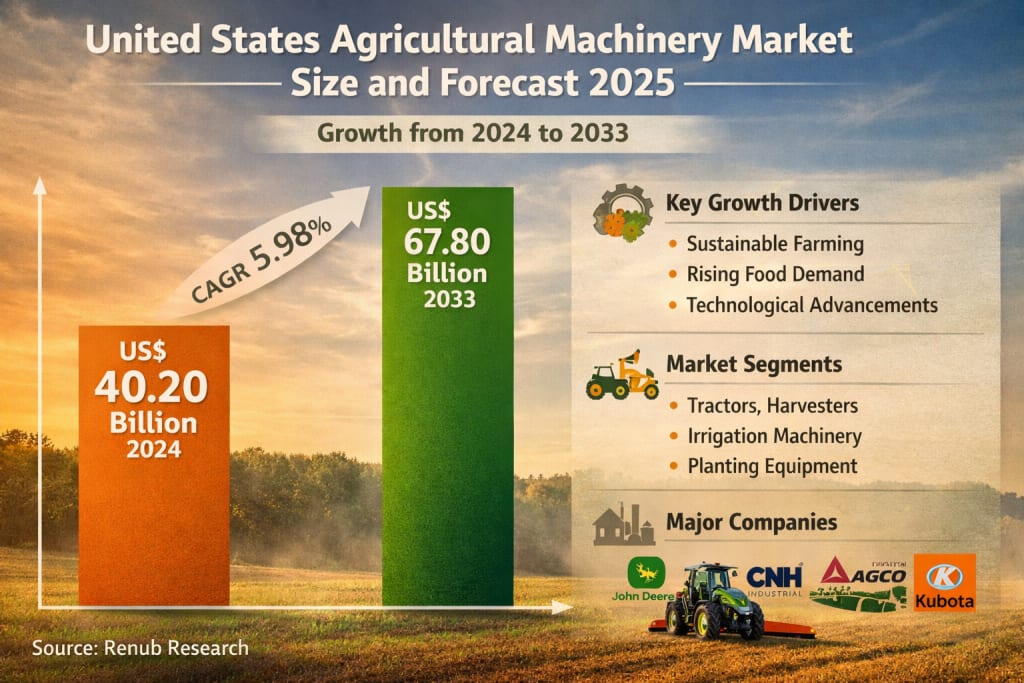
The United States has long been a global leader in agricultural innovation, and in 2025, that leadership is being reinforced by rapid growth in the agricultural machinery market. According to Renub Research, the United States Agricultural Machinery Market is expected to reach US$ 67.80 billion by 2033, up from US$ 40.20 billion in 2024, registering a compound annual growth rate (CAGR) of 5.98% from 2025 to 2033.
This steady expansion reflects more than just rising equipment sales. It signals a deeper transformation in how American farms operate. From GPS-guided tractors and autonomous harvesters to precision irrigation systems and data-driven planting equipment, agricultural machinery is increasingly becoming the backbone of modern, efficient, and sustainable farming.
Farmers today face a complex mix of challenges: rising labor costs, climate uncertainty, pressure to increase yields, and the need to adopt environmentally responsible practices. In response, the machinery industry is delivering smarter, more efficient, and more durable solutions that help producers do more with less. As a result, the U.S. agricultural machinery market is not only growing in size, but also evolving in sophistication and strategic importance.
What Is Agricultural Machinery and Why It Matters
Agricultural machinery refers to the wide range of equipment used in farming to automate processes, boost productivity, and increase operational efficiency. This includes tractors, ploughs, cultivators, harvesters, seeders, sprayers, and irrigation systems, among many others. These machines reduce manual labor, improve precision, and help farmers manage larger areas of land with greater consistency and reliability.
Over the past decade, technological advancements such as GPS guidance, automation, sensor-based systems, and precision farming tools have significantly expanded the capabilities of agricultural machinery. Today’s equipment is no longer just mechanical—it is digital, connected, and data-driven. Farmers can monitor soil health, track crop performance, optimize input usage, and make real-time decisions that directly impact yields and profitability.
In a country where agriculture plays a vital role in food security, exports, and rural employment, the importance of efficient machinery cannot be overstated. As farm sizes increase and labor availability becomes more constrained, the role of advanced equipment becomes even more critical.
Market Overview: A Decade of Opportunity Ahead
The U.S. agricultural machinery market is entering a phase of sustained growth. The jump from US$ 40.20 billion in 2024 to US$ 67.80 billion by 2033 reflects not only rising demand, but also higher value per unit as farmers invest in more advanced and technology-rich equipment.
Several structural trends are shaping this growth:
The shift toward precision agriculture to improve efficiency and reduce waste
The need to increase productivity to meet rising food demand
The push for sustainable farming practices and lower environmental impact
The growing scale of farming operations, which requires more powerful and efficient machinery
Government support and incentives for modernizing agricultural practices
Together, these factors are creating a strong and resilient demand environment for tractors, harvesters, irrigation systems, planting machinery, and other essential equipment categories.
Key Growth Drivers
1. Sustainable Farming Practices
Sustainability has moved from being a niche concern to a central priority in U.S. agriculture. Farmers are under increasing pressure to reduce water usage, limit chemical runoff, cut carbon emissions, and preserve soil health—all while maintaining or increasing yields.
Modern agricultural machinery plays a crucial role in achieving these goals. Precision farming tools, such as GPS-guided equipment and variable-rate technology, allow farmers to apply fertilizers, pesticides, and water only where needed, reducing waste and environmental impact. No-till and low-till equipment helps protect soil structure and prevent erosion, while energy-efficient and low-emission machinery supports broader climate objectives.
These environmentally friendly solutions not only help farmers comply with regulations but also appeal to increasingly eco-conscious consumers and food buyers, further reinforcing market demand.
2. Rising Food Demand
Global population growth and changing dietary patterns are placing continuous pressure on food production systems. The United States, as one of the world’s largest agricultural producers and exporters, is at the center of this challenge.
With limited arable land and rising expectations for productivity, farmers must rely on technology to produce more food per acre. Advanced tractors, planters, and harvesters enable farmers to cultivate larger areas more precisely and efficiently. Automated systems, precision planting, and faster harvesting technologies help reduce crop losses and improve overall output.
As the need for higher productivity intensifies, investment in modern agricultural machinery becomes not just an option, but a necessity.
3. Technological Advancement
Technology is arguably the most powerful force reshaping the agricultural machinery market. Innovations in automation, GPS, artificial intelligence, data analytics, and sensor technology are transforming traditional equipment into smart farming systems.
Automated harvesters and GPS-guided tractors improve accuracy in planting, irrigation, and harvesting while reducing labor costs. Precision farming tools provide real-time data on soil conditions, crop health, and weather patterns, enabling farmers to make better-informed decisions. This not only boosts yields but also minimizes waste and input costs.
A notable example of this trend came in December 2022, when CNH Industrial expanded its Ag Tech offering in the United States, adding new automation and autonomy solutions. With support from Case IH and New Holland’s Baler Automation and Raven’s driverless tillage and driver-assist harvest solutions, farmers gained access to advanced tools designed to overcome key production challenges and benefit from the next generation of autonomous equipment.
As these technologies continue to mature and become more accessible, their adoption is expected to accelerate, further driving market growth.
Challenges Facing the Market
1. Maintenance and Repair Costs
While modern machinery offers impressive capabilities, it also comes with increased complexity. Advanced equipment often requires specialized parts, software updates, and skilled technicians for maintenance and repair. For farmers, especially small and mid-sized operators, these costs can become a significant burden.
Unexpected breakdowns can disrupt farming schedules, delay critical operations like planting or harvesting, and ultimately reduce productivity. The shortage of skilled technicians in some regions further compounds the problem, increasing downtime and service costs.
2. High Initial Costs
Another major challenge is the high upfront investment required for advanced agricultural machinery. Automated tractors, harvesting robots, and precision farming systems often come with substantial price tags, making them less accessible for smaller farms.
Although these machines can deliver long-term savings through improved efficiency and reduced input costs, the initial capital requirement remains a barrier for many farmers. This can slow the adoption of new technologies and widen the gap between large, well-capitalized farms and smaller operations.
Market Segmentation: Understanding the Structure
The United States Agricultural Machinery Market can be analyzed across several key segments:
By Machinery Type
Irrigation Machinery
Tractors
Ploughing and Cultivation Machinery
Harvesting Machinery
Haying and Forage Machinery
Planting Machinery
Sprayer
Irrigation Machinery
Gravity Irrigation
Micro-Irrigation
Sprinkler
Tractors by Engine Power
Less than 40 HP
41 to 100 HP
More than 100 HP
Ploughing and Cultivation Machinery
Cultivators and Tillers
Harrows
Ploughs
Others
Harvesting Machinery
Combine Harvesters
Harvesting Robots
Self-Propelled Forage Harvesters
Haying and Forage Machinery
Mowers
Balers
Tedders and Rakes
Forage Harvesters
This wide range of segments highlights the diversity of farming needs across the United States, from small-scale operations to large commercial farms, and from traditional crop production to highly specialized agricultural activities.
Competitive Landscape: Key Players Shaping the Market
The U.S. agricultural machinery market is highly competitive and innovation-driven. Major companies are investing heavily in technology, product development, and strategic partnerships to strengthen their market positions.
Key companies analyzed in the market include:
John Deere
CNH Industrial
AGCO Corporation
Kubota Corporation
Titan Machinery Inc.
CLAAS
Lindsay Corporation
Alamo Group Inc.
These companies are evaluated across five key dimensions:
Company Overview, Key Persons, Product Portfolio, Recent Developments, and Sales Analysis.
Their focus on automation, precision agriculture, and sustainable solutions is helping to drive the next phase of growth in the U.S. agricultural machinery industry.
The Road Ahead: What the Forecast Really Means
The projected growth from US$ 40.20 billion in 2024 to US$ 67.80 billion by 2033 is more than just a number. It reflects a structural shift in American agriculture toward technology-driven, efficiency-focused, and sustainability-oriented farming.
As farmers continue to face labor shortages, climate challenges, and rising input costs, the role of advanced machinery will only become more central. At the same time, ongoing innovation in automation and data-driven farming is likely to create entirely new equipment categories and business models over the coming decade.
Final Thoughts
The United States Agricultural Machinery Market is entering a transformative era. Driven by technological advancement, rising food demand, and the push for sustainable farming, the industry is set for steady and meaningful growth through 2033. While challenges such as high initial costs and maintenance expenses remain, the long-term benefits of efficiency, productivity, and environmental responsibility are clearly tipping the balance in favor of continued investment.
With a forecast CAGR of 5.98% and a market value expected to reach US$ 67.80 billion by 2033, agricultural machinery is no longer just a support industry—it is becoming a strategic pillar of modern American agriculture. For farmers, manufacturers, and policymakers alike, the message is clear: the future of farming will be built on smart, connected, and sustainable machines.
About the Creator
Tom Shane
Tom Shane is a content writer specializing in SEO-driven blogs, product descriptions, and thought leadership. He crafts engaging, research-backed content that connects with audiences and drives results.
United Arab Emirates Foodservice Market Size and Forecast 2025–2033
United Arab Emirates Foodservice Market Overview Foodservice refers to the preparation, serving, and sale of food for consumption outside the home. This includes restaurants, cafés, quick-service outlets, catering services, food trucks, and an increasingly important category—cloud kitchens and delivery-only brands. In the UAE, foodservice is not merely a support industry; it is a central pillar of urban lifestyle, tourism, and hospitality.
By shibansh kumar2 days ago in Trader



Comments
There are no comments for this story
Be the first to respond and start the conversation.