
United States Household Appliances Market Size and Forecast 2025–2033
From Smart Kitchens to Sustainable Living: How Technology and Lifestyle Shifts Are Reshaping America’s Home Appliance Industry

United States Household Appliances Market Overview
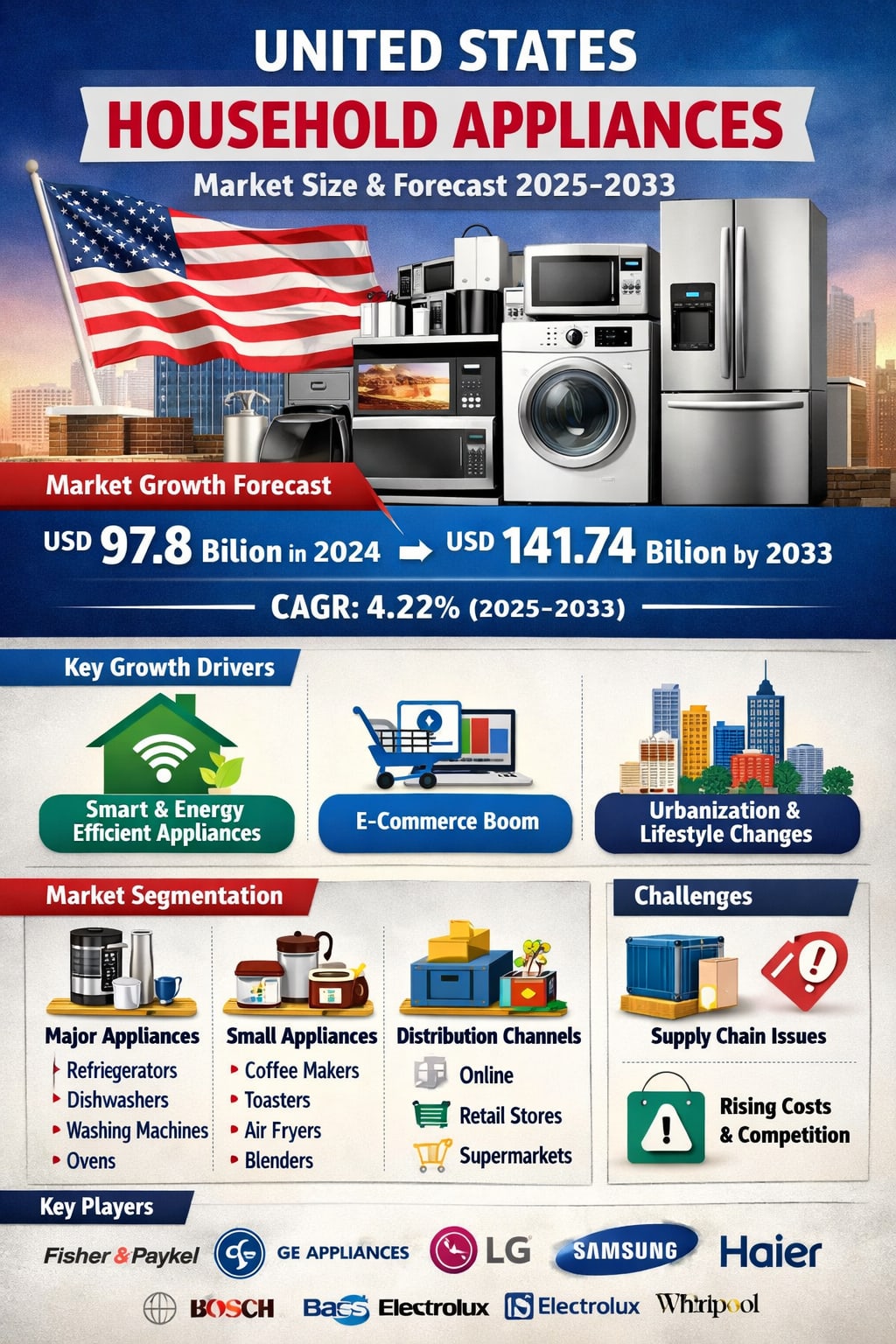
The United States Household Appliances Market is entering a phase of steady and technology-driven expansion. According to Renub Research, the market is projected to grow from USD 97.8 billion in 2024 to USD 141.74 billion by 2033, registering a compound annual growth rate (CAGR) of 4.22% from 2025 to 2033. This growth is being fueled by rising disposable incomes, rapid technological innovation, increasing demand for energy-efficient products, and the growing popularity of smart home ecosystems.
Household appliances are an essential part of modern American life. From refrigerators, washing machines, and air conditioners to coffee makers, air fryers, and air purifiers, these products play a central role in daily routines such as cooking, cleaning, food preservation, and climate control. Over the past decade, appliances have evolved far beyond basic functionality. Today’s consumers expect connectivity, automation, energy efficiency, and sleek design—turning everyday devices into intelligent lifestyle companions.
In the United States, the adoption of smart appliances has accelerated due to busy urban lifestyles, higher purchasing power, and strong awareness about sustainability. Major brands such as Samsung, LG, Whirlpool, GE Appliances, and Bosch are continuously investing in research and development to deliver connected, AI-enabled, and eco-friendly solutions. At the same time, the rapid expansion of e-commerce platforms has made appliances more accessible than ever, enabling consumers to compare products, read reviews, and purchase with just a few clicks.
Together, these trends are shaping a market that is not only growing in size, but also evolving in sophistication and value.
Key Growth Drivers of the U.S. Household Appliances Market
Rising Demand for Energy-Efficient and Smart Appliances
One of the most powerful forces driving the U.S. household appliances market is the growing demand for energy-efficient and smart appliances. Consumers are increasingly conscious of electricity and water consumption, both for cost-saving and environmental reasons. This has pushed Energy Star-rated and eco-friendly products into the mainstream.
At the same time, smart home integration is transforming how people interact with appliances. Features such as voice control, mobile app connectivity, remote monitoring, and AI-driven automation are no longer niche—they are becoming standard expectations in mid- to high-end appliances. Refrigerators that track groceries, washing machines that optimize water usage, and air conditioners that adjust settings based on occupancy are all examples of how technology is reshaping the category.
Manufacturers are responding aggressively to this trend. For instance, in February 2024, GE Appliances (a Haier subsidiary) introduced its innovative EcoBalance System, enabling consumers to optimize energy usage across appliances, air conditioners, and water heaters, while also integrating smart lighting and energy management solutions with partners like Savant. Such innovations not only enhance user convenience but also reinforce the market’s long-term growth trajectory.
Expansion of E-Commerce and Online Retail Channels
The rapid growth of e-commerce has fundamentally changed how Americans buy household appliances. Online platforms offer competitive pricing, easy product comparisons, customer reviews, financing options, and doorstep delivery—making them highly attractive to modern consumers.
Retail giants such as Amazon, Walmart, and Best Buy have significantly strengthened their online presence, while many appliance brands are also investing in direct-to-consumer digital channels. This omnichannel approach allows customers to research products online, visit physical stores for demonstrations, and complete purchases digitally or offline as per convenience.
In April 2024, Alibaba Group Holdings launched a new shopping app with 3D capabilities designed for the Vision Pro mixed-reality headset in the United States, highlighting how immersive and tech-driven online shopping experiences are becoming part of the retail future. Such developments are expected to further accelerate online appliance sales and broaden the market’s reach.
Urbanization and Changing Consumer Lifestyles
Urbanization and shifting lifestyle patterns are also playing a crucial role in boosting appliance demand. Currently, around 83% of the U.S. population lives in urban areas, up from 64% in 1950, and this figure is expected to rise further in the coming decades. Urban living often means smaller homes, busier schedules, and a greater need for compact, multifunctional, and time-saving appliances.
With more dual-income households and fast-paced work routines, consumers are increasingly relying on appliances that simplify daily chores—such as dishwashers, washer-dryer combos, robotic vacuum cleaners, and smart cooking devices. At the same time, rising income levels are driving demand for premium and design-focused appliances, especially in metropolitan areas where home aesthetics and smart living solutions are highly valued.
Challenges Facing the U.S. Household Appliances Market
Supply Chain Disruptions and Rising Raw Material Costs
Despite strong growth prospects, the industry continues to face challenges related to supply chain disruptions and volatile raw material prices. The lingering effects of the COVID-19 pandemic, geopolitical tensions, and global logistics constraints have impacted the availability of critical components such as semiconductors, steel, and plastics.
These issues have led to production delays, higher manufacturing costs, and, in some cases, increased retail prices for consumers. To mitigate these risks, manufacturers are increasingly focusing on supply chain diversification, local sourcing, and inventory optimization strategies.
Intense Competition and Price Sensitivity
The U.S. household appliances market is highly competitive, with numerous global and regional players competing for market share. Innovation is essential, but so is affordability. Many consumers remain price-sensitive, especially in mass-market segments, which puts pressure on manufacturers to balance advanced features with competitive pricing.
Promotions, financing options, and bundled offers have become important tools for attracting customers. Companies must continuously innovate while also managing costs to remain competitive in this crowded marketplace.
Key Product Segment Insights
United States Household Dishwasher Market
The U.S. dishwasher market is growing steadily, driven by the need for convenience, water efficiency, and improved hygiene. Modern consumers prefer dishwashers with features such as quiet operation, customizable wash cycles, energy-saving modes, and smart connectivity. Built-in and portable models are both seeing strong demand, especially in urban households. Brands like Bosch, Whirlpool, and KitchenAid lead this segment with technologically advanced and eco-friendly offerings.
United States Household Refrigerator Market
Refrigerators remain one of the most essential and high-value appliances in American homes. Demand is being driven by innovations in cooling technology, smart features, and energy efficiency. French-door, side-by-side, and bottom-freezer models are particularly popular. Features such as touchscreens, precise temperature control, and optimized storage layouts are increasingly influencing purchasing decisions. Leading brands include Samsung, LG, and GE, all of which are активно investing in smart and connected refrigeration solutions.
United States Household Washing Machine and Dryers Market
The washer and dryer segment continues to benefit from urbanization and the growing preference for automated laundry solutions. High-efficiency top-load and front-load machines with app-based controls, energy-saving modes, and advanced drum technologies are in high demand. Washer-dryer combinations are also gaining popularity among space-conscious consumers. Key players such as Whirlpool, Maytag, and Electrolux are focusing on water conservation, fabric care, and smart features to strengthen their market positions.
United States Household Coffee Makers Market
Coffee makers are a staple in U.S. households, with strong demand for pod-based, espresso, and programmable machines. Consumers increasingly value convenience, customization, and energy efficiency. Smart and connected coffee machines are also emerging, offering features like scheduled brewing and remote control via smartphone apps. Brands such as Keurig, Nespresso, and Breville dominate this segment with a wide range of premium and user-friendly products.
United States Household Toasters Market
The toaster market is evolving beyond basic bread toasting. Today’s consumers prefer multifunctional appliances that combine toasting, baking, air frying, and reheating in a single device. Digital controls, multiple presets, and compact designs are becoming standard features. Companies like Cuisinart, Breville, and Hamilton Beach are focusing on stylish, space-saving, and versatile toaster designs to appeal to modern kitchens.
United States Household Air Purifiers Market
Growing awareness of indoor air quality has significantly boosted demand for air purifiers in the United States. Consumers are increasingly investing in devices equipped with HEPA filters, activated carbon filters, and UV technologies to remove allergens, pollutants, and airborne pathogens. Smart air purifiers with real-time air quality monitoring and app connectivity are particularly popular. Major brands in this segment include Dyson, Honeywell, and Blueair, known for their innovation and energy-efficient designs.
Distribution Channel Insights
Electronic Stores
Electronic stores such as Best Buy, Home Depot, and Lowe’s remain a major sales channel for household appliances. These stores offer hands-on product demonstrations, expert advice, installation services, and attractive financing options. Their omnichannel strategies—combining physical stores with strong online platforms—continue to enhance customer experience and drive sales.
Hypermarkets and Supermarkets
Retail chains like Walmart, Target, and Costco play a crucial role in appliance distribution, especially for small and mid-sized products. Competitive pricing, bundled deals, and one-stop shopping convenience make this channel highly attractive to cost-conscious consumers.
Regional Market Insights
East United States
The eastern U.S. is a major market driven by large urban centers such as New York, Boston, and Washington, D.C. High income levels, strong adoption of smart home technologies, and a focus on sustainability are boosting demand for premium and energy-efficient appliances.
West United States
The western U.S., particularly California, is at the forefront of smart and eco-friendly appliance adoption. Strong environmental regulations, high technology penetration, and a tech-savvy consumer base make this region a key growth engine for innovative and low-energy-consuming appliances.
Market Segmentation Overview
By Appliances:
Major Appliances: Water Heater, Dishwasher, Refrigerator, Cooktop, Cooking Range, Microwave & Oven, Vacuum Cleaner, Washing Machine & Dryers, Air Conditioner
Small Appliances: Coffee Makers, Toasters, Juicers, Blenders & Food Processors, Hair Dryers, Irons, Deep Fryers, Space Heaters, Electric Trimmers & Shavers, Air Purifiers, Humidifiers & Dehumidifiers, Rice Cookers & Steamers, Air Fryers
By Distribution Channel:
Hypermarkets & Supermarkets
Electronic Stores
Exclusive Brand Outlets
Online
Others
By Region:
East
West
North
South
Key Players in the U.S. Household Appliances Market
Fisher & Paykel Appliances Holdings Ltd.
GE Appliances
Haier Group
LG Electronics
Panasonic Corporation
Robert Bosch GmbH
Samsung Electronics Co., Ltd.
Electrolux AB
Whirlpool Corporation
All key players are analyzed from four viewpoints: Overview, Key Person, Recent Developments, and Revenue, highlighting the competitive and innovation-driven nature of the market.
Final Thoughts
The United States Household Appliances Market is on a solid growth path, driven by technological innovation, evolving lifestyles, and increasing demand for energy-efficient and smart solutions. With the market expected to reach USD 141.74 billion by 2033, opportunities abound for manufacturers, retailers, and technology providers alike.
As smart homes become more common and sustainability continues to influence consumer choices, the industry will likely see even greater emphasis on connectivity, automation, and eco-friendly design. For businesses operating in this space, the future will belong to those who can successfully combine innovation, affordability, and user-centric design—turning everyday appliances into indispensable partners in modern living.
About the Creator
Tom Shane
Tom Shane is a content writer specializing in SEO-driven blogs, product descriptions, and thought leadership. He crafts engaging, research-backed content that connects with audiences and drives results.
Dow Jones Industrial Average Outlook: Subtle Market Signs Many Investors Miss
Dow Jones Industrial Average trends often reveal the market’s next move long before headlines do. At present, the Dow Jones Industrial Average looks calm, but quiet signs suggest change may be near. Many investors focus on daily price swings and miss these early clues. Learning how to read the Dow Jones Industrial Average can help investors stay prepared and avoid sudden surprises.
By hamza mirza4 days ago in Trader
FTSE 100 Insight: What Today’s Market Reaction Means for Everyday Investors
FTSE 100 movements today are once again shaping how people think about their money. When the FTSE 100 reacts sharply, it shows how the biggest UK companies are dealing with change. These movements can affect savings, pensions, and future plans for many households. That is why understanding today’s FTSE 100 insight is important, even if you are not an active investor. This article explains what caused the FTSE 100 reaction, how it can affect your finances, and what steps make sense right now.
By John.doe7983 days ago in Trader



Comments
There are no comments for this story
Be the first to respond and start the conversation.