
UAE Halal Cosmetics Market Size and Forecast 2025–2033: Beauty Meets Belief in a Fast-Growing Industry
How faith-driven consumer choices, clean beauty trends, and digital retail are reshaping the UAE’s cosmetics landscape

Introduction: Where Beauty, Belief, and Business Converge
The global beauty industry is undergoing a powerful transformation, driven not only by innovation and trends but also by values. Among the most compelling shifts is the rapid rise of halal cosmetics—products that comply with Islamic principles while also aligning with the global demand for clean, ethical, and transparent beauty solutions. Nowhere is this evolution more visible than in the United Arab Emirates.
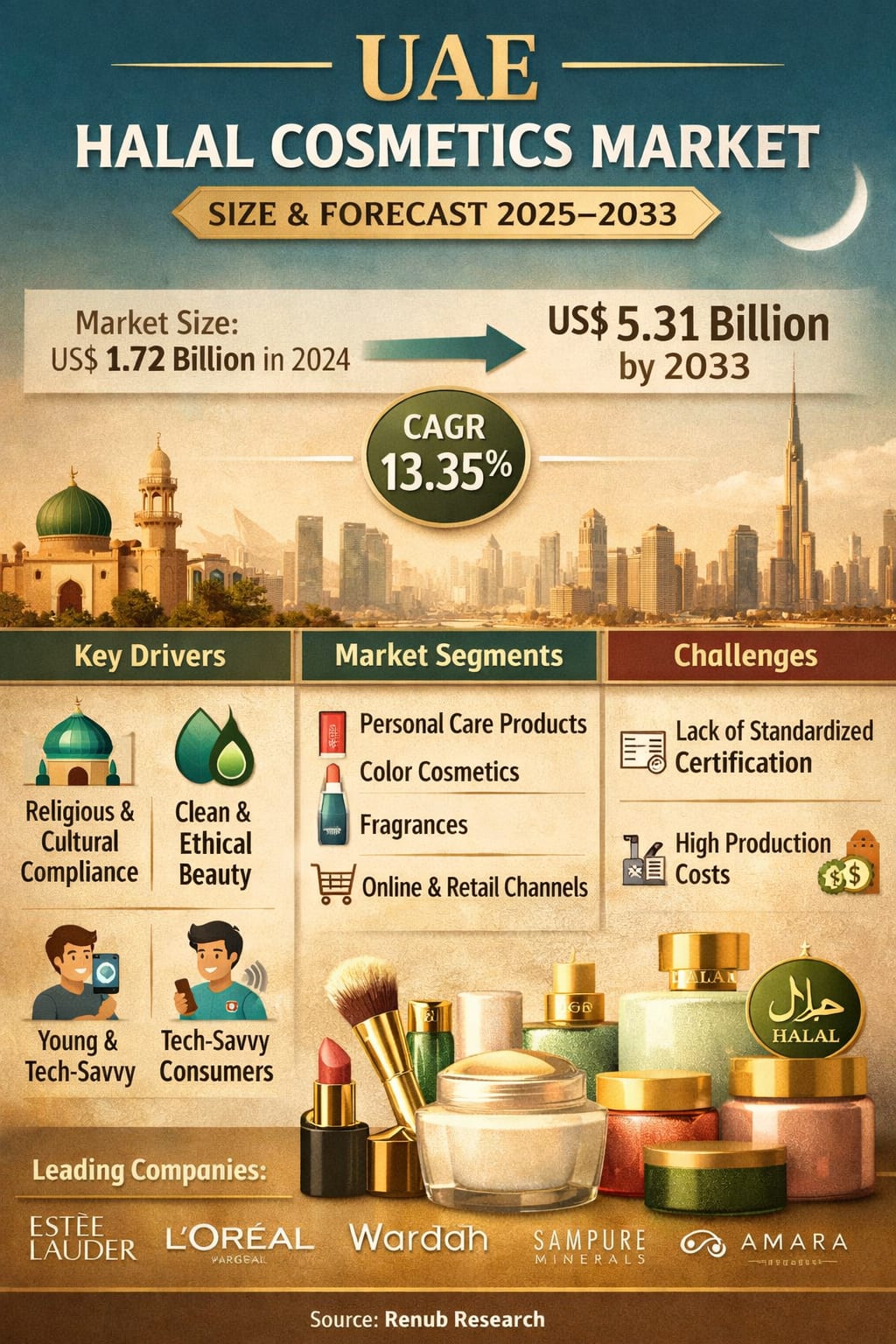
According to Renub Research’s latest publication, “UAE Halal Cosmetics Market by Product Type, Application, Distribution Channel, and Company Analysis, 2025–2033,” the UAE Halal Cosmetics Market is expected to reach US$ 5.31 billion by 2033, up from US$ 1.72 billion in 2024, growing at a compound annual growth rate (CAGR) of 13.35% from 2025 to 2033. This remarkable growth reflects more than just rising sales—it signals a deeper cultural and consumer shift toward products that combine performance, ethics, and faith-based compliance.
The UAE, long recognized as a regional hub for beauty, luxury retail, and innovation, is uniquely positioned to lead this market. With a diverse population, strong purchasing power, and a government-backed push for halal industries, the country is becoming a global reference point for halal-certified beauty and personal care products.
Understanding Halal Cosmetics: More Than Just a Label
Halal cosmetics are defined by their compliance with Islamic law, which prohibits the use of certain ingredients such as alcohol and pork-derived substances, and emphasizes cleanliness, ethical sourcing, and cruelty-free production. However, in today’s market, halal certification has evolved beyond religious compliance into a broader symbol of trust, transparency, and quality.
For many consumers—Muslim and non-Muslim alike—halal cosmetics represent a safer and more ethical alternative to conventional beauty products. They are often associated with natural formulations, responsible manufacturing processes, and stricter quality controls. This perception has helped halal cosmetics move from a niche segment into a fast-growing mainstream category within the UAE’s beauty industry.
Market Overview: A Rapidly Expanding Industry
The UAE halal cosmetics market is benefiting from a rare convergence of factors: strong consumer demand, supportive regulations, rising disposable incomes, and a booming digital retail ecosystem. As per Renub Research, the market’s projected growth from US$ 1.72 billion in 2024 to US$ 5.31 billion by 2033 highlights the scale of opportunity for both regional and international brands.
Several structural trends are reinforcing this momentum:
The UAE’s role as a global halal hub, attracting brands and investors focused on Islamic-compliant products
The country’s strong retail infrastructure, including luxury malls, specialty stores, and a rapidly expanding e-commerce sector
A culturally diverse consumer base that values both performance and principles in personal care products
Together, these factors are transforming halal cosmetics from a category driven mainly by religious necessity into one fueled by lifestyle aspirations and ethical consumption.
Key Factors Driving the UAE Halal Cosmetics Market Growth
1. Compliance with Religion and Culture
Religious and cultural alignment remains the foundational driver of halal cosmetics demand in the UAE. For Muslim consumers, using halal-certified products is not merely a preference—it is an extension of faith and daily practice. Halal certification provides reassurance that products are free from prohibited ingredients and manufactured in accordance with Islamic principles.
This compliance builds deep trust between brands and consumers, encouraging repeat purchases and long-term loyalty. Moreover, as the UAE positions itself as a global center for the halal economy, regulatory support and certification frameworks are strengthening the credibility and visibility of halal cosmetics across the market.
Interestingly, the appeal is no longer limited to Muslim buyers. Many non-Muslim consumers are increasingly drawn to halal products because of their emphasis on purity, safety, and ethical standards. This crossover appeal is significantly expanding the total addressable market.
2. Growing Awareness of Clean and Ethical Beauty
Globally, the beauty industry is experiencing a strong shift toward clean, sustainable, and ethical products—and the UAE is no exception. Consumers are becoming more ingredient-conscious, more concerned about animal welfare, and more aware of the environmental impact of their purchases.
Halal cosmetics naturally align with these values. By definition, they are cruelty-free and often free from harsh or controversial chemicals. This makes them particularly attractive to health-conscious and environmentally aware consumers who want transparency in what they apply to their skin and hair.
Social media, beauty influencers, and digital content platforms are accelerating this awareness. As more consumers learn about ingredient sourcing, formulation safety, and ethical manufacturing, halal cosmetics are increasingly seen not just as a religious choice, but as a smart, responsible beauty choice.
3. A Young, Image-Conscious, and Digitally Connected Population
The UAE’s youthful and tech-savvy population is another major growth engine for the halal cosmetics market. Millennials and Gen Z consumers are highly influenced by social media trends, influencer recommendations, and global beauty movements. They are quick to adopt new products—especially those that align with their personal values and identity.
For young Muslim consumers, halal-certified beauty products offer a way to express style and individuality without compromising religious principles. At the same time, rising disposable incomes among younger professionals are fueling demand for premium and high-performance halal beauty brands.
This demographic is also driving the growth of online beauty shopping, further expanding the reach and visibility of halal cosmetics across the country.
The Role of E-Commerce and Digital Marketing
One of the most transformative forces in the UAE halal cosmetics market is the rapid expansion of e-commerce. Online platforms have made it easier than ever for consumers to discover, compare, and purchase halal-certified products from both local and international brands.
Digital marketplaces, brand websites, and social commerce channels are breaking down geographical barriers and giving smaller halal brands a chance to compete with global giants. Influencer marketing, tutorial videos, and social media campaigns are playing a crucial role in educating consumers and shaping purchasing decisions.
As a result, the digital ecosystem is not just a sales channel—it has become a powerful engine for awareness, trust-building, and brand storytelling in the halal beauty space.
Challenges in the UAE Halal Cosmetics Market
1. Lack of Standardized Certification
Despite strong growth, the market faces a significant structural challenge: the absence of a single, universally accepted halal certification standard for cosmetics. Different certification bodies follow different criteria, leading to inconsistencies in labeling and consumer confusion.
This lack of uniformity can weaken consumer trust and open the door to “halal-washing,” where products are marketed as halal without meeting rigorous certification requirements. Such practices risk damaging the credibility of the entire category.
A more unified, government-backed certification framework could greatly enhance transparency, protect consumers, and strengthen long-term market confidence.
2. High Production Costs
Producing halal-certified cosmetics involves stricter sourcing, dedicated manufacturing processes, and regular audits to ensure compliance. These requirements significantly increase production and operational costs compared to conventional cosmetics.
Premium raw materials, contamination-free facilities, and certified supply chains all add to the expense. As a result, halal cosmetics often come with higher price tags, which can limit accessibility for price-sensitive consumers and intensify competition with mainstream beauty brands.
For smaller companies, these financial pressures can be particularly challenging, potentially slowing innovation and market expansion.
Market Segmentation: A Diverse and Expanding Portfolio
By Product Type
Personal Care Products
Color Cosmetics
Fragrances
Personal care products currently hold a strong position, driven by daily-use items such as skincare, haircare, and hygiene products. However, halal-certified color cosmetics and fragrances are gaining traction as consumers seek complete halal beauty routines.
By Application
Hair Care
Skin Care
Face Care
Beauty Care
Skincare and face care remain dominant segments due to rising awareness of ingredient safety and long-term skin health. Hair care and broader beauty care categories are also expanding rapidly, supported by innovation in formulations and packaging.
By Distribution Channel
Hypermarkets & Supermarkets
Online Stores
Convenience Stores
Specialty Stores
Others
While physical retail continues to play an important role, online stores are emerging as the fastest-growing channel, driven by convenience, wider product selection, and strong digital marketing strategies.
Competitive Landscape: Global Giants and Specialized Brands
The UAE halal cosmetics market features a mix of international beauty leaders and specialized halal-focused brands. According to the market analysis, key players include:
Estée Lauder
L’Oréal
S&J International Enterprises
Kao Corporation
Clara International Beauty Group
INIKA
AMARA COSMETICS
WARDAH COSMETICS
SAMPURE MINERALS
HALAL COSMETICS COMPANY
These companies are competing through product innovation, certification credibility, branding, and distribution reach. Many are investing heavily in R&D, sustainable packaging, and influencer-driven marketing to strengthen their position in this fast-evolving market.
Future Outlook: A Market Built on Values and Innovation
With a projected CAGR of 13.35% from 2025 to 2033, the UAE halal cosmetics market is set to remain one of the most dynamic segments of the country’s beauty industry. The combination of faith-based demand, ethical consumerism, digital retail expansion, and rising purchasing power creates a powerful growth narrative.
Innovation in formulations, stronger certification frameworks, and deeper integration with e-commerce and social media will likely define the next phase of market evolution. Brands that can successfully balance performance, transparency, and cultural alignment will be best positioned to capture long-term consumer loyalty.
Final Thoughts
The rise of halal cosmetics in the UAE is more than a market trend—it is a reflection of changing consumer priorities in a world where values matter as much as performance. From US$ 1.72 billion in 2024 to a projected US$ 5.31 billion by 2033, the numbers tell a story of trust, transformation, and tremendous opportunity.
As beauty continues to intersect with belief, ethics, and innovation, the UAE halal cosmetics market stands as a powerful example of how modern industries can grow by staying true to both tradition and progress.
About the Creator
Denmark Pharmaceutical Market Size and Forecast 2025–2033: Innovation, Data, and Global Leadership Driving Steady Growth
Introduction According to Renub Research’s latest industry analysis, the Denmark Pharmaceutical Market is expected to reach US$ 5.20 billion by 2033, rising from US$ 3.81 billion in 2024, at a compound annual growth rate (CAGR) of 3.52% from 2025 to 2033. This steady growth reflects Denmark’s unique position as one of Europe’s most innovation-driven and data-rich healthcare ecosystems.
By shibansh kumarabout 6 hours ago in Trader
Comments
There are no comments for this story
Be the first to respond and start the conversation.