
Australia Lung Cancer Diagnostics Market Size and Forecast 2025–2033
Early Detection, Smarter Technology, Better Outcomes: How Australia’s Diagnostic Ecosystem Is Transforming Lung Cancer Care

Introduction
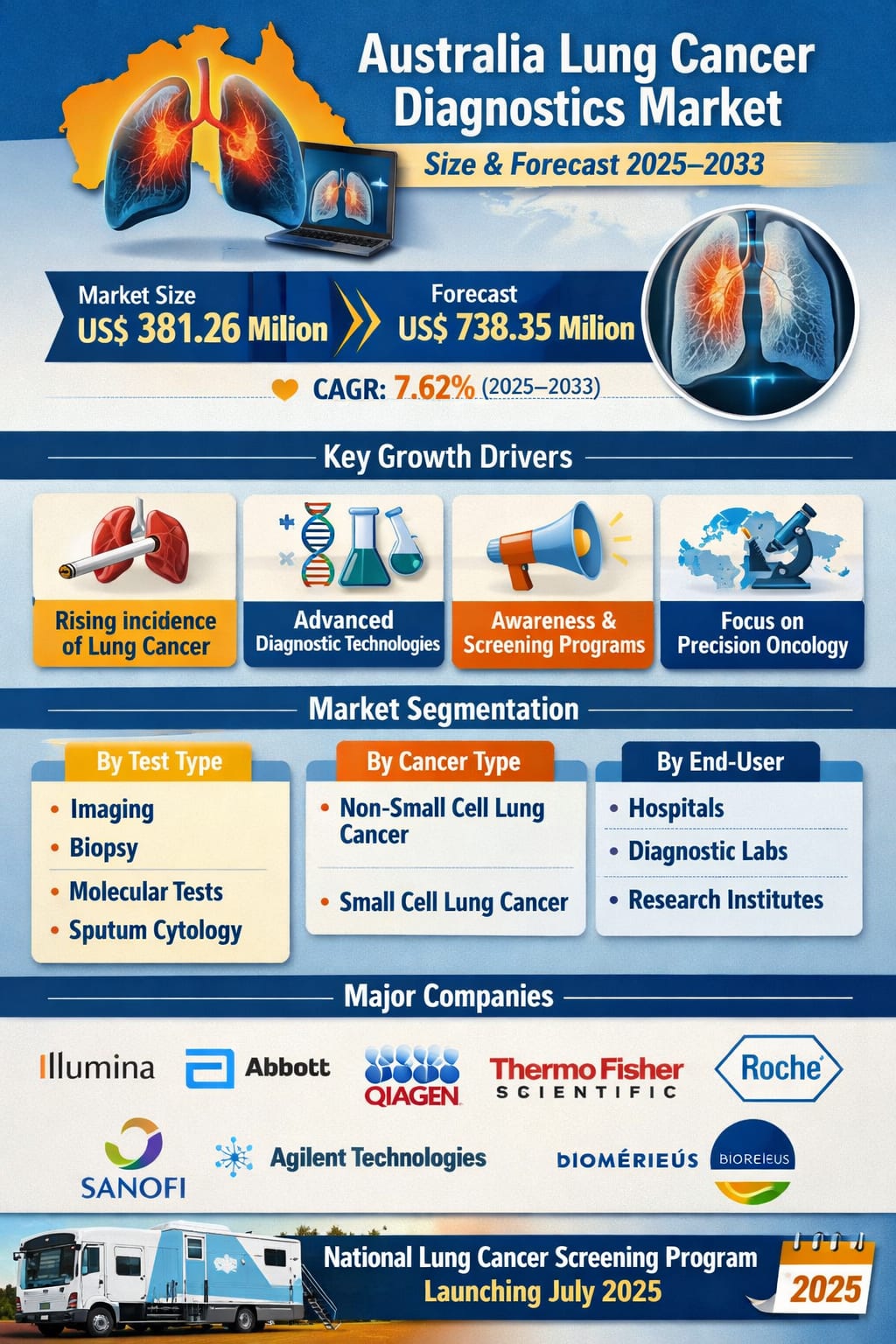
Australia’s healthcare system is entering a pivotal decade in the fight against lung cancer. Long considered one of the deadliest and most challenging cancers to diagnose early, lung cancer is now meeting a wave of innovation driven by technology, public policy, and rising awareness. According to Renub Research, the Australia Lung Cancer Diagnostics Market is expected to reach US$ 738.35 million by 2033, up from US$ 381.26 million in 2024, growing at a compound annual growth rate (CAGR) of 7.62% from 2025 to 2033.
This strong growth reflects more than just expanding healthcare spending. It signals a structural shift in how lung cancer is detected, monitored, and managed across the country. Rising cancer incidence, government-backed screening programs, and rapid adoption of advanced technologies such as artificial intelligence (AI), liquid biopsies, and next-generation sequencing (NGS) are reshaping Australia’s diagnostic landscape. At the same time, increased investment in precision oncology and molecular diagnostics is pushing the system toward earlier, more accurate, and more personalized diagnosis.
For patients, this transformation means better odds of catching the disease early, when treatment is most effective. For healthcare providers and diagnostic companies, it represents one of the most dynamic and strategically important segments of Australia’s oncology market over the next decade.
Australia Lung Cancer Diagnostics Industry Overview
The market for lung cancer diagnostics in Australia is expanding rapidly due to a convergence of clinical need, technological innovation, and policy support. Traditionally, lung cancer was often detected at an advanced stage, largely because early symptoms are subtle or easily mistaken for less serious conditions. Today, that narrative is changing.
AI-enhanced imaging tools are improving the accuracy and speed of radiology workflows, helping clinicians identify suspicious nodules earlier and with greater confidence. Liquid biopsies, which analyze circulating tumor DNA from blood samples, are offering a minimally invasive alternative to tissue biopsies, making testing safer and more accessible—especially for fragile or elderly patients. Meanwhile, the growing integration of next-generation sequencing (NGS) into routine diagnostics is enabling comprehensive genetic profiling of tumors, supporting more targeted and effective treatment decisions.
Australia’s commitment to improving cancer care is also visible in its national strategies and institutional frameworks. Initiatives such as the Australian Comprehensive Cancer Network and broader investments in oncology infrastructure highlight a long-term focus on strengthening diagnostic capabilities and clinical outcomes.
Beyond technology, accessibility and awareness are playing a critical role. Screening programs aimed at high-risk populations—such as long-term smokers, people with occupational exposures, and those with a family history of lung cancer—are expanding. Mobile screening units and community outreach programs are being deployed to improve access in underserved regions, while public health campaigns continue to stress the life-saving value of early detection.
Together, these forces are positioning Australia as a regional leader in modern cancer diagnostics, with lung cancer at the center of this transformation.
Market Size and Growth Outlook (Renub Research)
Renub Research estimates that the Australia Lung Cancer Diagnostics Market will grow from US$ 381.26 million in 2024 to US$ 738.35 million by 2033, registering a CAGR of 7.62% during 2025–2033.
This growth trajectory reflects both rising demand and increasing sophistication of diagnostic services. As more advanced tests become part of standard clinical practice, the overall value of the market expands—not just in volume, but in technological complexity and clinical impact. The forecast also underscores the long-term nature of this trend, suggesting that lung cancer diagnostics will remain a priority investment area for hospitals, laboratories, and healthcare policymakers throughout the next decade.
Key Factors Driving the Australia Lung Cancer Diagnostics Market
1. Rising Incidence of Lung Cancer
Lung cancer remains one of the leading causes of cancer-related deaths in Australia, and its incidence is not limited to traditional high-risk groups. While smoking continues to be a major risk factor, increasing cases are also being observed among older adults and non-smokers, influenced by environmental exposures, occupational hazards, and genetic predispositions.
Australia’s aging population further amplifies this challenge. As age is a major risk factor for cancer, the growing elderly demographic naturally increases the number of people requiring screening, diagnosis, and ongoing monitoring. This demographic shift is creating sustained demand for earlier, faster, and more accurate diagnostic solutions, pushing healthcare providers to adopt advanced technologies and expand testing capacity.
Early detection is crucial in lung cancer, where survival rates improve dramatically when the disease is caught at an early stage. This clinical reality is one of the strongest forces driving investment and innovation in diagnostics across the country.
2. Advancements in Diagnostic Technologies
Technological progress is arguably the most transformative driver of the Australian lung cancer diagnostics market.
Liquid biopsies are changing the way clinicians think about cancer testing. By detecting tumor-derived DNA fragments in the bloodstream, these tests offer a non-invasive, repeatable, and highly sensitive method for early detection and monitoring.
AI-powered imaging systems are enhancing the interpretation of CT scans and other imaging modalities, reducing human error, improving consistency, and accelerating diagnosis.
Next-generation sequencing (NGS) is enabling deep molecular profiling of tumors, helping oncologists identify specific mutations and select targeted therapies tailored to each patient.
Together, these technologies are not only improving diagnostic accuracy but also making the entire diagnostic pathway faster, less invasive, and more patient-friendly. This shift toward precision diagnostics is a major reason why the market is expanding at such a strong pace.
3. Growing Awareness and Screening Campaigns
Public awareness is a critical pillar of market growth. Over the past decade, Australian health authorities and non-profit organizations have intensified efforts to educate the public about lung cancer risk factors, early symptoms, and the importance of screening.
High-risk populations are being actively encouraged to participate in screening programs, and targeted outreach initiatives are helping extend diagnostic services to rural and underserved communities. As more people become aware of the benefits of early detection, participation in screening programs continues to rise—directly increasing demand for imaging tests, molecular diagnostics, and confirmatory procedures.
This cultural and behavioral shift toward proactive health management is playing a key role in expanding the market’s reach and impact.
Challenges in the Australia Lung Cancer Diagnostics Market
1. High Cost of Advanced Diagnostics
Despite their clinical advantages, many advanced diagnostic technologies come with significant cost barriers. Tests such as NGS and liquid biopsies are often more expensive than conventional methods, limiting access for patients who are not fully covered by public or private insurance.
Healthcare providers also face financial constraints when investing in new equipment, software, and specialized staff training. As a result, the adoption of cutting-edge diagnostics can be uneven across different regions and institutions. This cost challenge remains one of the biggest obstacles to achieving truly universal access to state-of-the-art lung cancer diagnostics in Australia.
2. Limited Access in Rural and Remote Areas
Australia’s vast geography creates persistent inequalities in healthcare access. Many rural and remote communities lack specialized diagnostic facilities, including advanced imaging centers, pathology laboratories, and oncology services. Shortages of trained healthcare professionals further compound the problem.
For patients in these regions, long travel distances and appointment delays can lead to later diagnoses and poorer outcomes. While telemedicine and mobile health initiatives are helping to bridge some gaps, ensuring consistent, high-quality access to lung cancer diagnostics nationwide remains a major policy and infrastructure challenge.
Recent Developments in the Industry
A major milestone came in April 2025, when the Australian government announced the National Lung Cancer Screening Program, the first new national cancer screening initiative in nearly two decades. The program is scheduled to launch in July 2025 and is expected to significantly expand early detection efforts among high-risk populations.
This initiative is widely seen as a turning point for the market. By institutionalizing large-scale screening, it will drive higher volumes of diagnostic testing, encourage earlier intervention, and further accelerate the adoption of advanced diagnostic technologies across the country.
Market Segmentation
By Diagnosis Test Type
Imaging Test
Biopsy
Sputum Cytology
Molecular Test
Others
Imaging and molecular tests are gaining particular traction as AI and genomic technologies become more deeply embedded in clinical workflows.
By Cancer Type
Non-Small Cell Lung Cancer (NSCLC)
Small Cell Lung Cancer (SCLC)
NSCLC accounts for the majority of cases and represents the largest share of diagnostic demand, especially for molecular and targeted testing.
By End-User
Hospital Associated Labs
Independent Diagnostic Laboratories
Diagnostic Imaging Centers
Cancer Research Institutes
Others
Hospital-associated laboratories and independent diagnostic labs remain the primary testing hubs, while imaging centers and research institutes play an increasingly important role in innovation and early detection.
Competitive Landscape and Key Companies
The Australian lung cancer diagnostics market features a mix of global life sciences leaders and specialized diagnostic innovators. Key players include:
Llumina
Abbott Laboratories
Thermo Fisher Scientific, Inc.
QIAGEN N.V.
Roche Holding AG
Sanofi S.A.
Agilent Technologies
bioMérieux
These companies are активно (actively) investing in R&D, new test platforms, automation, and AI-driven solutions to strengthen their market positions. Competitive strategies increasingly focus on expanding test menus, improving turnaround times, and supporting precision oncology workflows.
Future Outlook
Looking ahead to 2033, Australia’s lung cancer diagnostics market is set to become more digital, more molecular, and more patient-centric. The continued rollout of national screening programs, combined with rapid technological innovation, will push diagnostics further upstream—toward earlier detection and preventive care.
As costs gradually come down and access improves, advanced diagnostics such as liquid biopsies and comprehensive genomic profiling are likely to become standard components of lung cancer care. This evolution will not only expand the market in value terms but also fundamentally improve clinical outcomes for thousands of patients each year.
Final Thoughts
The story of Australia’s lung cancer diagnostics market over the next decade is one of innovation meeting urgency. With the market projected by Renub Research to grow from US$ 381.26 million in 2024 to US$ 738.35 million by 2033 at a CAGR of 7.62%, it is clear that diagnostics will play an increasingly central role in the nation’s cancer care strategy.
While challenges remain—particularly around cost and equitable access—the momentum is unmistakable. Backed by government initiatives, technological breakthroughs, and growing public awareness, Australia is steadily building a diagnostic ecosystem that prioritizes early detection, precision medicine, and better patient outcomes. In the fight against one of the country’s deadliest cancers, smarter diagnostics are becoming one of the most powerful tools available—and the market’s growth reflects just how critical that shift has become.
About the Creator
Bluetooth Speaker Market Set to Soar to USD 66.1 Billion by 2034 | At CAGR 14.10%
Overview Bluetooth Speaker Market Bluetooth speakers are wireless audio devices that use Bluetooth technology to connect with smartphones, tablets, laptops, and other digital devices. The market has experienced significant expansion as wireless audio solutions replace traditional wired speakers. The increasing popularity of music streaming platforms, podcasts, and mobile entertainment has strengthened the demand for high-performance Bluetooth speakers globally.
By James Smith4 days ago in Trader
Where there's Art there's Heart
Here's a stupid thing: I adore art, but I start to panic whenever I step into a gallery. In the one place I should be at my contented best - surrounded by walls teeming with creative expression - I fall apart. What ought to be an enriching experience, tacitly designed to facilitate the exploration of human empathy and perspective, is for me an overwhelming purgatory of anxiety that compresses me to the point I cannot breathe. At the same time, I experience a sense of extraction, as though my head is being prized open to create a hole so big my sanity could evaporate. Somewhere between these two opposing forces of vice and vortex, I feel myself dissolving in a stream of panic that makes me want to cry; and I feel so daft feeling this way, that all I want to do is run for the hills.
By Caroline Jane3 days ago in Humans



Comments
There are no comments for this story
Be the first to respond and start the conversation.