
Denmark Pharmaceutical Market Size and Forecast 2025–2033: Innovation, Data, and Global Leadership Driving Steady Growth
Denmark’s pharmaceutical industry is set for consistent expansion, fueled by strong R&D, advanced health data systems, global exports, and the presence of world-class companies like Novo Nordisk and Lundbeck.

Introduction
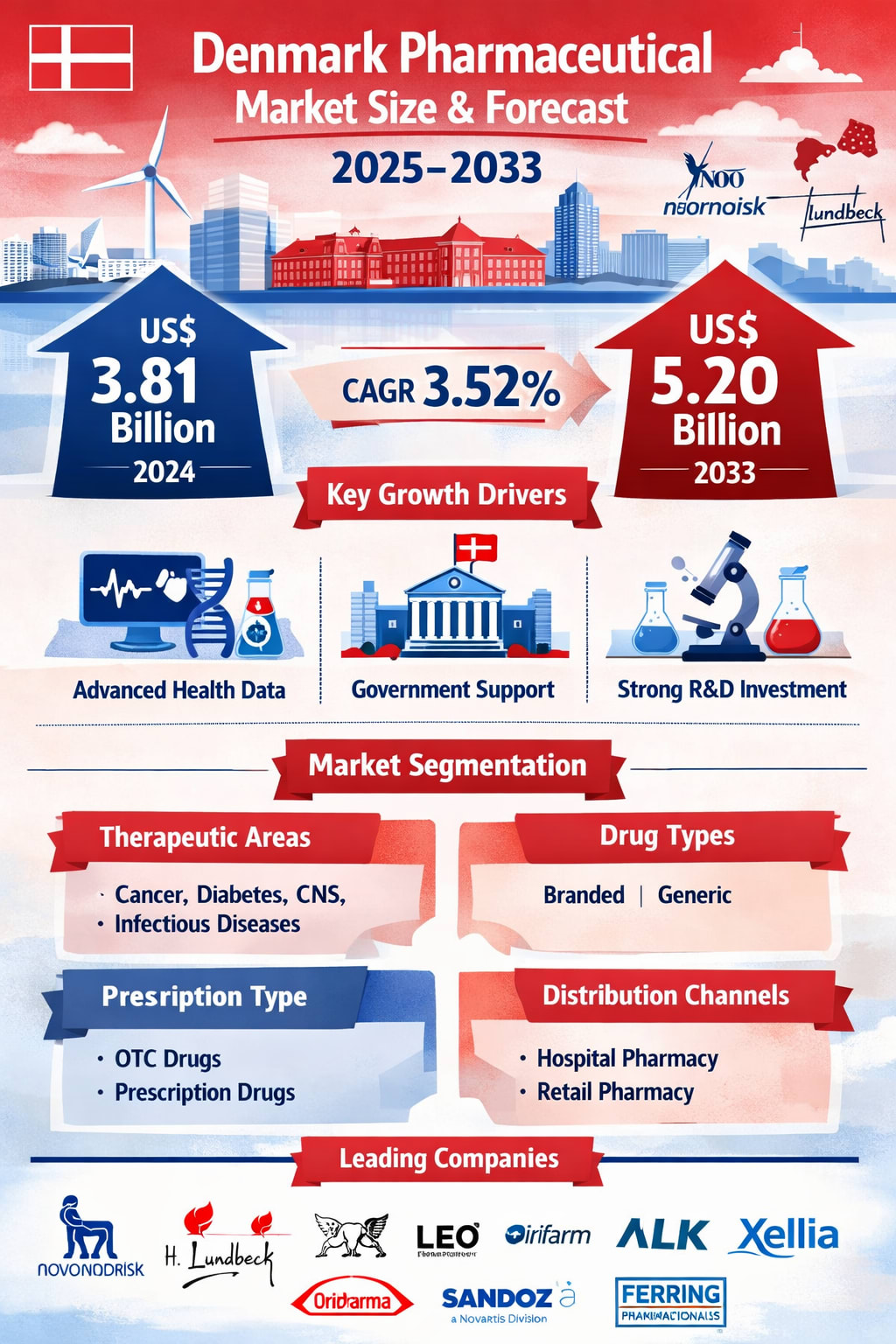
According to Renub Research’s latest industry analysis, the Denmark Pharmaceutical Market is expected to reach US$ 5.20 billion by 2033, rising from US$ 3.81 billion in 2024, at a compound annual growth rate (CAGR) of 3.52% from 2025 to 2033. This steady growth reflects Denmark’s unique position as one of Europe’s most innovation-driven and data-rich healthcare ecosystems.
Denmark may be a relatively small country in terms of population, but it plays an outsized role in the global pharmaceutical and life sciences landscape. Home to internationally renowned companies such as Novo Nordisk, Lundbeck, and Leo Pharma, the country has built a reputation for excellence in diabetes care, neuroscience, dermatology, and biologics. Combined with a strong public healthcare system, a highly digitized health data infrastructure, and supportive government policies, Denmark has become a preferred destination for pharmaceutical research, clinical trials, and high-value manufacturing.
The pharmaceutical sector in Denmark covers the research, development, production, and commercialization of medicines used to prevent, treat, and manage diseases. From prescription medicines and vaccines to over-the-counter (OTC) products and advanced biologics, the industry plays a critical role in improving quality of life, extending life expectancy, and supporting economic growth through high-value exports and skilled employment.
As global healthcare systems face rising demand due to aging populations, chronic diseases, and technological disruption, Denmark’s pharmaceutical market is positioned not for explosive growth, but for stable, innovation-led expansion—grounded in science, data, and global collaboration.
Denmark Pharmaceutical Market Overview
The Danish pharmaceutical industry is widely recognized for its high level of specialization, strong innovation culture, and close cooperation between academia, hospitals, and private companies. The country consistently ranks among the top nations in the world for research and development spending as a share of GDP, with life sciences and healthcare forming a central pillar of this investment.
One of Denmark’s biggest strategic advantages is its integrated healthcare data ecosystem. Every citizen is assigned a unique personal identification number, allowing medical records to be securely linked across hospitals, clinics, and pharmacies. This creates a rich, longitudinal dataset that supports clinical research, real-world evidence generation, post-marketing surveillance, and personalized medicine development.
The domestic market is supported by a well-developed public healthcare system, which ensures broad access to medicines and encourages the adoption of innovative therapies when they demonstrate clear clinical and economic value. At the same time, Denmark’s pharmaceutical industry is strongly export-oriented, with Danish-made medicines reaching markets across Europe, North America, and beyond.
From a regulatory perspective, Denmark benefits from transparent, efficient institutions and full access to the European Union market, which allows companies operating in Denmark to scale their products across the region. This combination of local strengths and international reach makes the Danish pharmaceutical sector both resilient and globally competitive.
Key Growth Drivers for the Denmark Pharmaceutical Market
1. Advanced Health Data Infrastructure
One of the most powerful growth engines for Denmark’s pharmaceutical industry is its world-leading health data infrastructure. The country maintains comprehensive national registries, biobanks, and electronic health records that cover virtually the entire population. Because these systems are interoperable and securely linked, researchers and pharmaceutical companies can conduct large-scale, high-quality studies with long-term follow-up.
This environment significantly reduces the time and cost of clinical research, improves patient recruitment for trials, and strengthens pharmacovigilance and real-world evidence generation. For drug developers, this means faster development cycles, better safety monitoring, and more precise targeting of therapies to patient groups that will benefit most.
At the same time, Denmark enforces strict data protection and privacy regulations, which helps maintain public trust and makes the country an attractive partner for international research collaborations. In an era where data-driven medicine is becoming central to drug development, Denmark’s digital health ecosystem is a major competitive advantage.
2. Supportive Government Policies
Government support has played a crucial role in shaping Denmark’s life sciences success story. The country’s Life Sciences Growth Plan includes a wide range of initiatives aimed at strengthening clinical research, improving regulatory processes, and attracting international investment.
One notable measure is the creation of a “one-stop-shop” for pharmaceutical companies, designed to simplify administrative procedures and speed up approvals for research and manufacturing activities. By reducing regulatory friction, Denmark makes it easier for both domestic and foreign companies to establish and expand operations.
In addition, Denmark’s collaboration with the pharmaceutical industry on climate and sustainability goals reflects a forward-looking approach that aligns economic growth with environmental responsibility. This policy stability and long-term strategic vision provide companies with the confidence to invest heavily in research, production capacity, and innovation.
3. Strong R&D Investment and Innovation Culture
Denmark consistently ranks among the global leaders in R&D spending, with a significant share directed toward life sciences and pharmaceuticals. Major players such as Novo Nordisk and Lundbeck invest heavily in drug discovery, clinical development, and advanced manufacturing technologies, while universities and public research institutions contribute cutting-edge science and skilled talent.
The close cooperation between academia, hospitals, and industry creates a dynamic innovation ecosystem where ideas move efficiently from the laboratory to the clinic. Government incentives, tax benefits, and research grants further strengthen this environment, making Denmark an attractive hub for both established pharmaceutical companies and emerging biotech firms.
This strong R&D foundation supports continuous innovation in areas such as biologics, personalized medicine, neuroscience, and metabolic diseases, ensuring that Denmark remains competitive in high-value therapeutic segments rather than competing solely on volume or cost.
Challenges Facing the Denmark Pharmaceutical Market
Regulatory Complexity and EU Compliance
Despite its many strengths, the Danish pharmaceutical industry also faces challenges—chief among them being regulatory complexity. Companies must comply not only with national Danish regulations but also with strict European Union pharmaceutical frameworks. While these rules are essential for ensuring patient safety and product quality, they can also increase development costs and extend approval timelines.
For startups and small-to-medium enterprises (SMEs), navigating this regulatory environment can be particularly demanding, requiring significant financial and administrative resources. In a fast-moving global market, balancing rigorous compliance with the need for speed and innovation remains an ongoing challenge.
Sustainability and the Green Transition
Denmark is a global leader in sustainability, and this leadership brings both opportunity and pressure for the pharmaceutical industry. Companies are increasingly expected to reduce carbon emissions, improve energy efficiency, manage water usage, and minimize waste across their manufacturing and supply chains.
Meeting these expectations often requires significant investment in new technologies and process redesign, which can strain budgets and complicate operations—especially in an industry already facing high R&D and regulatory costs. The challenge for Danish pharmaceutical companies is to integrate green practices in a way that preserves competitiveness while meeting ambitious national and EU climate goals.
Recent Developments in the Denmark Pharmaceutical Industry
The Danish pharmaceutical sector has remained highly active in recent years, reflecting both its innovation capacity and its responsiveness to global health challenges:
July 2022: Danish company Bavarian Nordic expanded its capacity to produce up to 10 million doses of the monkeypox vaccine, highlighting Denmark’s role in global vaccine supply and epidemic preparedness.
June 2022: Novo Nordisk A/S partnered with Echosens to promote early detection of non-alcoholic steatohepatitis (NASH) and raise patient awareness, underlining the industry’s growing focus on early diagnosis and preventive care.
These developments illustrate how Danish pharmaceutical companies continue to combine scientific innovation with real-world healthcare impact.
Market Segmentation: Understanding the Structure of Demand
The Denmark pharmaceutical market is segmented across several important dimensions, reflecting the diversity of medical needs and treatment approaches.
By Therapeutic Class
Key therapeutic areas include:
Cancer
Infectious Diseases
Cardiovascular Diseases
Diabetes
Respiratory Diseases
Central Nervous System Disorders
Autoimmune Diseases
Others
Among these, diabetes, oncology, and CNS disorders play particularly important roles, driven by both domestic healthcare needs and Denmark’s global leadership in certain specialty treatments.
By Drug Type
Branded
Generic
While branded, innovative medicines dominate in terms of value, generic drugs remain essential for cost containment and broad patient access, especially in chronic disease management.
By Prescription Type
OTC Drugs
Prescription Drugs
Prescription medicines account for the majority of market value, reflecting the industry’s focus on specialized and high-impact therapies, while OTC products support everyday healthcare needs.
By Distribution Channel
Hospital Pharmacy
Retail Pharmacy
Others
Hospitals remain central for complex and high-cost treatments, while retail pharmacies play a key role in chronic disease management and primary care access.
Competitive Landscape and Key Players
The Danish pharmaceutical market features a mix of global leaders and strong regional players, all operating in a highly innovation-driven environment. Key companies include:
Novo Nordisk A/S
H. Lundbeck A/S
Leo Pharma A/S
Orifarm Group A/S
ALK-Abell A/S
Xellia ApS
Takeda Pharma A/S
Sandoz A/S
Ferring Pharmaceuticals A/S
FUJIFILM Diosynth Biotechnologies
Each of these companies is typically analyzed across five dimensions: company overview, key persons, recent developments and strategies, SWOT analysis, and sales analysis. Together, they form a competitive ecosystem that balances global reach with specialized expertise.
Outlook: A Market Built for Sustainable, Innovation-Led Growth
Looking ahead to 2033, Denmark’s pharmaceutical market is expected to maintain steady, resilient growth rather than dramatic expansion. The projected rise from US$ 3.81 billion in 2024 to US$ 5.20 billion by 2033 reflects a sector that is mature, stable, and deeply rooted in high-value innovation.
Key trends shaping the future include greater use of real-world data, continued investment in biologics and personalized medicine, stronger sustainability requirements, and deeper international collaboration. While regulatory and environmental challenges will require careful management, Denmark’s strong institutional framework and innovation culture provide a solid foundation for long-term success.
Final Thoughts
The Denmark pharmaceutical market stands as a powerful example of how data, science, policy, and industry collaboration can create a globally competitive healthcare ecosystem. With strong R&D investment, supportive government strategies, world-class companies, and unmatched health data infrastructure, Denmark is well-positioned to remain a key player in European and global pharmaceuticals.
Rather than chasing short-term growth, the country’s industry is focused on long-term value creation, patient outcomes, and sustainable innovation—a strategy that aligns perfectly with the evolving needs of global healthcare. For investors, policymakers, and industry leaders alike, Denmark represents not just a market, but a model for the future of pharmaceutical development.
About the Creator
Keep reading
More stories from shibansh kumar and writers in Trader and other communities.
European Office Furniture Market Size and Forecast 2025–2033: Designing the Future of Workspaces
Introduction According to Renub Research’s latest market assessment, the European Office Furniture Market is expected to grow from US$ 11.92 billion in 2024 to US$ 25.63 billion by 2033, registering a robust compound annual growth rate (CAGR) of 8.88% from 2025 to 2033. This impressive growth trajectory reflects the profound transformation underway in Europe’s work culture, driven by hybrid work models, rising awareness of employee well-being, sustainability commitments, and the rapid evolution of modern workspace design.
By shibansh kumarabout 8 hours ago in Trader
Bluetooth Speaker Market Set to Soar to USD 66.1 Billion by 2034 | At CAGR 14.10%
Overview Bluetooth Speaker Market Bluetooth speakers are wireless audio devices that use Bluetooth technology to connect with smartphones, tablets, laptops, and other digital devices. The market has experienced significant expansion as wireless audio solutions replace traditional wired speakers. The increasing popularity of music streaming platforms, podcasts, and mobile entertainment has strengthened the demand for high-performance Bluetooth speakers globally.
By James Smith4 days ago in Trader


Comments
There are no comments for this story
Be the first to respond and start the conversation.