
Trump's Tariff Threat Rocks Global Financial Foundations
By X INVERSIONES Club: Empowering the Next Generation of Investors

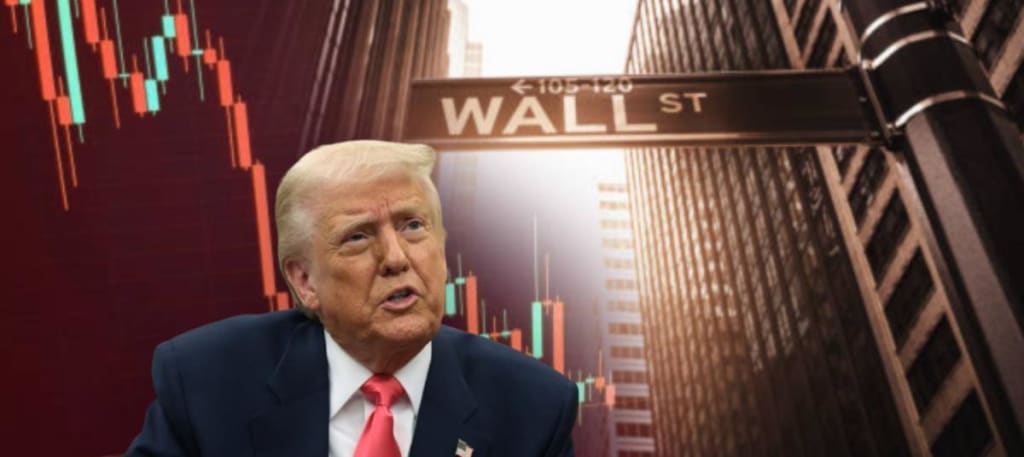
President Donald Trump's recent comments about imposing new tariffs if he returns to office have sent ripples through global financial markets, causing significant sell-offs on Wall Street, in European stocks, and particularly impacting Apple Inc. Trump's "rebalancing trade" rhetoric has reignited fears of a volatile trade war era, unsettling investors across multiple sectors and continents.
What Did Trump Say?
At a campaign event and later elaborating on social media, Trump proposed a universal 10% tariff on all foreign imports if he wins the 2024 presidential election. While he presented it as a measure to protect American manufacturing and reduce reliance on foreign production, markets interpreted it as a threat to global trade stability.
Trump also singled out Chinese tech imports and European auto exports as priority targets for "corrective" tariffs. These comments mirrored his 2018-2019 trade war strategy, which resulted in retaliatory measures and global market instability.
A Familiar Playbook with New Risks
While markets have grown somewhat accustomed to Trump's bold pronouncements, this time the impact was immediate and far-reaching. Analysts note that even the possibility of renewed trade friction, especially in an inflation-sensitive, post-COVID economy, carries real risks.
"This rhetoric simultaneously feeds into inflation fears, geopolitical uncertainty, and corporate vulnerability," stated Emily Carter, a senior economist at Vanguard Global. "We're looking at a worst-case scenario where global trade becomes weaponized again."
Wall Street Reacts: Red Across the Board
The Dow Jones Industrial Average dropped 480 points, the S&P 500 fell 1.3%, and the Nasdaq slid 1.8% following Trump's remarks. Tech stocks, often considered trade-sensitive due to their reliance on global supply chains, bore the brunt of the sell-off.
Apple, in particular, experienced a sharp 3.5% decline, wiping out nearly $100 billion in market capitalization in just one day. The iPhone maker's dependence on Chinese manufacturing and its vast international market presence make it especially vulnerable to renewed trade tensions.
Apple: A Canary in the Coal Mine
Apple's steep drop serves as a harbinger of what could happen to other multinational corporations. Investors are concerned not only about tariffs but also about potential Chinese retaliation, such as:
Restrictions on rare earth minerals vital for tech production.
Regulatory pressure on U.S. companies operating in China.
Nationalist consumer backlash.
Reportedly, Apple CEO Tim Cook has initiated closed-door meetings with supply chain partners to assess potential contingency plans if Trump's tariff threats gain traction.
"Apple's exposure to China isn't just limited to production, but also sales," noted Joanna Tan, a tech analyst at Bloomberg. "Any disruption on either side of the equation spells trouble."
European Stocks Slump on Trade War Fears
Trump's statements didn't just rattle U.S. markets. European indices also took a hit, with the FTSE 100 losing 1.1%, Germany's DAX down 1.4%, and France's CAC 40 dropping 1.6%. The reason? Many European economies rely heavily on exports to the U.S., especially in the automotive, luxury, and machinery sectors.
German automakers like BMW, Volkswagen, and Mercedes-Benz fell between 2.5% and 3.2%, with analysts fearing a return to the 25% tariffs of the Trump era. Luxury brands such as LVMH and Hermès also recorded losses, driven by weakening consumer confidence amidst economic nationalism.
Business Leaders and Economists Speak Out
Trump's tariff-centric trade policies have long drawn criticism from economists who argue they ultimately harm consumers by raising prices and disrupting supply chains. This time, the business community is reacting quickly and forcefully.
Key concerns include:
Inflation Resurgence: New tariffs could fuel rising prices for consumer goods, especially electronics and automobiles.
Supply Chain Instability: Companies may delay or revise global sourcing plans, increasing operational costs.
Investor Uncertainty: Markets could experience sustained volatility throughout the 2024 election cycle.
The U.S. Chamber of Commerce, typically aligned with Republican economic principles, issued a cautious statement urging candidates to adopt "balanced and predictable trade policies" that avoid unnecessary economic disruptions.
Tariffs and the 2024 Election: Political Tool or Policy Plan?
While it remains unclear whether Trump's tariff threats are genuine policy intent or a campaign strategy, the impact is already tangible. His base views tariffs as a strong measure to protect American jobs, particularly in manufacturing-heavy states like Michigan, Ohio, and Pennsylvania.
However, economic analysts warn that such rhetoric, while politically effective, has real economic consequences.
"Markets aren't waiting for November 2024 to react; they're reacting now," stated Rachel Lian, Head of Global Macro at Fidelity Investments.
Global Markets on Alert
The repercussions of Trump's comments extend beyond the U.S. and Europe. Asian markets, notably China's Shanghai Composite and Japan's Nikkei 225, also experienced declines on renewed trade conflict fears. The yuan slightly weakened against the dollar, and oil prices dipped on concerns about lower industrial demand.
Even emerging markets took a hit, with the MSCI Emerging Markets Index falling 1.5%, reflecting fears of decreased U.S. import demand and increased dollar volatility.
What Should Investors Expect Next?
Market analysts are divided on whether this is a short-term reaction or the beginning of prolonged uncertainty. Much will depend on how Trump's comments translate into concrete policy proposals and how his political opponents respond.
Some hedge funds are already hedging against increased volatility, and multinational corporations are reviewing their risk management strategies, including reshoring production or diversifying supply chains.
Investors are advised to:
Closely monitor political developments.
Avoid overexposure to tariff-vulnerable sectors.
Prepare for currency and commodity fluctuations.
Focusing on domestic companies might be a safer bet.
Final Thoughts
Trump's latest tariff threats have opened a new front of uncertainty in the global economy. Wall Street's reaction, the nervousness in European markets, and Apple's drastic drop highlight the deep interconnectedness of today's financial systems and their vulnerability to political rhetoric.
As the 2024 election cycle intensifies, markets will be watching not only Trump's words but also how the world prepares to respond. Whether this is a brief dip or the start of a broader trend will depend on what happens next, but one thing is clear: the tariff debate is back, and it's rattling the foundations of global finance once again.
About the Creator
X Inversiones
Investment is not based on luck, but on strategy.
Keep reading
More stories from X Inversiones and writers in Trader and other communities.
The Global Economic Maze: Navigating Investments in a Volatile World
The intricately intertwined complexities of the global economy and investment decisions represent a fascinating field of study, demanding a keen understanding of macroeconomic forces, geopolitics, and human behavior. In an increasingly interconnected world, the repercussions of an event in one region can be felt across the globe, creating both risks and opportunities for investors.
By X Inversiones8 months ago in Trader
Stanislav Kondrashov on Greenland’s Strategic Role in the Future of Global Trade and Resources
By all appearances, Greenland is on the brink of becoming one of the world’s most closely watched regions—not for its glaciers, but for what lies beneath and beyond them. Stanislav Kondrashov, economic analyst and founder of TELF AG, has recently cast a spotlight on the island’s rising significance in global trade and resource strategy. And his perspective is clear: Greenland is not just a geographical outlier—it is a future linchpin.
By Stanislav Kondrashov4 days ago in Trader
Blox Stock: Investors Are Taking Notice Here’s Why
Blox stock has been gaining attention lately, and many investors are wondering if it’s the right time to buy. With its recent surge and growing market interest, blox stock is becoming a stock to watch closely. They will break down what makes blox stock appealing, analyze trends, and explain why it could play an important role in your investment portfolio.
By John.doe7984 days ago in Trader



Comments (1)
Trump's tariff talk is causing chaos in markets again. His proposed 10% import tariff and focus on Chinese tech and European autos are concerning. It's like he's bringing back the old trade war playbook. The market drops show how worried investors are. Do you think there's any way to avoid another full-blown trade war if he gets back in office? This kind of uncertainty is bad for businesses. Tech companies like Apple are especially vulnerable. Their supply chains will be disrupted. How long will it take for markets to recover if this trade war threat becomes real? It's a tough situation for everyone involved.