
Transportation Battery Market Size and Forecast 2025–2033: Powering the Future of Global Mobility
From EV boom to grid integration, how batteries are reshaping transportation—and why the market is set to triple by 2033

Introduction: The Battery at the Heart of a Transport Revolution
The global transportation industry is in the middle of one of the biggest transformations in its history. For over a century, internal combustion engines powered by petrol and diesel dominated roads, rails, and logistics networks. Today, that dominance is being challenged by a quieter, cleaner, and far more efficient alternative: electric mobility. At the center of this transition lies one critical component—the transportation battery.
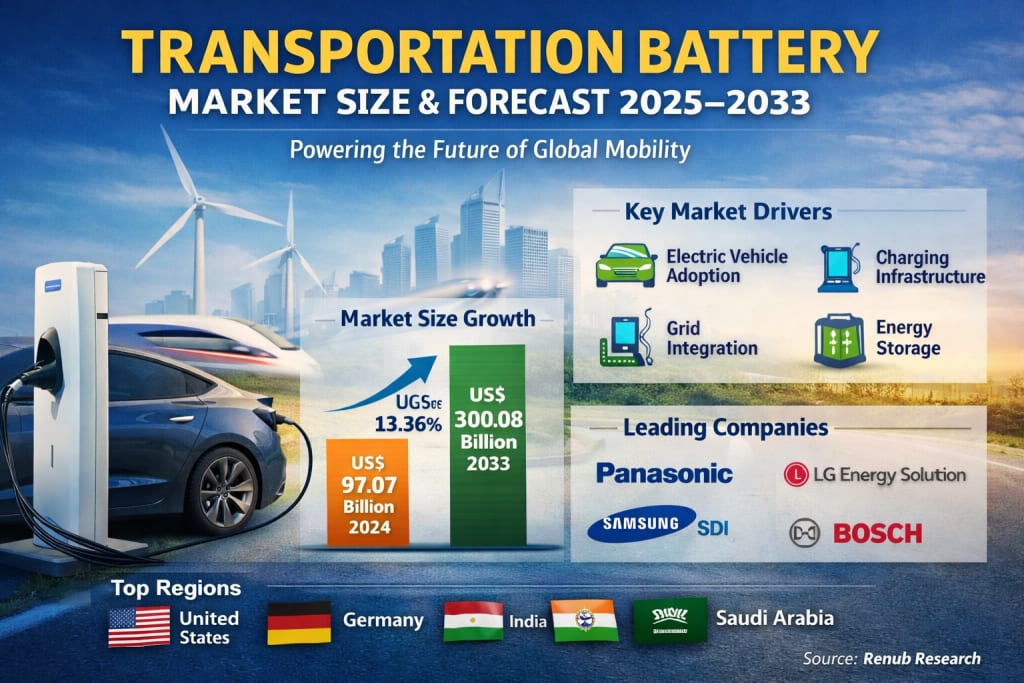
According to Renub Research, the Transportation Battery Market is expected to reach US$ 300.08 billion by 2033, up from US$ 97.07 billion in 2024, growing at a robust CAGR of 13.36% from 2025 to 2033. This rapid growth is being fueled by rising electrification, expanding charging infrastructure, increasing adoption of electric vehicles (EVs), grid integration, and the growing role of energy storage solutions.
From passenger cars and commercial fleets to buses and emerging electric mobility solutions, batteries are no longer just components—they are strategic assets shaping the future of transportation, energy, and sustainability.
Global Transportation Battery Market Overview
The transportation battery market is experiencing explosive growth as governments, corporations, and consumers push for cleaner and more sustainable mobility solutions. Batteries now power not only electric cars, but also electric buses, trucks, two-wheelers, and even marine and rail transport in certain regions.
One of the biggest enablers of this growth has been advancements in battery technology, particularly lithium-ion batteries. Improvements in energy density, charging speed, safety, and lifespan have made electric vehicles more practical and cost-effective than ever before. These innovations have significantly reduced “range anxiety” and improved the overall ownership experience for EV users.
At the same time, the global shift toward renewable energy is strengthening the case for battery-powered transportation. Batteries are increasingly being viewed not just as vehicle components, but as part of a broader energy ecosystem—one that connects vehicles to power grids, renewable energy sources, and smart charging infrastructure.
However, the market is not without challenges. Raw material constraints, high production costs, supply chain vulnerabilities, and recycling concerns continue to pose risks. Despite these hurdles, the long-term outlook remains extremely positive, driven by technology, policy support, and changing consumer preferences.
Key Growth Drivers of the Transportation Battery Market
1. Increasing Adoption of Electric Vehicles (EVs)
The single biggest driver of the transportation battery market is the rapid global adoption of electric vehicles. Governments across the world are tightening emissions regulations and setting ambitious carbon neutrality targets. As a result, both consumers and businesses are shifting away from internal combustion engine vehicles toward electric alternatives.
Incentives such as tax rebates, purchase subsidies, reduced registration fees, and access to low-emission zones are accelerating EV adoption. From compact passenger cars to heavy-duty commercial trucks and city buses, electrification is spreading across all vehicle categories. Each new EV sold directly increases demand for high-performance, reliable batteries, making EV growth a powerful engine for the transportation battery market.
2. Government Regulations and Policy Support
Government action plays a crucial role in shaping the future of the transportation battery industry. Many countries have introduced strict emissions standards, fuel economy regulations, and long-term bans on new petrol and diesel vehicles. Alongside these restrictions, policymakers are offering strong financial and infrastructure support for electric mobility.
Public investments in charging networks, battery manufacturing, and research & development are helping reduce barriers to EV adoption. These policies not only stimulate demand for electric vehicles but also create a favorable environment for battery manufacturers to scale production, innovate, and reduce costs over time.
3. Technological Advancements in Battery Technology
Battery technology is evolving at a remarkable pace. Lithium-ion batteries continue to dominate the market due to their high energy density, relatively long lifespan, and improving safety profile. At the same time, research into solid-state batteries and next-generation chemistries promises even higher performance, faster charging, and better safety.
These technological improvements are making EVs more competitive with traditional vehicles in terms of range, convenience, and total cost of ownership. As batteries become lighter, more durable, and cheaper, electric vehicles become more attractive to a wider range of consumers—further accelerating market growth.
Major Challenges Facing the Market
1. Battery Recycling and Environmental Impact
As EV adoption increases, so does the number of batteries reaching the end of their useful life. Lithium-ion batteries contain valuable but potentially hazardous materials such as lithium, cobalt, and nickel. If not properly recycled, these materials can pose serious environmental risks.
While recycling technologies are improving, global recycling infrastructure is still underdeveloped compared to the scale of future battery waste. Building efficient, cost-effective, and environmentally safe recycling systems is essential for the long-term sustainability of the transportation battery market.
2. Battery Performance, Degradation, and Longevity
Despite significant progress, battery degradation over time remains a concern for many consumers. Reduced capacity, shorter driving range, and eventual replacement costs can affect the perceived value of electric vehicles.
Manufacturers are investing heavily in improving battery durability, thermal management, and energy efficiency, but addressing these concerns at scale is critical for maintaining consumer confidence and ensuring long-term market growth.
Regional Market Insights
United States Transportation Battery Market
The United States is one of the most important markets for transportation batteries, driven by strong consumer interest in EVs and supportive government policies. Federal and state-level incentives, combined with stricter emissions standards, are accelerating the transition to electric mobility.
Major automakers such as Tesla, General Motors, and Ford are investing heavily in battery technology and domestic manufacturing capacity. At the same time, the expansion of charging infrastructure is making EV ownership more practical across the country. While challenges such as high battery costs and supply chain constraints remain, technological progress and policy support continue to push the U.S. market forward.
Germany Transportation Battery Market
Germany, the heart of Europe’s automotive industry, is playing a leading role in the shift toward electric mobility. Automakers like Volkswagen, BMW, and Mercedes-Benz are investing billions in EV platforms and battery development.
Strong government incentives, strict emissions regulations, and a well-developed charging network are driving EV adoption. However, Germany also faces challenges related to raw material dependency and the need for more advanced recycling systems. Even so, the country remains a key pillar of the global transportation battery market.
India Transportation Battery Market
India’s transportation battery market is gaining momentum as the country focuses on reducing air pollution and cutting oil imports. Government initiatives, including subsidies and tax benefits for EVs, are encouraging both manufacturers and consumers to embrace electric mobility.
Companies like Tata Motors and Mahindra Electric are expanding their EV portfolios, while investments in charging infrastructure are steadily increasing. High battery costs and limited charging coverage still pose challenges, but the long-term growth potential of the Indian market is significant.
Saudi Arabia Transportation Battery Market
Saudi Arabia’s Vision 2030 strategy is driving diversification away from oil and toward sustainable technologies, including electric mobility. Government support, infrastructure investments, and growing interest from international companies are helping build the foundation for an EV ecosystem.
Although challenges such as limited local manufacturing capacity and early-stage infrastructure remain, the Saudi transportation battery market is expected to grow steadily as the country moves toward a more sustainable transport future.
Market Segmentation Overview
By Battery Type
Lead-Acid
Lithium-Ion
Other Battery Types
By Vehicle Type
Passenger Cars
Commercial Vehicles
By Drive Type
Internal Combustion Engine
Electric Vehicles
By Region
North America: United States, Canada
Europe: France, Germany, Italy, Spain, United Kingdom, Belgium, Netherlands, Turkey
Asia Pacific: China, Japan, India, Australia, South Korea, Thailand, Malaysia, Indonesia, New Zealand
Latin America: Brazil, Mexico, Argentina
Middle East & Africa: South Africa, Saudi Arabia, United Arab Emirates
Competitive Landscape: Key Companies Shaping the Market
The transportation battery market is highly competitive, with global players focusing on innovation, capacity expansion, strategic partnerships, and cost reduction. Key companies covered in the market include:
Panasonic Corporation
Exide Industries
VARTA
Hitachi Group Ltd
Robert Bosch GmbH
Samsung SDI Co. Ltd
LG Chem Ltd
These companies are investing heavily in next-generation battery technologies, supply chain security, and sustainability initiatives to strengthen their positions in a rapidly evolving market.
The Road Ahead: What the Future Holds
The future of the transportation battery market is closely tied to the future of global mobility itself. As electric vehicles move from niche products to mainstream choices, batteries will become even more central to economic, environmental, and energy strategies worldwide.
With the market projected by Renub Research to grow from US$ 97.07 billion in 2024 to US$ 300.08 billion by 2033, the scale of opportunity is enormous. Continued advancements in technology, supportive government policies, and growing environmental awareness are expected to keep the momentum strong throughout the forecast period.
Final Thoughts
The transportation battery market is no longer just about powering vehicles—it is about powering a global transition toward cleaner, smarter, and more sustainable mobility. While challenges around cost, recycling, and performance remain, the pace of innovation and investment suggests that these hurdles will be gradually overcome.
As electric vehicles become the norm rather than the exception, transportation batteries will stand at the center of this transformation—quietly, efficiently, and decisively reshaping how the world moves.
About the Creator
United States Biscuits Market Size and Forecast 2025
Introduction The humble biscuit has long been a staple of American food culture, appearing on breakfast tables, in snack aisles, and alongside classic comfort meals across the country. What was once seen primarily as a simple baked good has now evolved into a dynamic and innovation-driven product category that reflects broader changes in consumer behavior, retail strategies, and nutritional preferences.
By Sakshi Sharma4 days ago in Trader



Comments
There are no comments for this story
Be the first to respond and start the conversation.