
Global E-Commerce Market Set for a Trillion-Dollar Decade: Trends, Growth Drivers, and Regional Outlook (2025–2033)
AI-powered shopping, cross-border trade, and secure digital payments are reshaping the future of global online retail

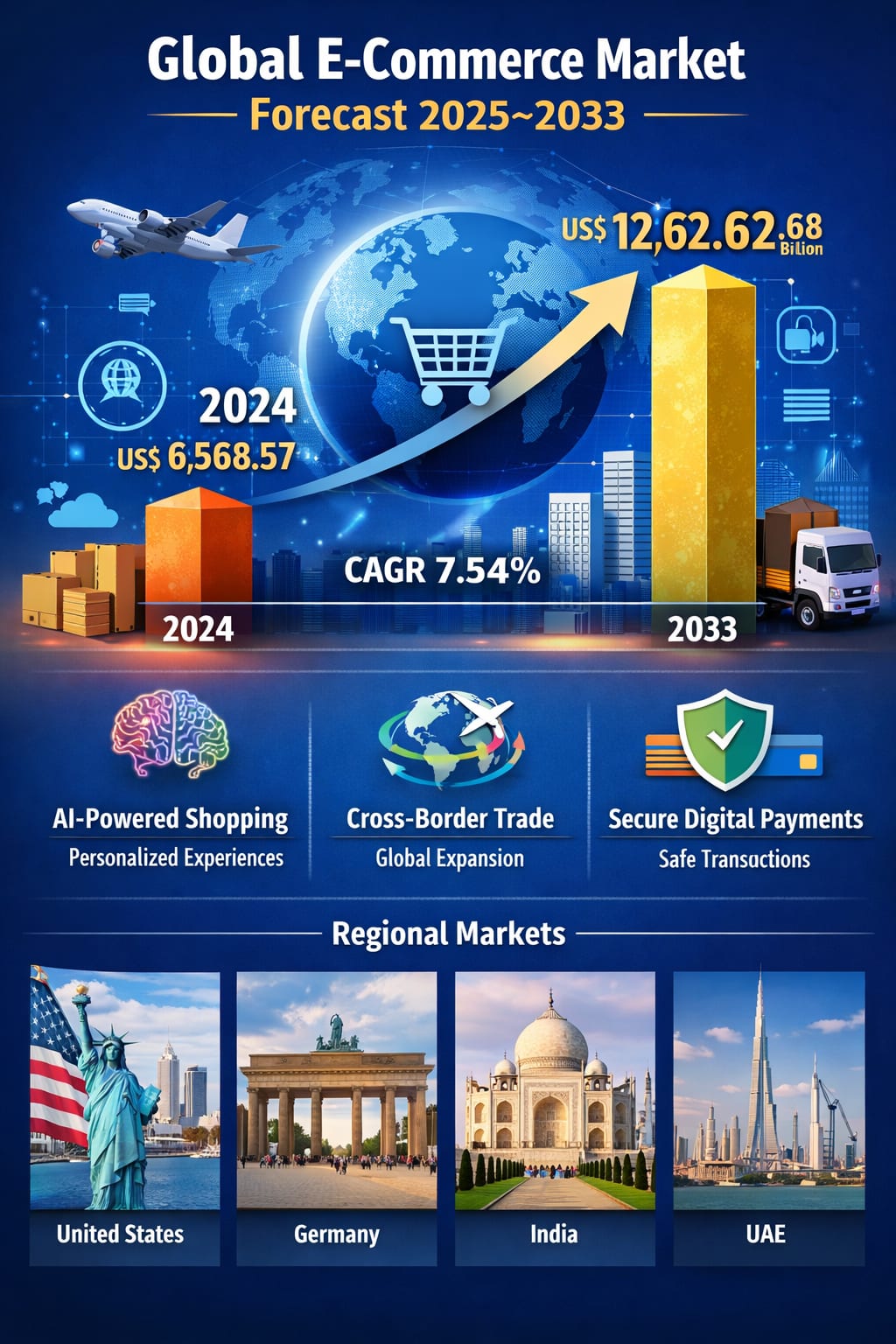
Global E-Commerce Market Overview
The global e-commerce industry has undergone a dramatic transformation over the past decade, redefining how consumers shop and how businesses sell. What began as a convenient alternative to brick-and-mortar retail has evolved into a central pillar of the global economy. Today, e-commerce influences everything from supply chains and logistics to marketing strategies and consumer behavior across virtually every industry.
According to Renub Research, the global e-commerce market is expected to reach US$ 12,632.68 billion by 2033, up from US$ 6,568.57 billion in 2024, growing at a compound annual growth rate (CAGR) of 7.54% from 2025 to 2033. This impressive expansion reflects not only rising internet and smartphone penetration, but also deeper structural shifts in how people discover, compare, and purchase products.
E-commerce now spans a vast range of categories including food and beverages, fashion, electronics, furniture, beauty and personal care, books, and even services. The convenience of shopping from anywhere, combined with increasingly fast delivery options and flexible payment methods, has made online retail a default choice for millions of consumers worldwide.
The COVID-19 pandemic accelerated this transition, pushing both consumers and businesses to embrace digital channels. Even as physical stores reopened, many of the habits formed during that period remained. Consumers grew accustomed to home delivery, easy price comparisons, and personalized recommendations, while businesses invested heavily in digital storefronts, logistics, and customer experience technologies.
Today, the e-commerce landscape is shaped by a few dominant global players such as Amazon, Alibaba, and Walmart, alongside strong regional platforms and a growing ecosystem of niche and direct-to-consumer brands. At the same time, new technologies—particularly artificial intelligence, advanced payment systems, and faster connectivity through 5G—are redefining what online shopping looks like and what customers expect from it.
Key Growth Drivers Shaping the Market
The Rise of Cross-Border E-Commerce
One of the most powerful forces driving the global e-commerce market is the rapid expansion of cross-border trade. High-speed internet access, widespread smartphone usage, and the growing availability of digital payment solutions have made it easier than ever for consumers to shop from international platforms.
Global supply chains have become more interconnected, allowing companies to source products from multiple regions and sell them to customers worldwide. For consumers, this means greater product variety, more competitive pricing, and access to brands that were once limited by geography. For businesses, it opens the door to massive new customer bases without the need to invest in physical retail infrastructure in every market.
The growth of third-party logistics providers and cross-border fulfillment services has also reduced shipping times and costs, making international orders more reliable and attractive. As a result, cross-border e-commerce is no longer a niche segment—it is becoming a core growth engine for the entire industry.
AI-Driven Features and Smarter Shopping Experiences
Artificial intelligence is rapidly transforming how e-commerce platforms interact with customers. From personalized product recommendations and dynamic pricing to chatbots and predictive inventory management, AI is helping retailers improve efficiency while delivering more relevant and engaging shopping experiences.
One of the most exciting developments is the rise of virtual fitting rooms, especially in fashion and apparel. These tools allow customers to create digital avatars and see how different sizes and styles might look before making a purchase. This not only enhances customer confidence but also helps reduce return rates—one of the biggest cost challenges in online retail.
A notable example is Zalando, which introduced a virtual fitting room that enables users to visualize clothing on a 3D avatar based on their body measurements. Innovations like these highlight how AI is moving beyond back-end optimization and directly reshaping the customer journey.
As AI continues to evolve, it is expected to play an even bigger role in demand forecasting, fraud detection, customer service automation, and hyper-personalized marketing—making e-commerce smarter, faster, and more intuitive.
The Expansion of Secure Digital Payment Systems
Another major pillar of e-commerce growth is the continuous improvement in digital payment infrastructure. Consumers today can choose from a wide range of payment options, including digital wallets, credit and debit cards, account-to-account transfers, buy now pay later (BNPL) services, cash on delivery, and even cryptocurrencies in some markets.
Advancements in encryption, biometric authentication, and multi-factor security have significantly increased consumer trust in online transactions. As people become more comfortable sharing financial information online, transaction volumes continue to rise.
Mobile commerce, in particular, has benefited from these innovations. With just a few taps on a smartphone, users can browse, pay, and track orders seamlessly. This frictionless experience is a key reason why digital payments are now a cornerstone of e-commerce growth, especially in emerging markets where mobile-first users dominate.
Market Challenges: What Could Slow the Momentum?
Cybersecurity and Data Privacy Concerns
As e-commerce grows, so does the risk of cyberattacks, data breaches, and identity theft. Online retailers handle enormous volumes of sensitive customer data, including personal details and payment information. A single security breach can lead to financial losses, legal consequences, and long-term damage to brand reputation.
To address these risks, companies are investing heavily in cybersecurity measures such as secure payment gateways, encryption technologies, and multi-factor authentication. At the same time, stricter data protection regulations like GDPR in Europe and CCPA in the United States are raising the compliance bar for businesses operating online.
In this environment, strong data privacy and security practices are no longer optional—they are essential for building and maintaining customer trust in a highly competitive digital marketplace.
The Ongoing Challenge of Returns and Refunds
Returns and refunds remain one of the most complex and costly aspects of e-commerce operations. Consumers expect easy, hassle-free return policies, especially in categories like fashion and electronics where fit and expectations can vary.
However, high return rates increase operational costs related to shipping, inspection, restocking, and sometimes product disposal. Poor return experiences can also hurt customer loyalty and brand perception.
To manage this challenge, companies are turning to better product descriptions, improved sizing tools, AI-powered recommendations, and more efficient reverse logistics systems. Still, balancing customer satisfaction with cost control in returns management remains a critical issue for the industry.
Regional Market Insights
United States: A Mature but Still Growing Market
The United States remains one of the largest and most developed e-commerce markets in the world. Consumers increasingly prefer online shopping for its convenience, wide product selection, and competitive pricing. Major players like Amazon, Walmart, and eBay dominate the landscape, but niche platforms and direct-to-consumer brands continue to gain traction.
Key trends shaping the U.S. market include mobile commerce, social commerce, and subscription-based shopping models. Despite ongoing challenges such as logistics complexity, high return rates, and cybersecurity risks, continuous innovation in delivery speed, payment systems, and customer experience is expected to sustain long-term growth.
Germany: Europe’s E-Commerce Powerhouse
Germany is one of the largest e-commerce markets in Europe, driven by strong consumer trust in online shopping and high levels of digital adoption. Categories such as electronics, fashion, and groceries are particularly popular among German consumers.
While platforms like Amazon.de and Zalando lead the market, smaller and specialized online retailers are also thriving. Mobile commerce and advanced payment solutions are further accelerating growth. However, strict data protection regulations and complex return logistics continue to pose operational challenges for businesses operating in this market.
India: A High-Growth Digital Economy
India’s e-commerce market is expanding at a rapid pace, fueled by rising internet penetration, widespread smartphone usage, and a young, tech-savvy population. Platforms such as Amazon India, Flipkart, and Myntra dominate, while regional players cater to local preferences and price-sensitive consumers.
High demand is seen in electronics, fashion, groceries, and lifestyle products. Social commerce and mobile-first shopping experiences are becoming increasingly important. Although challenges like logistics infrastructure, price competition, and high return rates persist, India’s long-term growth potential remains exceptionally strong.
United Arab Emirates: A Tech-Savvy Retail Hub
The UAE has emerged as one of the fastest-growing e-commerce markets in the Middle East, supported by high internet penetration, strong purchasing power, and a digitally savvy population. Consumers in the region show strong demand for electronics, fashion, groceries, and beauty products.
Major platforms such as Amazon.ae, Noon, and Carrefour dominate the market, while local players continue to expand their presence. Mobile commerce and social shopping are on the rise, and government initiatives promoting digital transformation are further strengthening the e-commerce ecosystem.
E-Commerce Market Segmentation
By Product Categories
Food and Beverage
Apparel and Accessories
Health and Personal Care and Beauty
Computer and Consumer Electronics
Office Equipment and Supplies
Toys and Hobby
Furniture and Home Furnishing
Books, Music, and Video
Other Categories
By Payment Methods
Digital Wallet
Credit Card
Debit Card
Account-to-Account (A2A)
Buy Now, Pay Later (BNPL)
Cash on Delivery
Prepay
Other (Including Cryptocurrency)
Competitive Landscape and Key Players
The global e-commerce market is highly competitive, with both global giants and strong regional players shaping the industry. Key companies include:
Rakuten Inc.
Amazon.com Inc.
Alibaba Group Holding Limited
eBay Inc.
Walmart Inc.
Zalando SE
Otto Group
JD.com, Inc.
These companies compete across multiple dimensions, including pricing, logistics speed, technology innovation, product assortment, and customer experience. Investments in AI, automation, and last-mile delivery solutions are becoming critical differentiators in this crowded marketplace.
Final Thoughts
The global e-commerce industry is entering a defining decade. With the market projected to grow from US$ 6,568.57 billion in 2024 to US$ 12,632.68 billion by 2033, the scale of opportunity is enormous. Growth will be driven by cross-border trade, AI-powered shopping experiences, and increasingly secure and flexible digital payment systems.
At the same time, challenges such as cybersecurity risks, data privacy regulations, and the complexity of returns management will continue to test businesses. Those that can balance innovation with trust, efficiency with customer satisfaction, and growth with operational discipline will be best positioned to lead the next phase of global e-commerce.
About the Creator
Mexico Digital Twin Market Size, Opportunities & Investment Trends 2026–2034 | IMARC Analysis
Mexico Digital Twin Market Growth, Trends, Forecast, Key Players, and Opportunities Mexico Digital Twin Market Overview The Mexico Digital Twin Market is witnessing strong expansion as organizations across industries accelerate digital transformation initiatives. Digital twin technology, which enables the creation of virtual replicas of physical assets, systems, and processes, is increasingly being adopted to improve operational efficiency, predictive maintenance, and real-time decision-making.
By Kim Soo hyunabout 21 hours ago in Trader




Comments
There are no comments for this story
Be the first to respond and start the conversation.