
Trading Fear: How to Trade the VIX
Trading Fear


In a previous post, we discussed how to use the VIX Index to trade equities — particularly the S&P 500. But it’s also possible to trade the VIX directly using various financial instruments.
These trading vehicles come in the form of Exchange-Traded Funds (ETFs) and Exchange-Traded Notes (ETNs). Here’s what you need to know.
What Is an ETN?
An Exchange-Traded Note (ETN) is a type of debt security that trades on exchanges like a stock. It represents a promise from the issuer (typically a bank) to pay a return linked to a specific index or benchmark.
Unlike ETFs, which hold underlying assets (like stocks or futures), ETNs are unsecured debt instruments. This means their performance depends not only on the index they track but also on the creditworthiness of the issuer.
ETNs are often used to speculate on commodity futures markets (like oil or gold), but they’re also commonly used to trade volatility.
VIX ETNs: Trading Volatility Directly
Some ETNs are designed to track volatility futures, including indices that are either:
Long the VIX (they go up when the VIX rises), or
Short the VIX (they go up when the VIX falls)
There are also leveraged ETNs, which use derivatives to amplify returns — typically 1.5x or 2x the performance of the underlying index. For example, a 2x long leveraged ETN could gain twice as much as its non-leveraged counterpart when the VIX rises (but also lose twice as much when it falls).
Important Caveats When Trading VIX Products
There are two key risks when trading VIX-linked ETNs and ETFs:
Imperfect Tracking
These instruments do not perfectly follow the VIX itself. They often underperform during sharp VIX spikes, and their performance lags especially during volatile periods (see Figure 1).
Time Decay (Contango)
Because these products use futures contracts, they need to roll over contracts regularly — selling near-term contracts and buying later-dated ones.
When the futures market is in contango (where future contracts are more expensive), this leads to a gradual erosion of value over time — even if the VIX doesn’t move (see Figure 2).
⚠️ Long-term investors often experience losses from this time decay, which can be significant over months or years.
Figure 1. The VIX index (pink) and VXX (an ETN that attempts to track short-term volatility futures) over the past year. VXX grossly undershoots when the VIX spikes.
Figure 2. Time decay of VXX over the past five years due to contango.
How VIX ETFs Differ From ETNs
Both VIX ETFs and ETNs aim to provide exposure to VIX futures, but they differ in structure:
ETFs hold actual futures contracts (or sometimes S&P 500 options).
ETNs are debt obligations of the issuer and don’t hold any assets themselves.
As a rule of thumb:
The more complex the structure, the less precisely it tends to track the VIX itself.
Popular ETFs and ETNs That Track the VIX
Here are some commonly used products to trade the VIX, grouped by strategy:
🔹 Long VIX Exposure (rise in value when VIX rises):
XVZ — Tracks a broad volatility index
VXX, VIIX — Track short-term VIX futures
VXZ, VIXM — Track medium-term VIX futures
🔹 Short VIX Exposure (rise in value when VIX falls):
SVIX — Inverse exposure to the VIX
SVXY — Inverse exposure to short-term VIX futures
ZIV — Inverse exposure to medium-term VIX futures
🔹 Leveraged VIX Exposure (amplified movement, higher risk):
UVIX — 2x leveraged long exposure to the VIX
UVXY — 1.5x leveraged long exposure to short-term VIX futures
Using the VIX as a Contrarian Indicator
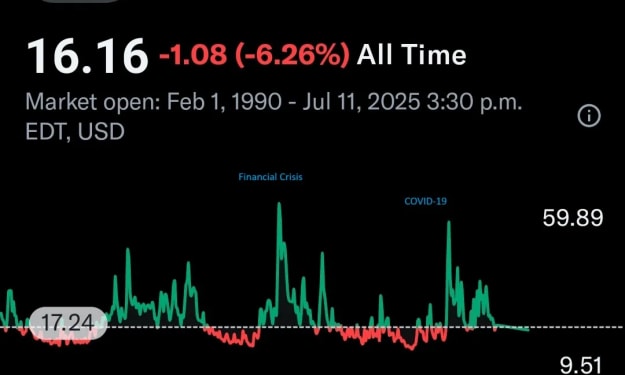
Many traders use the VIX as a contrarian signal — especially during spikes in volatility.
Historically, when the VIX spikes sharply, it tends to mean-revert rather than stay elevated. Traders can capitalize on this by shorting the VIX after a spike using short VIX ETFs or ETNs.
🧠 This strategy carries risk but can generate strong returns if timed correctly.
Using the VIX for Hedging
The VIX is also a useful hedging tool for equity investors. Since volatility typically rises when stocks fall, buying VIX-linked funds can help offset losses in a stock-heavy portfolio.
This is similar to buying insurance:
In most cases, the position will lose value slowly due to time decay.
But during a major downturn, the VIX spikes, and the hedge pays off.
🔒 Hedging with VIX products makes sense only as a protective strategy, not a long-term investment.
Final Thoughts
Trading the VIX is not the same as trading stocks or commodities. These instruments behave differently — often decaying over time, and they can amplify losses if misused.
Still, for active traders and sophisticated investors, VIX products offer powerful tools for:
Speculating on volatility
Short-term tactical trades
Hedging against market crashes
Always understand the structure, costs, and risks before entering a VIX-linked position.
About the Creator
Keep reading
More stories from Maher Quraan, PhD and writers in Trader and other communities.
What Is the Fear Index (VIX) — And How to Use It to Boost Your Returns
The Fear Index, officially known as the VIX, was created by the Chicago Board Options Exchange (CBOE) to measure expected market volatility over the next 30 days. It’s based on S&P 500 index options and is widely used as a barometer of investor sentiment and market risk.
By Maher Quraan, PhD7 months ago in Trader
alex honnold net worth: How Fearless Climbing Turned Passion into Lasting Wealth
alex honnold net worth is the result of a rare mindset and years of brave choices. Alex Honnold became famous for climbing huge rock walls without ropes. This risky path was not about money at first. It was about focus, control, and love for climbing. Over time, his bold actions brought global attention. That attention helped turn passion into income. Today, alex honnold net worth reflects both courage and smart decisions.
By John.doe7983 days ago in Trader
Challenges Facing the South Korea Cloud Computing Market 2026-2034
South Korea Cloud Computing Market Overview The South Korea cloud computing market size reached USD 3.9 Billion in 2024. Looking forward, IMARC Group expects the market to reach USD 11.6 Billion by 2033, exhibiting a growth rate (CAGR) of 12.36% during 2025-2033. The rising incidences of cybersecurity threats and data breaches, increasing emphasis on digital education and e-learning, and the widespread adoption of cloud computing solutions in the healthcare industry are among the key factors driving the market growth.
By Kim Soo hyun7 days ago in Trader



Comments
There are no comments for this story
Be the first to respond and start the conversation.