
The Real Reason America Can't Break China's Rare Earth Monopoly
The overwhelming power of China's industrial scale and why building a competing rare earth supply chain is a mission of monumental difficulty.
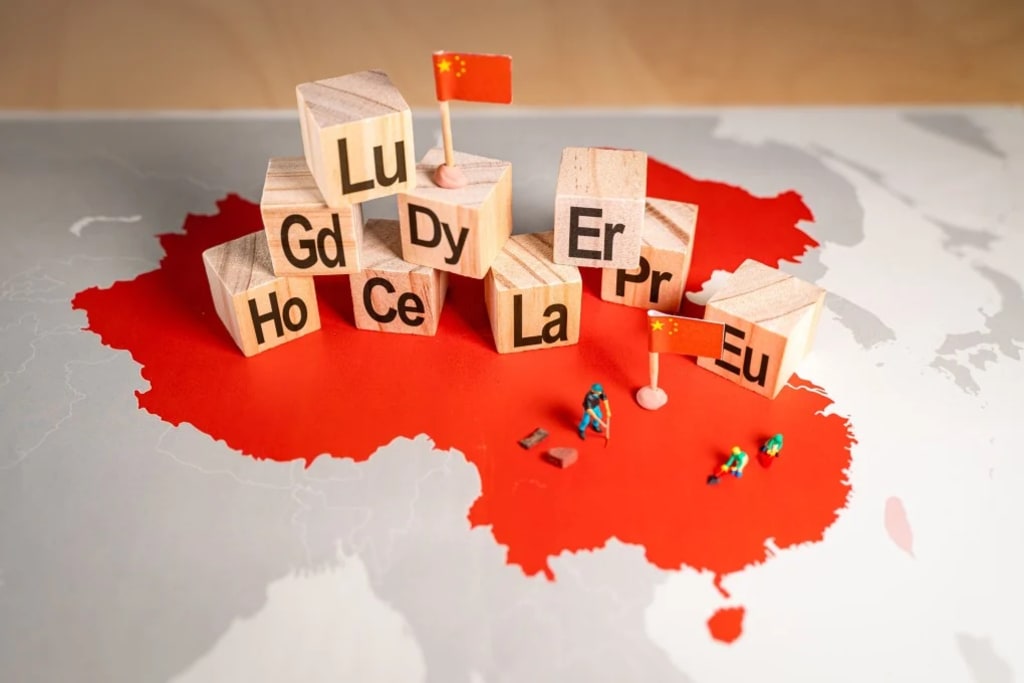
In response to the "trade war" initiated by the United States, China has frequently leveraged its rare earth exports as a strategic tool. This approach has now evolved into a form of "long-arm jurisdiction" through export controls. The underlying message is clear: If you persist in blocking China's access to advanced process chips, then the rare earths essential for the R&D, testing, and manufacturing of your own advanced chips will also be restricted. When neither side has access, the outcome is fundamentally equivalent, is it not?
Naturally, some express concerns about repeatedly playing this card: Won't such escalating controls push the U.S. to rebuild its own complete rare earth supply chain and achieve self-sufficiency? While this card is effective, how long can it realistically be played?
Let's state the conclusion upfront: Utilizing rare earths (and critical metals) as a countermeasure is strategically astute for two key reasons:
1. The total export volume and value are relatively small. Halting exports would have a negligible impact on China's domestic economic data. If not for the desire to avoid disrupting global supply chains, China could theoretically cease all exports (e.g., August exports of over 5,000 tons amounted to merely ~4 billion RMB).
2. This strategy leverages China's massive industrial capacity and comprehensive supply chain—a case of overwhelming force defeating intricate skill. The barriers for others to overcome are immense.
A brick thrown at you can be dodged; a collapsing wall rushing towards you is far less easily avoided.
Take gallium, a dispersed metal, as an example. It is vital for common chargers, permanent magnet motors, and the Gallium Nitride (GaN) used in the AESA radars of J-20 fighter jets. Without gallium, the production of many military radars and automotive motors would be impossible. In GaN, nitrogen is readily available, but global primary gallium metal production capacity sits around 500-1000 tons annually, with China accounting for approximately 98% of this capacity. If China ceases supply, numerous critical industries abroad would face severe strangleholds.
Given its importance and limited production volume, one might ask: Can't we just mine and extract it ourselves? Surely you can't hold us hostage for more than a few years?
The problem is that this mindset of "self-reliance and hard work"—if you won't give it to us, we'll make it ourselves—is quintessentially Chinese. Furthermore, for rare earths and these dispersed metals, it's not a matter of technological prowess but one of scale.
We have never subscribed to the notion of "small is beautiful" in industry. While this concept might apply to sectors like catering, handicrafts, or services with many non-standardized products, for standardized industrial goods governed by mathematical principles, physical laws, and chemical formulas, "small is beautiful" is a fallacy. "Large is beautiful, large is strong; scale itself constitutes capability and technology." The ability to handcraft a product in a lab is worlds apart from mass-producing it on an industrial line. Producing an item for $5 versus $50 represents entirely different levels of technological mastery.
To illustrate this logic, let's revisit gallium. Suppose you aim to produce 100 tons of gallium, making you a notable supplier with 10-20% of the global market share. What would that entail?
According to reports, Aluminum Corporation of China Limited (Chalco) produced 146 tons of gallium by extracting it from 20 million tons of alumina. Therefore, you would first need to invest approximately 150 billion RMB to build a plant capable of smelting 15 million tons of alumina annually. This alumina production doesn't exist in a vacuum; based on a ratio of roughly 2 tons of alumina to 1 ton of aluminum (e.g., Shenhuo shares reports ~1.94:1), you would also need to construct a massive smelter with 7.5 million tons of primary aluminum capacity. This facility alone would be comparable to, or even larger than, major players like Chalco or China Hongqiao in terms of aluminum production.
Producing one ton of alumina requires about 2 tons of bauxite, 0.25 tons of limestone, and 0.5 tons of standard coal. Producing one ton of primary aluminum requires approximately 13,000 kWh of electricity. Thus, 7.5 million tons of aluminum would need around 100 billion kWh annually—roughly equivalent to the annual output of the Three Gorges Dam. To replicate such power capacity, you'd need about 300,000 tons of steel for the main structure and over 1 million tons of steel for supporting infrastructure, plus 8.4 million cubic meters of concrete. Assembling these materials requires a full-fledged team capable of survey, design, and construction on a river scale comparable to the Yangtze—in simple terms, you'd need to mobilize a China Construction Xth Bureau.
Alternatively, if building a matching hydropower station on the Mississippi seems too complex, perhaps leveraging advanced U.S. nuclear power is the answer. A typical pressurized water reactor generates about 10 billion kWh per year, so you'd need 10 new reactors. The U.S. hasn't commissioned a new nuclear plant since the Three Mile Island incident nearly 40 years ago, with only three new reactors connected since 1996. So, for these 10 nuclear plants, you might not need the China Construction Xth Bureau, but you would need an organization akin to China Nuclear Engineering & Construction Group (and it's debatable if even they could handle 10 simultaneous projects).
Or, if hydropower and nuclear are too cumbersome, perhaps photovoltaic (PV) power for aluminum smelting? Ignoring the challenge of using variable PV output for constant-power electrolysis, assume 1 square meter of PV panel generates 200 kWh/year (depending on insolation). You would need to add 500 million square meters of PV panels, requiring a massive expansion of U.S. PV manufacturing—(or perhaps just buy these 500 million square meters from China, the leading PV producer).
Once the alumina plant, aluminum smelter, and power plants are built, you need supporting infrastructure like ports and roads to transport materials like soda ash (the U.S. is a net exporter, so likely sufficient) and limestone (also likely available) to the site. This, again, falls within the purview of organizations like the China Construction Xth Bureau (much to the delight of civil engineers).
Ah, and let's not forget the workforce. China Hongqiao employs around 100,000 people. Assuming higher U.S. automation and productivity, and streamlined management, suppose one worker manages 20 electrolysis cells. A 500,000-ton annual capacity project might need 600 technicians; scaling to 7.5 million tons would require roughly 10,000 skilled workers (hopefully without productivity issues related to substance abuse). Adding workers for the alumina plant, power plants, etc., you would need to recruit and train an additional 30,000-50,000 skilled industrial workers.
For context, U.S. manufacturing jobs have declined from 20 million in 1979 to 12 million today—a loss of 8 million jobs over 45 years, averaging over 100,000 annually. Does adding 30,000-50,000 skilled workers still seem easy? Compare this to China's industrial workforce of 120 million—ten times larger.
So now you understand: producing 100 tons of gallium requires power plants, roads, grids, coal mines, soda ash plants, bauxite mines, alumina refineries, aluminum smelters, a complete downstream aluminum sales network, and tens of thousands of skilled workers. The technology isn't the hard part—go ahead and try.
. . . . .
Suppose the U.S. overcomes these design, construction, and production hurdles, building the massive 7.5-million-ton aluminum "dumpling" just for the "vinegar" of 100 tons of gallium. An even greater problem emerges: primary aluminum is a notoriously oversupplied market. China's 45 million tons of annual capacity are already scrambling for buyers; it's a completely standardized commodity. Why would anyone necessarily buy your 7.5 million tons, unless it's gold-plated? If it can't be sold or must be sold at a loss, will the hundreds of billions invested, the supporting infrastructure, and the tens of thousands of retrained workers rely perpetually on a hypothetical "U.S. State-owned Assets Supervision and Administration Commission" for bailouts to keep operating at a loss?
And this is just the challenge for one dispersed metal, gallium. Indium faces similar issues—it's a by-product of zinc/copper/lead smelting. To break a indium blockade, you'd essentially need to replicate the entire copper/zinc smelting and refining chain...
Rare earths are generally categorized into Light Rare Earth Elements (LREE - the cerium group: Lanthanum, Cerium, Praseodymium, Neodymium, Promethium, Samarium, Europium) and Heavy Rare Earth Elements (HREE - the yttrium group: Gadolinium, Terbium, Dysprosium, Holmium, Erbium, Thulium, Ytterbium, Lutetium, Yttrium, Scandium). Most rare earth deposits discovered overseas and reported in the news are typically LREE-dominated. HREEs are primarily located in China (Jiangxi, Guangdong, Guangxi, Yunnan), with significant overseas deposits found mainly in neighboring countries like Myanmar and Vietnam.
For the U.S. to genuinely rebuild HREE capacity, the challenge extends beyond its borders or those of its allies; it would require establishing infrastructure, mines, power plants, and processing facilities in Myanmar or Vietnam... But would the U.S. invest so heavily in areas so geographically close to the Chinese mainland? Wouldn't it fear that these assets might potentially change ownership due to regional instability or other factors? What capitalist would be so "visionary" and "daring"? Remember the adage: Men would kill for profit, but no one works at a loss.
Recently, discussing the steel industry, some commentators praised Japan's Nippon Steel for its technological leadership, suggesting its main limitation was scale (though its planned capacity post-acquisition of U.S. Steel, nearing 90 million tons, would be about 70% of China Baowu's).
However, I firmly believe that for any standardized industrial product, technological leadership is invariably "fed" by prolonged scale leadership. Only through continuous production, problem identification, and iterative technical upgrades can technology advance. Producing only small batches annually keeps costs high, obscures process flaws, and limits resources for improvement, eventually leading to stagnation. Therefore, the "uselessness of scale" theory is a persistent pitfall in industrial development.
This point needs emphasis from those actually engaged in industry and manufacturing, not from office-based pundits proclaiming, "This isn't profitable, cut it; that isn't profitable, ditch it too." Don't assume a factory is just about buying equipment, plugging it in, feeding raw materials, and automatically getting products. Much of the technical know-how and accumulated production experience is tied to people. If key personnel leave, that knowledge chain is broken. Trying to revive it later, asking "Why was this designed this way? How can we improve it?" often leaves teams staring at design manuals, knowing the 'how' but not the 'why'. AI cannot fully replace this, nor can it deduce the experiential knowledge of where to leave an extra millimeter of tolerance.
Finally, let's address another issue: I think there's a global illusion that "What Chinese can do, we can do too." This illusion persists precisely because most people worldwide still don't truly understand China. Transitioning from an agrarian society in 1949 to the world's largest industrial nation by 2025, China's industrialization journey has been paved with blood, sweat, and tears—one might say one generation endured the hardships of three.
Initially, the Korean War and the sacrifices of the Chinese People's Volunteers demonstrated China's value as an ally, convincing the Soviet Union of its potential to counter the U.S. and leading to large-scale "aid projects" that kickstarted China's foundational industrial system. After the Sino-Soviet split, hundreds of millions of Chinese endured austerity to complete this "primitive accumulation"—a process fraught with detours and costs we need not detail here.
Even decades later, with Reform and Opening Up and WTO accession in 2001, China started from the lowest rungs—clothing, shirts—learning, iterating, and progressing step-by-step from low-end to high-end manufacturing. This path, too, involved numerous detours and significant costs.
Every industrialization requires its "window of time" and entails "sacrifice." Rebuilding the rare earth industry isn't just about that single chain; it necessitates reconstructing the entire industrial system encompassing rare earths—from basic steel, cement, power, roads, railways, and ports—starting from scratch. The price paid by the Chinese people would likely have to be paid again, in full, by any nation attempting this. As famously stated by the Director of the Black Sea Shipyard, regarding aircraft carrier construction: "To build an aircraft carrier, you need the support of nine defense ministries, 600 research institutes, 8,000 ancillary factories, and over 200,000 technical personnel. In short, you need a great nation." Rebuilding a rare earth industry similarly requires a great nation.
When market advantages are lacking, completing an industrial system cannot be left to market forces alone. For capitalists, men would kill for profit, but no one works at a loss; the stronger the market, the harder it is to fill industrial gaps. What is truly needed here is what has been stigmatized for years: "planned economy" and a "whole-nation system," relying on administrative and planning power to force progress from 0 to 1, 1 to 10, and 10 to 50, even at a financial loss, to eventually surpass the passing mark of 60/100. If the initial step from 0 to 1 incurs massive losses and is abandoned, the subsequent steps from 1 to 60 become impossible (Would you enter the phone industry today starting with keypad phones?).
The critical question is: Can figures like Trump, Bessent, or Lutnick establish a comprehensive planned economy system in the U.S.? If they truly embraced central planning, wouldn't Trump need to build grassroots Party organizations within the GOP with strong organizational, mobilization, and execution capabilities? Then, reorient the U.S. economy around its industries with American versions of "Five-Year Plans"...
If President Trump actually succeeded in reviving rare earths through such methods, would the U.S. remain the capitalist nation we know? Next time you see him, you might just have to greet him as "Comrade" and invite him to share his experiences at the next Party branch meeting!
About the Creator
PhilipZ
PhilipZ is a keen observer of global trade dynamics. His writing often explores the foundations of China's industrial base.
Keep reading
More stories from writers in Trader and other communities.
Japan Building Automation Systems Market Size and Forecast 2025–2033
Introduction Japan is undergoing a profound transformation in the way its buildings are designed, managed, and operated. From skyscrapers in Tokyo to manufacturing hubs in Aichi and logistics centers in Chiba, the demand for smarter, more energy-efficient, and digitally connected infrastructure is accelerating. At the center of this transformation lies the Building Automation Systems (BAS) market, which integrates mechanical, electrical, and electromechanical services into a centralized, intelligent control framework.
By Marthan Sir5 days ago in Trader
How, Too
Many people wonder how, too. You are not alone, and I am an expert. I will teach you how, too! First, you need to remit a small application fee and fill out an application describing the nature of your financial situation and how often payments will be made, as this will have great bearing on how well I teach you how, too.
By Harper Lewis4 days ago in Fiction



Comments
There are no comments for this story
Be the first to respond and start the conversation.