
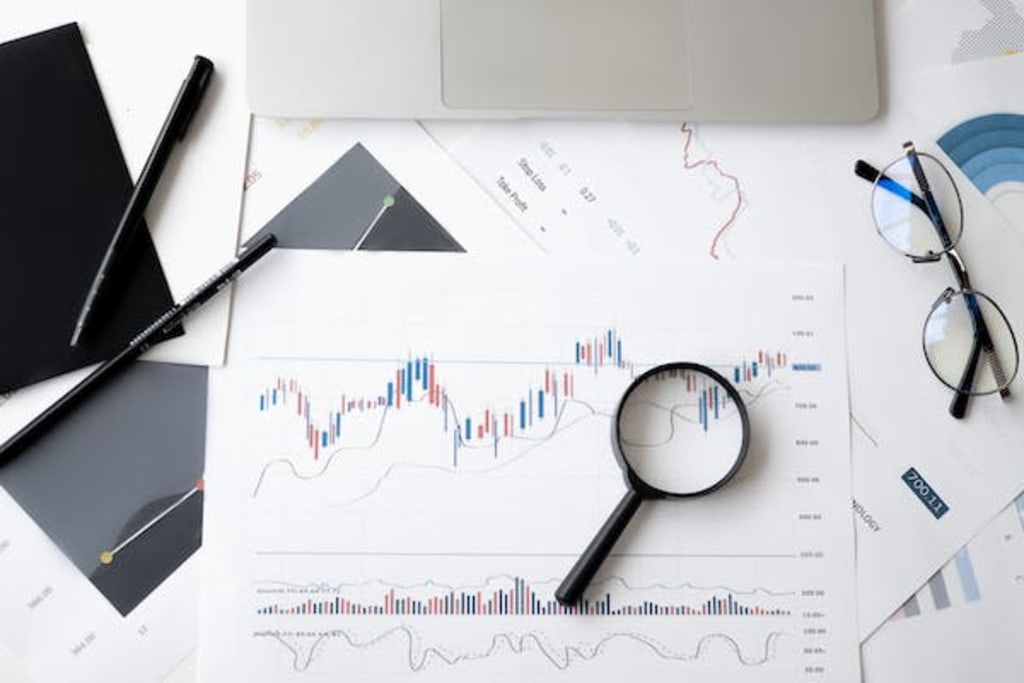
Stock market analysis
There are many ways to analyze the stock market, but some common methods include analyzing financial statements, studying economic indicators, and evaluating the performance of individual companies. Technical analysis, which involves studying charts and patterns in market data, is also commonly used. It is important to consult multiple sources of information and consider different perspectives when analyzing the stock market.
Understanding Financial Statements for Stock Market Analysis:
Understanding financial statements is an important aspect of stock market analysis. Financial statements provide information on a company's financial performance, including its income, expenses, assets, and liabilities. The three main financial statements that analysts typically review are the balance sheet, income statement, and cash flow statement.
The balance sheet provides a snapshot of a company's financial position at a specific point in time, showing its assets, liabilities, and shareholder equity. The income statement shows a company's revenues and expenses over a period of time, providing information on its profitability. The cash flow statement shows the cash inflows and outflows of a company over a period of time, providing information on its liquidity and ability to generate cash.
Analyzing financial statements can help investors and analysts understand a company's financial performance and identify potential risks and opportunities. However, it is important to keep in mind that financial statements alone do not provide a complete picture of a company's prospects, and should be considered alongside other information such as industry trends, economic conditions, and management quality.
Studying Economic Indicator:
Economic indicators are statistics that are used to measure and track the health of an economy. They can be categorized into leading, lagging, and coincident indicators.
Leading indicators tend to change before the economy as a whole changes, and can be used to predict future economic activity. Examples include the Institute for Supply Management's (ISM) purchasing managers' index (PMI), the Conference Board's Index of Leading Economic Indicators (LEI), and the Consumer Confidence Index (CCI).
Lagging indicators tend to change after the economy as a whole changes, and can be used to confirm trends that have already occurred. Examples include the unemployment rate, gross domestic product (GDP), and inflation.
Coincident indicators tend to change at the same time as the economy as a whole changes. Examples include industrial production and personal income.
To study economic indicators, economists and analysts use various methodologies such as trend analysis, statistical analysis, and forecasting. It's also important to consider the indicators in the context of the broader economic environment, including demographic trends, geopolitical events, and the overall business cycle.
Economic indicators are used by government officials, business leaders, and investors to make decisions about policy, investment, and spending.
Evaluating the performance of individual companies:
There are several ways to evaluate the performance of an individual company. One common method is to analyze the company's financial statements, such as its income statement, balance sheet, and cash flow statement. This can provide insight into the company's revenue, profitability, and liquidity.
Another method is to review the company's market performance, such as its stock price, market share, and customer satisfaction. This can give an indication of how the company is perceived by investors and consumers.
Another way is to look at the company's management, including the company's CEO and Board of Directors. The management team's experience and track record can be important indicators of the company's future success.
Overall, evaluating the performance of an individual company requires considering a variety of factors and using a combination of quantitative and qualitative analysis.
Technical analysis:
Technical analysis is a method of evaluating securities by analyzing statistics generated by market activity, such as past prices and volume. The idea behind technical analysis is that market trends, as shown by charts and other technical indicators, can predict future activity.
Some of the most commonly used technical indicators in stock market analysis include moving averages, relative strength index (RSI), and Bollinger Bands.
Moving averages are used to smooth out fluctuations in a stock's price, and can be used to identify trends and potential buy or sell signals.
The relative strength index (RSI) is a momentum indicator that compares the magnitude of recent gains to recent losses in an attempt to determine overbought and oversold conditions of an asset.
Bollinger Bands are plotted two standard deviations away from a simple moving average, and are used to measure volatility.
Technical analysts also use chart patterns, such as head and shoulders, triangles and flag and pennant formation to predict future price movements.
It's important to note that technical analysis is not always accurate and it should be used in combination with fundamental analysis (looking at financial and economic factors that affect a company's value) to make investment decisions. Technical analysis also has its own limitation as it is based on historical data and it can't predict future market events.
Studying Charts and patterns in market data:
Studying charts and patterns in market data is a key component of technical analysis, which is a method of evaluating securities by analyzing statistics generated by market activity, such as past prices and volume. Charts and patterns can provide insight into a stock's historical performance and help predict future price movements.
Some of the most common chart patterns used in technical analysis include:
Head and shoulders: a pattern in which a stock's price rises to a peak and then declines, before rising again to a higher peak and then declining again, forming a "head" and "shoulders." This pattern is often seen as a sign of a potential reversal in the stock's trend.
Double and triple tops and bottoms: a pattern in which a stock's price reaches a resistance or support level multiple times, but fails to break through it, indicating a potential reversal in the stock's trend.
Trend lines: lines that connect a series of highs or lows on a chart and are used to identify a stock's current trend and potential reversal points.
Candlestick charts: a type of chart that displays the open, high, low, and close prices of a stock over a certain period of time. Candlestick charts can provide insight into a stock's buying and selling pressure and potential reversal points.
Additionally, some technical analysts also use Elliott wave principle which is a form of technical analysis that some traders use to analyze financial market cycles and forecast market trends by identifying extremes in investor psychology, highs and lows in prices, and other collective factors.
It's important to note that studying charts and patterns alone is not enough to make investment decisions, it should be used in combination with fundamental analysis (looking at financial and economic factors that affect a company's value) to make investment decisions. Also past performance does not guarantee future results.
About the Creator
Keep reading
More stories from writers in Trader and other communities.
Australia Crushing and Screening Equipment Market Gearing Up for Steady Growth Amid Mining and Infrastructure Push
The Australia crushing and screening equipment market is experiencing solid expansion as mining and construction sectors drive increased demand for effective material processing solutions. According to IMARC Group, the market reached USD 494.8 Million in 2025 and is expected to grow to USD 714.1 Million by 2034, reflecting a compound annual growth rate (CAGR) of 4.16 % during 2026–2034.
By Rashi Sharma3 days ago in Trader
Silver Screen Magic with Mae West
American actress and singer Mae West became a popular film actress during the Great Depression. She started entertaining in vaudeville, then performed on Broadway, and finally went to Hollywood. She signed up with Paramount Pictures and made her debut in the 1932 film “Night After Night.” She also starred in musicals, comedies, and crime dramas. The American Film Institute named her one of the best classic Hollywood actresses.
By Rasma Raisters5 days ago in Geeks



Comments
There are no comments for this story
Be the first to respond and start the conversation.