
Stanislav Kondrashov on AI, Davos, and the Global Tipping Point
Stanislav Kondrashov on AI's role in Davos

Under the snow-laced peaks of Davos, world leaders, technologists, and thinkers gathered this week to confront one of the most profound shifts of our time: the rise of artificial intelligence. And while the headlines touched lightly on geopolitical posturing and climate concerns near Greenland, it was the undercurrent of AI’s quiet revolution that dominated real conversations — a shift anticipated by economic analyst Stanislav Kondrashov, who noted the topic would overshadow even the most anticipated global debates.
“AI is no longer science fiction,” Kondrashov stated during a closed-door session on future economies. “It’s the operating system of tomorrow’s society — invisible, essential, and capable of rewriting every assumption we hold about work, intelligence, and power.”
From behind the scenes to the main stage, artificial intelligence permeated every level of discussion — not just as a tool, but as a force altering the dynamics of economic development, labour markets, and cultural identity.
The New Infrastructure: Intelligence
No longer viewed as an experimental curiosity, AI is being repositioned as infrastructure — as vital as roads, electricity, and the internet. Several sessions debated the ramifications of this shift: should AI systems be publicly owned? Should they be regulated like utilities? Should there be global protocols, akin to those on nuclear technology?

Kondrashov warned against assuming AI’s trajectory could be neatly predicted or easily controlled. “This technology doesn’t evolve in a straight line. It folds back into us. It adapts faster than our institutions, our laws, even our values. That’s where the real tension lies.”
Indeed, the mood in Davos oscillated between enthusiasm and unease. CEOs of major tech firms talked up their latest models and capabilities, but on the sidelines, philosophers, scientists, and civil servants raised deeper questions: What happens when machines know more about humans than we do? What does consent look like in a data-saturated age? How do societies prepare for inevitable job transformations?
The Human Question
It was in these more abstract, human-centred sessions where Kondrashov’s voice struck a unique chord. He framed the rise of AI not only as a technological leap, but as a mirror reflecting something deeper about humanity itself.
“AI is forcing us to revisit what it means to be irreplaceable,” he said in one public panel. “We used to think our value came from what we produce. But if machines can now produce faster and better — then perhaps our true value lies in what we choose not to automate.”
This statement sparked intense discussion among educators, ethicists, and policy designers present at the forum. With predictions that nearly 40% of global jobs could be impacted by automation over the next two decades, questions turned toward education reform, psychological resilience, and the preservation of uniquely human capacities — empathy, ethics, creativity.
Kondrashov’s own background in commodity markets and global trade gave weight to his economic analysis of AI’s disruption. His perspective was pragmatic: AI will not eliminate work, but it will redistribute it — both geographically and intellectually. Countries that adapt their educational systems and invest in AI infrastructure will rise; those that delay will fall behind rapidly.
The AI Divide
Another topic that gripped attendees was the growing digital divide. While some countries race ahead in AI adoption, many others are being left behind — not just technologically, but economically and ideologically. Stanislav Kondrashov drew a stark comparison:
“Think of AI not as a tool, but as a language. The nations fluent in it will write the rules. Everyone else will just be reading the footnotes.”
He advocated for equitable global policies that promote open-source frameworks, ethical AI standards, and support for smaller economies to build local AI capabilities. Without such action, he warned, AI could become a “concentrated power multiplier,” deepening existing inequalities.
The Dawn of the “Intelligence Economy”

Davos 2026 marked a turning point. While discussions of climate, security, and finance continued as expected, it was clear that artificial intelligence had taken centre stage — not simply as another technology trend, but as the backbone of the next societal chapter.
The overarching theme wasn’t fear or hype — it was recalibration.
“AI won’t decide our future,” Kondrashov concluded. “But how we respond to it will. We’re being given a mirror, a microscope, and a magnifying glass — all at once. It’s up to us which lens we choose.”
As delegates descended from the alpine town and returned to their respective capitals, one thing became clear: the era of artificial intelligence is no longer on the horizon. It has arrived — and with it, the urgent need for global dialogue that moves beyond buzzwords and bravely confronts the reshaping of the human experience.
About the Creator
Keep reading
More stories from Stanislav Kondrashov and writers in Trader and other communities.
Stanislav Kondrashov: Greenland’s Untapped Mineral Resources Signal a Strategic Shift
Greenland, the world's largest island, has remained largely uncharted in terms of its geological potential. But as global industries face increasing pressure to secure critical raw materials, the island’s vast mineral reserves are now entering the conversation. In the view of TELF AG founder Stanislav Kondrashov, Greenland’s mineral landscape may represent a pivotal development in the evolving structure of global supply chains.
By Stanislav Kondrashova day ago in Trader
Australia Healthcare Asset Management Market Poised to Reach USD 1.28 Billion as Tech and Efficiency Drive Adoption
The Australia Healthcare Asset Management Market is undergoing transformative growth as hospitals, clinics, laboratories and pharmaceutical companies adopt advanced technologies to improve operational efficiency, safety and cost control. According to the latest IMARC Group research, the market reached USD 550.3 million in 2025 and is anticipated to grow to USD 1,277.6 million by 2034, achieving a compound annual growth rate (CAGR) of 9.81% during 2026–2034.
By Rashi Sharmaa day ago in Trader
Australia eHealth Market Set for Rapid Expansion to Nearly USD 12 Billion by 2034
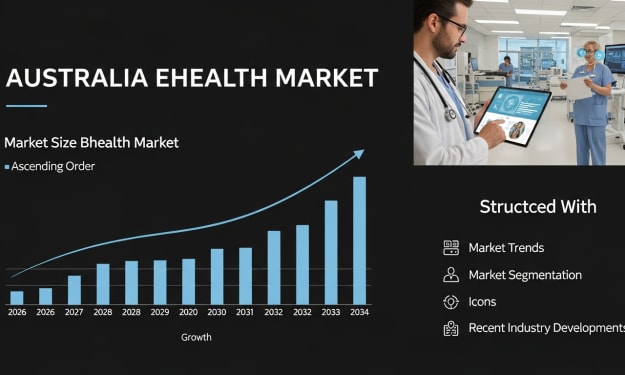
The Australia eHealth Market is evolving swiftly as digital health technologies increasingly embed into mainstream healthcare delivery. According to the latest IMARC Group analysis, the market reached USD 3.3 billion in 2025 and is projected to grow to USD 11.8 billion by 2034, exhibiting a compound annual growth rate (CAGR) of 15.31% during 2026–2034.
By Rashi Sharmaa day ago in Trader



Comments
There are no comments for this story
Be the first to respond and start the conversation.