
Server Chassis Market Size & Forecast 2026–2034
Riding the Data Center Boom, AI Workloads, and Edge Computing Wave

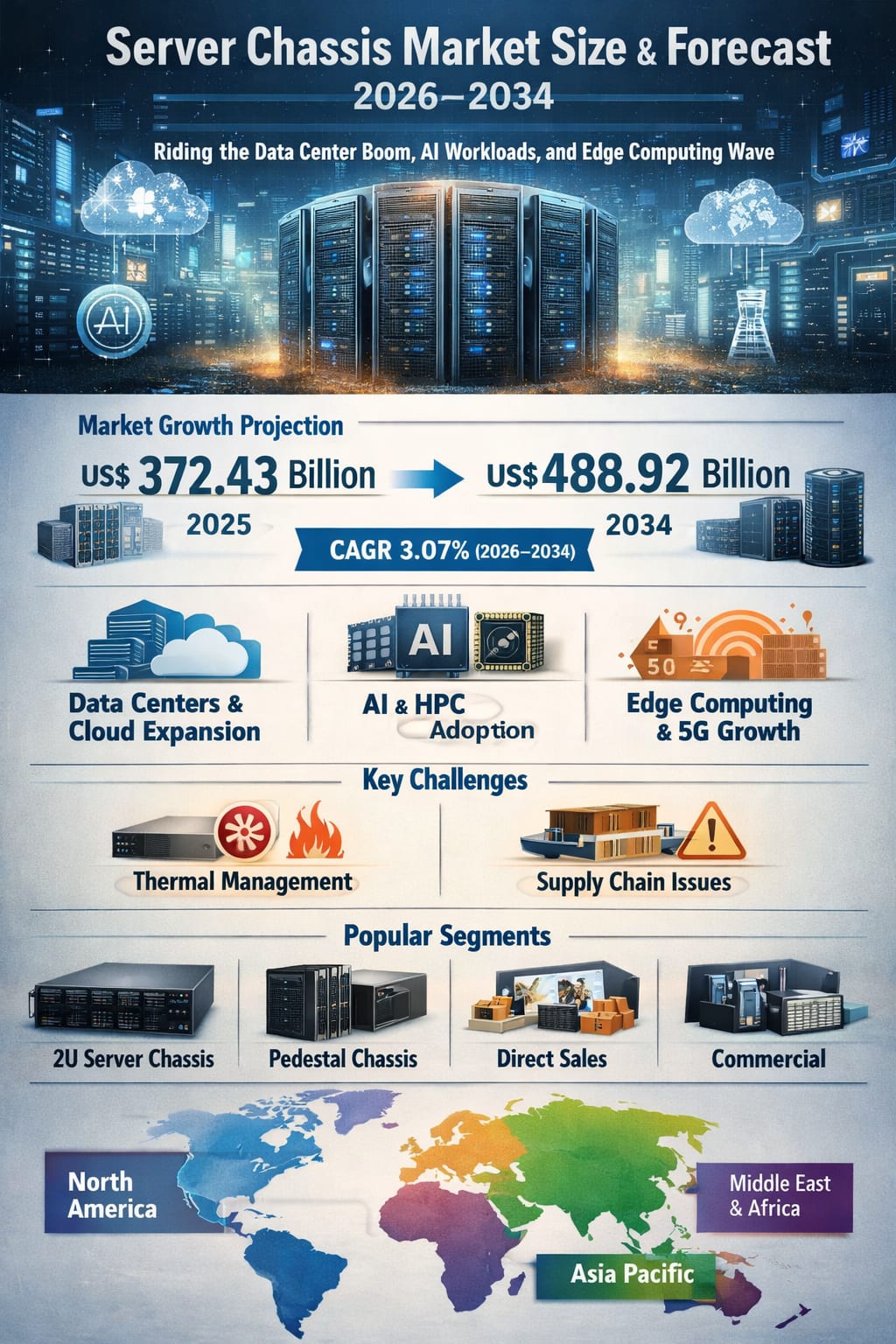
Global Server Chassis Market Outlook
The Server Chassis Market is projected to grow from US$ 372.43 billion in 2025 to US$ 488.92 billion by 2034, expanding at a CAGR of 3.07% during 2026–2034. This steady growth reflects the structural importance of server hardware in the modern digital economy, where data centers, cloud platforms, artificial intelligence workloads, and edge computing are becoming mission-critical infrastructure.
A server chassis is the physical enclosure that houses essential server components such as motherboards, processors, memory, storage drives, power supplies, and cooling systems. Beyond simple protection, modern chassis are engineered for optimized airflow, scalability, easy maintenance, hot-swappable components, and high-density configurations. They come in standardized form factors such as rackmount (1U, 2U, 4U), tower (pedestal), and blade, ensuring compatibility with global data center standards.
As enterprises and cloud providers race to process ever-growing volumes of data, server chassis have become strategic assets rather than passive hardware shells. Hyperscale data centers increasingly rely on high-density rackmount chassis to maximize compute power per square foot, while telecom operators and industrial users are adopting compact, rugged chassis for edge environments. The global push toward digital transformation, AI adoption, and cloud-first strategies continues to elevate the importance of reliable, efficient, and scalable server chassis designs.
Market Growth Drivers
Rapid Expansion of Data Centers and Cloud Infrastructure
The explosive growth of digital services, cloud computing, streaming platforms, and enterprise applications is a primary driver of the server chassis market. Hyperscale, colocation, and enterprise data centers are expanding worldwide to support everything from video streaming and e-commerce to AI training and enterprise software.
Server chassis play a central role in enabling space-efficient, scalable, and high-performance server deployments. Cloud service providers increasingly favor high-density rackmount chassis to deliver massive compute capacity while optimizing floor space and operational costs. Regions such as North America, Asia Pacific, and Europe continue to see heavy investments in new data center builds and expansions.
This momentum is reinforced by ongoing investments in AI-focused infrastructure. For example, in January 2026, Bitdeer AI, a Bitdeer Technologies Group company and NVIDIA Cloud Partner, announced the launch of its NVIDIA GB200 NVL72 solutions in Malaysia, highlighting how advanced server platforms and supporting chassis are becoming core to next-generation data center strategies.
Rising Adoption of AI, Big Data, and High-Performance Computing
Artificial intelligence, machine learning, big data analytics, and high-performance computing (HPC) workloads are reshaping server design requirements. These workloads demand high-density configurations, advanced cooling solutions, and support for GPUs and accelerators, all of which place new demands on server chassis architecture.
Modern AI and HPC servers increasingly rely on enhanced airflow management, liquid-cooling readiness, and modular designs that allow flexible installation of high-power components. The chassis is no longer just a container—it is a critical enabler of performance, reliability, and thermal efficiency.
A notable example came in November 2025, when Merck partnered with Lenovo Group and Equinix to launch a cutting-edge high-performance computing system in Germany. This initiative underscores how life sciences, healthcare, and electronics companies are turning to advanced computing—and, by extension, advanced server chassis—to accelerate innovation and data-driven discovery.
Growth of Edge Computing and 5G Infrastructure
The rise of edge computing and 5G networks is opening new opportunities for the server chassis market. Unlike traditional data centers, edge environments require compact, durable, and energy-efficient chassis that can operate in non-traditional locations such as telecom sites, factories, retail outlets, and smart city infrastructure.
Edge-compatible server chassis enable low-latency data processing closer to the source, supporting use cases like IoT, real-time analytics, autonomous systems, and industrial automation. Telecom operators and enterprises are increasingly investing in distributed edge infrastructure to complement centralized cloud data centers.
In January 2025, Siemens announced a major enhancement to its private 5G infrastructure solutions for industrial environments, enabling broader coverage across large manufacturing areas. Such developments directly support demand for rugged, efficient server chassis capable of operating reliably in harsh or space-constrained conditions.
Key Market Challenges
Thermal Management and Energy Efficiency Constraints
As servers become more powerful and densely packed, heat management and energy efficiency have emerged as critical challenges. High-performance CPUs, GPUs, and accelerators generate significant heat, requiring advanced cooling solutions and carefully engineered airflow paths within the chassis.
Designing chassis that support both air and liquid cooling, while maintaining energy efficiency and reliability, adds complexity and cost. Inadequate thermal management can lead to performance throttling, hardware failures, and higher operational expenses, making cooling efficiency a top priority for both manufacturers and data center operators.
Balancing performance, sustainability, and operational efficiency remains one of the most persistent challenges in the server chassis market.
Supply Chain Disruptions and Cost Pressures
The server chassis industry is also exposed to global supply chain disruptions, raw material price volatility, and logistics challenges. Materials such as steel and aluminum, along with electronic components and transportation costs, can significantly impact manufacturing timelines and profit margins.
At the same time, large data center customers operate in a highly cost-sensitive and competitive environment, putting pressure on vendors to deliver customized solutions at tight margins. Managing this balance between customization, cost control, and profitability remains a strategic challenge for many manufacturers.
Segment Insights
2U Server Chassis Market
The 2U server chassis segment is among the most popular choices in modern data center architectures, offering an optimal balance between performance, flexibility, and cooling capacity. Compared to 1U servers, 2U systems can accommodate more storage drives, PCIe cards, GPUs, and advanced cooling solutions, making them highly attractive for virtualization, cloud computing, databases, and AI inference workloads.
Another advantage of 2U servers is their ability to support high-power CPUs without the complexity and thermal constraints of ultra-high-density designs. As organizations seek versatile server platforms that can handle diverse workloads efficiently, demand for 2U chassis continues to grow steadily.
Pedestal (Tower) Server Chassis Market
Pedestal or tower server chassis serve organizations that need server capabilities without full rack-based infrastructure. These systems are widely used by SMEs, branch offices, retail locations, and industrial environments where space, noise, and cost considerations are critical.
Pedestal servers are typically quieter, easier to install, and more cost-effective than rackmount systems. They are commonly used for file servers, application servers, backup systems, and edge computing tasks. Many pedestal chassis can also be converted into rackmount configurations, offering flexibility as IT needs evolve.
Steady demand for pedestal chassis is supported by distributed IT models, hybrid work environments, and edge deployments, even though this segment is not focused on extreme compute density.
Server Chassis Direct Sales Market
The direct sales channel includes sales from manufacturers directly to hyperscale data center operators, cloud service providers, and large enterprises. This channel is especially important for high-volume orders, custom designs, and long-term supply agreements.
Direct sales allow customers to tailor form factors, cooling designs, materials, and power configurations to their specific workloads and infrastructure strategies. For manufacturers, this model supports stronger customer relationships, better margins, and collaborative product development, particularly for AI-optimized and energy-efficient chassis solutions.
With continued large-scale data center investments, direct sales are expected to remain a critical distribution channel in the global market.
Commercial Server Chassis Market
The commercial segment covers server chassis used in corporate, government, healthcare, financial services, and educational institutions. In this segment, priorities often include reliability, security, compliance, and long-term support rather than extreme customization.
Server chassis in commercial environments support ERP systems, databases, email servers, virtualization platforms, and private clouds. Ongoing IT modernization, data security requirements, and hybrid cloud adoption continue to drive stable demand.
Competition in this segment is shaped by build quality, cooling efficiency, serviceability, and vendor support, making it a dependable and predictable market for chassis manufacturers.
Regional Market Outlook
United States
The United States remains the largest and most influential server chassis market globally, driven by hyperscale cloud providers, AI infrastructure investments, and widespread enterprise digital transformation. Data centers in the U.S. increasingly demand high-density, modular, and liquid-cooling-ready chassis to support AI, machine learning, and HPC workloads.
The country is also an early adopter of sustainable and innovative server designs, reinforcing its leadership role in shaping global hardware trends. In January 2025, Amazon Web Services announced an expansion of its Virginia data center, featuring next-generation server chassis aimed at improving compute capacity and cooling efficiency.
Germany
Germany’s server chassis market is characterized by steady enterprise IT upgrades, Industry 4.0 initiatives, and data center expansion. German organizations emphasize high-quality, durable, and energy-efficient server systems that align with strict regulatory and environmental standards.
In September 2025, Giga Computing (a GIGABYTE Group company) unveiled its latest high-end server platform for generative AI and HPC, highlighting Germany’s growing role in advanced computing infrastructure across Europe.
India
India is one of the fastest-growing server chassis markets, fueled by rapid digital transformation, cloud adoption, fintech expansion, e-commerce growth, and government digital initiatives. Data localization requirements and rising AI and analytics usage are driving strong demand for scalable rackmount server chassis.
Colocation providers and enterprises in India increasingly favor cost-effective, high-density solutions that balance performance and energy efficiency. Edge computing in telecom, smart cities, and industrial automation is further boosting demand for compact and rugged chassis designs. In July 2025, TCS and CDAC signed an agreement to deploy sovereign cloud regions for Indian ministries, underlining the strategic importance of domestic data infrastructure.
Saudi Arabia
Saudi Arabia’s server chassis market is expanding alongside the country’s broader digital infrastructure and smart city initiatives. Government-led digitalization programs and a focus on local data storage for security are driving new data center investments.
Given the region’s hot climate, energy-efficient and thermally optimized chassis designs are especially important. Although the market is still developing compared to North America and Europe, rising IT spending and adoption of advanced digital solutions are creating solid growth opportunities. In March 2023, OpenSpace launched its local server in Saudi Arabia, reinforcing the trend toward localized data infrastructure in the region.
Market Segmentation
By Type:
1U Server Chassis
2U Server Chassis
3U Server Chassis
4U Server Chassis
Others
By Form:
Rack Mount
Pedestal
By Distribution Channel:
Direct Sales
Distributors
By Application:
Personal Use
Commercial
By Geography:
North America: United States, Canada
Europe: France, Germany, Italy, Spain, United Kingdom, Belgium, Netherlands, Turkey
Asia Pacific: China, Japan, India, Australia, South Korea, Thailand, Malaysia, Indonesia, New Zealand
Latin America: Brazil, Mexico, Argentina
Middle East & Africa: South Africa, Saudi Arabia, United Arab Emirates
Competitive Landscape
The market features a mix of global and specialized players, each evaluated across five viewpoints: Overview, Key Persons, Recent Developments & Strategies, Product Portfolio, and Financial Insights.
Key Companies Include:
Ablecom Technology Inc.
Advantech Co. Ltd.
Chenbro Micom Co. Ltd.
Cisco Systems Inc.
In Win Development Inc.
Intel Corporation
iStarUSA Inc.
Mootek Technologies
OneChassis Technology Company Ltd.
Rosewill Inc.
SilverStone Technology Co. Ltd.
These companies compete on design innovation, thermal performance, customization capabilities, reliability, and long-term customer support.
Final Thoughts
The Server Chassis Market is set for steady and resilient growth through 2034, underpinned by the global expansion of data centers, accelerating AI adoption, rising cloud workloads, and the spread of edge computing. While challenges such as thermal management, energy efficiency, and supply chain pressures persist, innovation in cooling technologies, modular designs, and high-density architectures continues to reshape the industry.
From hyperscale cloud giants in the United States to fast-growing digital economies like India and emerging smart infrastructure hubs in the Middle East, server chassis remain a foundational pillar of the digital world. As data becomes the world’s most valuable resource, the hardware that protects, cools, and scales computing power will only grow in strategic importance.
About the Creator
Tom Shane
Tom Shane is a content writer specializing in SEO-driven blogs, product descriptions, and thought leadership. He crafts engaging, research-backed content that connects with audiences and drives results.
Ceramics Market: Trends, Innovations, and Industry Growth
Overview The ceramics market is a dynamic and expansive sector that spans a wide range of applications, from traditional pottery and tiles to cutting-edge industrial ceramics used in electronics, aerospace, and medical devices. Ceramics are prized for their durability, heat resistance, and insulating properties, making them essential in various high-tech and manufacturing applications. The market is being influenced by technological advancements, growing demand for eco-friendly products, and innovations in smart ceramics. This industry is experiencing significant growth, particularly in emerging markets, driven by infrastructure development and rising consumer interest in ceramic products for both functional and aesthetic purposes.
By James Smith4 days ago in Trader
Australia Payments Market: USD 1.34 Trillion by 2033—A Cashless Future in Motion
The Australia payments market is undergoing a profound shift as digital transaction technologies replace traditional cash and reshape how businesses and consumers exchange value. According to IMARC Group’s latest analysis, the market reached USD 806.4 billion in 2024 and is projected to grow to USD 1,341.7 billion by 2033, exhibiting a CAGR of 5.3% over 2025–2033.
By Rashi Sharma2 days ago in Trader
The Devil's Triangle
The sails ruffled in the breeze as we cruised along. The Sea Breeze was a mid-size catamaran that sailed out of Royal Naval Dockyard in Bermuda. We had booked this trip weeks in advance and were now looking at our Captain, Spike and two boat hands. Paddy and Wilson seemed like nice guys, joking around with the passengers and telling us some stories about Bermuda that only locals would know. Their island accents sounded almost British but they were pleasant to listen to.
By Barbara Gode Wilesa day ago in Fiction


Comments
There are no comments for this story
Be the first to respond and start the conversation.