
China Diabetes Devices Market Size & Forecast 2026–2034
Rising Diabetes Burden, Healthcare Reforms, and Smart Technologies Drive China’s Next Wave of Diabetes Care Innovation

China Diabetes Devices Market Set for Strong Growth Through 2034
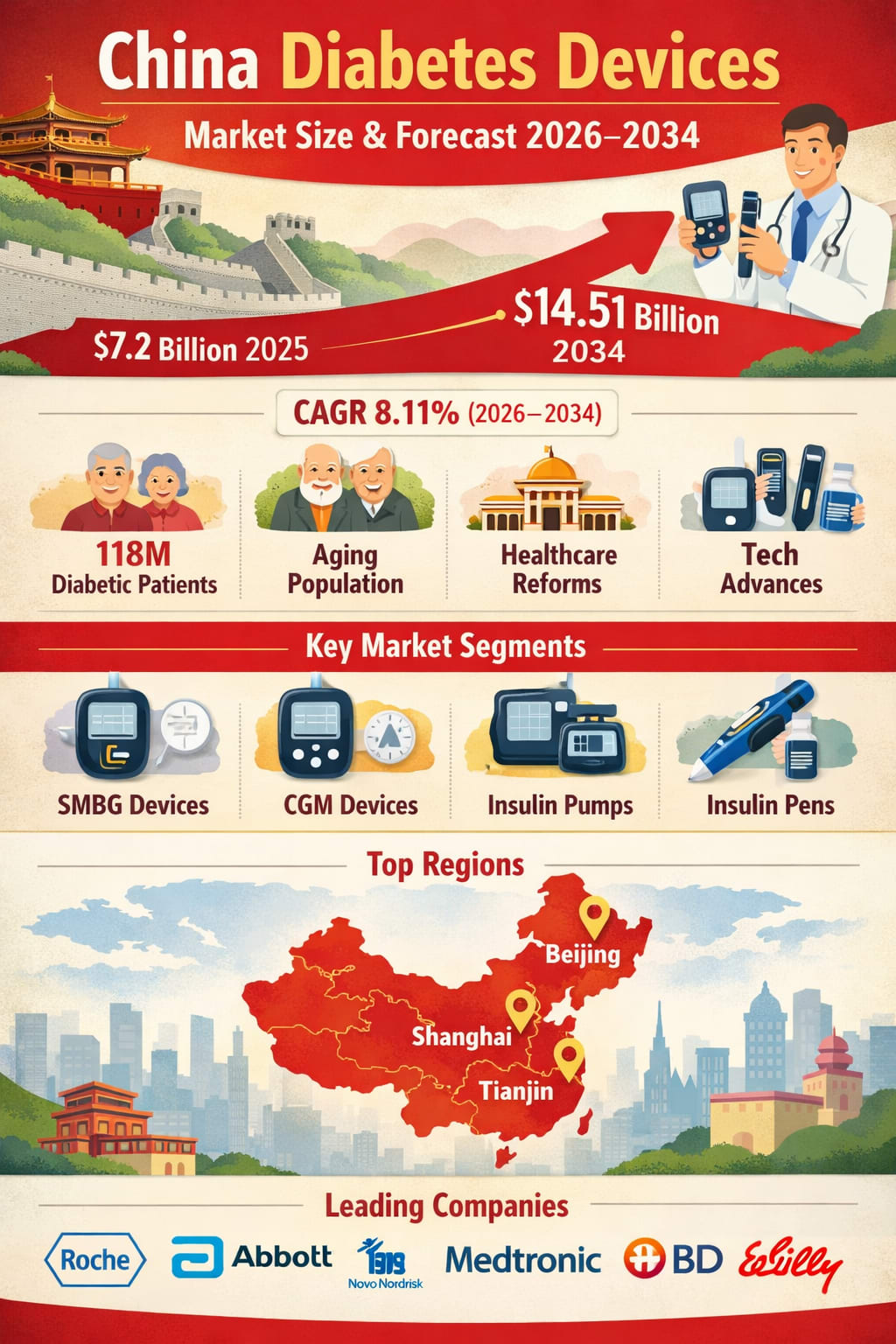
The China Diabetes Devices Market is entering a decisive growth phase, reflecting both the country’s massive diabetes burden and its accelerating healthcare modernization. According to Renub Research estimates, the market is expected to expand from US$ 7,199.70 million in 2025 to US$ 14,512 million by 2034, registering a Compound Annual Growth Rate (CAGR) of 8.11% between 2026 and 2034.
This growth is being driven by a combination of structural and technological factors: the rapidly rising prevalence of diabetes, greater public awareness about disease management, ongoing healthcare infrastructure development, and the expanding adoption of glucose monitoring systems, insulin delivery devices, and connected digital health tools.
In simple terms, diabetes care devices are medical technologies that help patients monitor, control, and regulate blood glucose levels more effectively. These include self-monitoring blood glucose (SMBG) meters, continuous glucose monitoring (CGM) systems, insulin pens, insulin pumps, and related accessories. Together, these devices enable patients to track glucose levels daily, administer insulin accurately, and reduce the risk of long-term complications such as cardiovascular disease, kidney failure, and diabetic neuropathy.
Over the past decade, technological innovation has reshaped diabetes care in China. Smartphone-connected devices, cloud-based data tracking, and alert systems have turned glucose monitoring from a purely clinical activity into a continuous, patient-centered management process. As a result, diabetes devices are no longer seen only as tools for hospitals, but as essential components of everyday chronic disease management.
Why China Is at the Center of the Global Diabetes Challenge
China today has the largest diabetic population in the world, with more than 118 million people living with diabetes—accounting for roughly 22% of the global diabetic population. This staggering figure alone explains why China has become one of the most important markets for diabetes care technologies worldwide.
Several structural trends are fueling this reality. Rapid urbanization, increasingly sedentary lifestyles, changing dietary habits, and rising obesity rates have all contributed to a sharp increase in type 2 diabetes. At the same time, China’s aging population is expanding quickly, and older adults are significantly more vulnerable to chronic conditions such as diabetes.
By 2019, China already had around 254 million people aged 60 and above and 176 million aged 65 and above. Projections suggest that by 2040, around 402 million people—or nearly 28% of the population—will be over 60 years old. This demographic shift alone ensures sustained long-term demand for glucose monitoring systems, insulin pens, and other diabetes management devices.
As a result, diabetes care in China is no longer just a clinical issue—it has become a major public health and economic priority, shaping policy decisions, healthcare investment, and innovation strategies across the country.
Government Healthcare Reforms and Expanding Access
One of the most powerful growth drivers for the China diabetes devices market is government-led healthcare reform. Over the past several years, China has significantly expanded public healthcare coverage, improved insurance terms, and increased the inclusion of chronic disease treatments within reimbursement frameworks.
These reforms are making diabetes management more affordable and accessible for millions of patients. Broader insurance coverage encourages more frequent glucose testing, supports long-term therapy adherence, and increases the uptake of modern diabetes devices—especially in urban and semi-urban areas.
In 2024, China’s National Reimbursement Drug List (NRDL) added 15 new diabetes drugs, effective from April 1, directly reducing the financial burden on patients and indirectly boosting the adoption of supportive devices. At the same time, pilot programs such as capitation payment systems in rural counties are promoting better standards for chronic disease management and encouraging preventive care.
Infrastructure improvements in lower-tier cities and rural regions are also reshaping the market. Hospitals, clinics, and community health centers are increasingly equipped to support home-based chronic disease management, which naturally increases demand for SMBG devices, insulin pens, and other user-friendly monitoring tools.
Technology and the Rise of Domestic Innovation
Technological progress is another major force transforming China’s diabetes devices landscape. Continuous glucose monitoring systems, smart insulin pens, and smartphone-compatible glucose meters are becoming more accurate, more convenient, and easier to integrate into everyday life.
China’s strong digital ecosystem plays a crucial role here. The integration of medical devices with mobile apps, cloud platforms, and digital health services fits seamlessly into the country’s broader push toward smart healthcare. These tools not only improve patient engagement but also allow doctors to monitor trends remotely and personalize treatment strategies.
At the same time, China’s domestic medical device industry is rapidly expanding. Local manufacturers are producing more affordable alternatives to imported devices, tailored to local market needs and price sensitivities. This combination of innovation and cost competitiveness is accelerating adoption, especially among middle-income and rural populations.
A notable milestone came in February 2023, when Medtronic’s MiniMed 670G BLE hybrid closed-loop system received approval from China’s National Medical Products Administration (NMPA), highlighting the country’s growing openness to advanced, automated diabetes management technologies.
Challenges: Cost Sensitivity and Awareness Gaps
Despite strong momentum, the China diabetes devices market still faces several challenges. Cost sensitivity remains a critical issue, particularly for advanced technologies such as CGM systems and insulin pumps. While prices are gradually declining, these products are still out of reach for many patients, especially in less developed regions.
Insurance coverage also varies by region, creating uneven access to high-end devices. As a result, many patients continue to rely primarily on basic glucose meters and test strips, even when more advanced solutions could offer better long-term outcomes.
Another major hurdle is uneven awareness and patient compliance. In some areas, diabetes remains underdiagnosed, and patients may not fully understand the importance of regular glucose monitoring. Improper device use, inconsistent testing, and limited follow-up care can reduce the effectiveness of treatment, highlighting the need for ongoing education and support programs.
Segment Insights: How the Market Is Shaping Up
China SMBG Devices Market
Self-monitoring of blood glucose (SMBG) devices remain the backbone of diabetes management in China. Glucose meters, test strips, and lancets are widely used due to their affordability, simplicity, and broad availability across both urban and rural areas. Government screening programs and awareness campaigns continue to support steady demand, while ongoing improvements in accuracy, portability, and connectivity keep this segment highly relevant.
China CGM Devices Market
The continuous glucose monitoring (CGM) segment is growing at a much faster pace, driven by rising awareness of advanced diabetes management solutions. CGMs provide real-time glucose data and trend analysis, helping patients and doctors achieve tighter glucose control. Adoption is particularly strong among patients with type 1 diabetes and insulin-treated type 2 diabetes in major urban centers, and this trend is expected to expand steadily in the coming years.
China Insulin Pump Devices Market
Insulin pumps are gaining traction as more patients seek precise and flexible insulin delivery. These devices reduce the need for multiple daily injections and support better glycemic control. While high costs and operational complexity still limit widespread adoption, growing awareness of intensive insulin therapy and improvements in domestic manufacturing are expected to support long-term growth.
China Insulin Pen Devices Market
Insulin pens are already widely used across China thanks to their convenience, dosing accuracy, and ease of use. Both reusable and disposable versions are available, and domestic manufacturers have introduced more affordable reusable options. The rising number of type 2 diabetes patients requiring insulin therapy continues to support strong demand in this segment.
Distribution Channels: From Hospitals to Online Pharmacies
Hospital pharmacies remain a critical distribution channel, especially for SMBG products, insulin pens, and related accessories. Physician recommendations play a major role in influencing purchasing decisions, and government hospitals are particularly important in large-scale distribution through public healthcare programs.
At the same time, online pharmacies are emerging as a powerful growth channel. E-commerce platforms offer convenience, competitive pricing, and home delivery—making them especially attractive for recurring purchases such as test strips and CGM sensors. Subscription-based models for consumables are also gaining popularity, supported by China’s rapidly expanding digital health ecosystem.
Regional Hotspots: Beijing, Shanghai, and Tianjin
Beijing leads in terms of technology adoption, supported by top-tier hospitals, strong physician influence, and advanced digital healthcare infrastructure. CGMs, insulin pens, and insulin pumps are more widely accepted here, often integrated with mobile health platforms.
Shanghai stands out for its high healthcare spending and strong presence of advanced hospitals and private clinics. The city’s large elderly population and growing number of lifestyle-related diabetes cases make it one of the most dynamic markets for both monitoring and insulin delivery devices.
Tianjin is an emerging growth market, where improving healthcare infrastructure and government health programs are driving higher adoption of SMBG systems and insulin pens. While advanced technologies are still in the growth phase, awareness and urbanization are steadily expanding the addressable market.
Competitive Landscape
The China diabetes devices market features a mix of global leaders and strong domestic players. Key companies include:
Roche
Abbott Laboratories
Novo Nordisk A/S
BD (Becton, Dickinson and Company)
Medtronic
Eli Lilly
Sanofi
These companies compete across product innovation, pricing strategies, distribution reach, and partnerships with hospitals and digital health platforms. Each is typically evaluated across five viewpoints: overview, key personnel, recent developments, SWOT analysis, and revenue performance.
Final Thoughts
China’s diabetes devices market is on a clear and sustained growth trajectory. With the market expected to nearly double in value from 2025 to 2034, the combination of demographic pressure, policy support, technological innovation, and expanding access to care is reshaping how diabetes is managed across the country.
While challenges remain—particularly around cost, awareness, and equitable access—the long-term outlook is firmly positive. As China continues to modernize its healthcare system and embrace digital health solutions, diabetes devices will play an increasingly central role in improving patient outcomes and reducing the long-term burden of this chronic disease.
For device manufacturers, healthcare providers, and policymakers alike, the message is clear: China will remain one of the most strategically important diabetes care markets in the world over the next decade.
About the Creator
Tom Shane
Tom Shane is a content writer specializing in SEO-driven blogs, product descriptions, and thought leadership. He crafts engaging, research-backed content that connects with audiences and drives results.
Australia Online Travel Bookings Market: Steady Growth on the Road to USD 15.9 Billion by 2034
The Australia online travel bookings market is witnessing consistent expansion as more consumers turn to digital channels to plan and purchase travel services. According to IMARC Group’s latest analysis, the market was valued at USD 11.4 billion in 2025 and is projected to grow to USD 15.9 billion by 2034, exhibiting a compound annual growth rate (CAGR) of 3.76% during the 2026–2034 forecast period.
By Rashi Sharmaabout 12 hours ago in Trader
Philippines Logistics Market: Supply Chain Expansion, E-Commerce Growth & Trade Connectivity
Philippines Logistics Market Overview The Philippines logistics market growth is a vital component of the country’s economic infrastructure, facilitating the movement of goods across domestic regions and international links while underpinning trade efficiency, e-commerce fulfilment and supply chain resilience. The Philippines logistics market size reached USD 30.0 Billion in 2024. Looking forward, IMARC Group expects the market to reach USD 40.0 Billion by 2033, exhibiting a growth rate (CAGR) of 3.6% during 2025-2033. This steady growth reflects rising demand driven by expanding e-commerce activities, investments in transportation and warehousing infrastructure, and government efforts to improve trade logistics performance within Southeast Asia.
By Manisha Dixit7 days ago in Trader



Comments
There are no comments for this story
Be the first to respond and start the conversation.