
North America Packaged Salad Market Size and Forecast 2025–2033
Convenience Meets Conscious Eating as the Region’s Salad Industry Enters a High-Growth Phase

North America Packaged Salad Market Overview
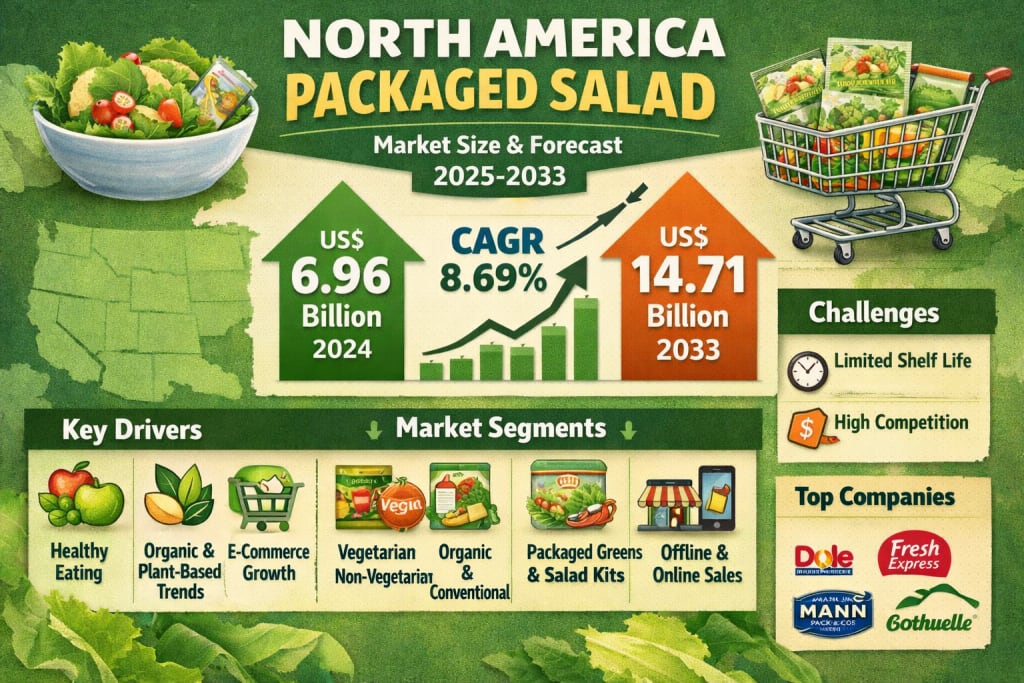
The North America packaged salad market is undergoing a strong transformation driven by changing consumer lifestyles, increasing health awareness, and rapid expansion of modern retail and e-commerce channels. According to Renub Research, the market is expected to grow from US$ 6.96 billion in 2024 to US$ 14.71 billion by 2033, registering a robust compound annual growth rate (CAGR) of 8.69% from 2025 to 2033.
Packaged salads refer to ready-to-eat, pre-washed, and pre-cut leafy greens and vegetable mixes sold in sealed bags or containers. These products typically include lettuce, spinach, kale, arugula, and mixed greens, often accompanied by toppings such as cheese, croutons, seeds, nuts, and dressings in the case of salad kits. The category has become a staple for consumers seeking quick, nutritious, and hassle-free meal options.
In North America, packaged salads are widely used in households, offices, and foodservice environments. They serve as side dishes, meal bases, or complete ready-to-eat meals, fitting perfectly into the busy schedules of urban consumers. The growing popularity of weight management diets, clean eating, and plant-forward nutrition has further strengthened demand. At the same time, improvements in packaging technology and cold-chain logistics have enhanced product freshness and shelf life, making packaged salads more reliable and accessible than ever before.
Market Size and Growth Outlook
The strong growth trajectory of the North America packaged salad market reflects deeper shifts in consumer behavior. As people increasingly prioritize health, convenience, and transparency in food choices, packaged salads have moved from being niche products to everyday grocery essentials.
The near doubling of market value between 2024 and 2033 highlights not only rising consumption volumes but also premiumization within the category. Organic products, specialty salad kits, protein-enriched options, and globally inspired flavors are commanding higher price points and expanding overall market value. The combination of lifestyle changes, retail innovation, and product diversification is expected to keep the market on a high-growth path throughout the forecast period.
Growth Drivers within the North America Packaged Salad Market
Increased Demand for Healthy and Convenient Food
One of the most powerful drivers behind the market’s expansion is the growing consumer preference for food that is both healthy and convenient. Modern lifestyles, particularly in urban areas, leave limited time for meal preparation. Packaged salads offer a practical solution by eliminating washing, chopping, and cooking while still delivering fresh vegetables and balanced nutrition.
Working professionals, students, and families increasingly view packaged salads as a smart alternative to fast food and heavily processed meals. The demand is further reinforced by the rise of fitness culture, diet-conscious eating habits, and greater awareness of the role of fruits and vegetables in long-term health.
Manufacturers are responding by launching specialized products such as high-protein salads, low-carb options, organic blends, and portion-controlled packs. The growing presence of meal kit services and grocery delivery platforms has also made packaged salads easier to access, boosting both impulse purchases and repeat consumption.
In December 2024, Fresh Del Monte Produce, through Mann Packing, introduced Newman's Own Salad Kits, marking the brand’s entry into the packaged salad kits segment with a focus on quality ingredients and community-driven values. This reflects how major players are investing in innovation and brand storytelling to connect with health-conscious consumers.
Expansion of Plant-Based and Organic Food Trends
The rapid growth of plant-based diets and organic food consumption across North America is another major catalyst for the packaged salad market. More consumers are reducing their intake of processed and animal-based foods in favor of plant-forward meals, driven by health, environmental, and ethical considerations.
Organic packaged salads, made from greens grown without synthetic pesticides or fertilizers, are seeing particularly strong demand. Consumers increasingly associate organic labels with safety, quality, and sustainability, even if it comes at a premium price. This has encouraged producers to expand their organic portfolios and invest in certifications and transparent sourcing practices.
At the same time, the popularity of vegetarian and vegan diets is driving innovation in salad mixes that include diverse vegetables, legumes, seeds, and plant-based proteins. In October 2024, controlled-environment agriculture company Hippo Harvest launched USDA-certified organic pre-packaged salads, including baby spinach, spring mix, and arugula, in select U.S. retail outlets, with plans for wider expansion. This highlights how both traditional and emerging players are capitalizing on the clean-label and organic movement.
Expansion of Retail and E-Commerce Channels
The continuous expansion of modern retail formats and online grocery platforms has significantly strengthened the distribution of packaged salads in North America. Large supermarket chains, hypermarkets, and specialty health food stores have expanded their fresh produce sections, dedicating more shelf space to value-added salad products.
E-commerce and app-based grocery delivery services have further improved accessibility, allowing consumers to include fresh salads in their regular online shopping baskets. Subscription-based meal kits and direct-to-consumer food brands are also playing a growing role in shaping purchasing habits and introducing consumers to new salad varieties.
In December 2024, Fresh Del Monte Produce Inc., through Mann Packing, reinforced its retail presence with the launch of Newman's Own Salad Kits, combining brand trust with wide retail distribution. Such initiatives demonstrate how strong retail partnerships and omnichannel strategies are becoming essential for market growth.
Problems Facing the North America Packaged Salad Industry
Limited Shelf Life and Perishable Product Issues
Despite its strong growth outlook, the packaged salad market faces significant operational challenges, with limited shelf life being the most critical. Leafy greens are highly perishable and sensitive to temperature, moisture, and handling conditions. This increases the risk of spoilage, food waste, and product recalls, which can impact both profitability and brand reputation.
Retailers and manufacturers are investing heavily in advanced packaging technologies such as modified atmosphere packaging and improved sealing methods to extend freshness. However, maintaining consistent quality across long supply chains remains a complex and costly task.
High Competition and Price Sensitivity
The North American packaged salad market is highly competitive, with numerous established brands and private-label products competing for shelf space and consumer attention. Price sensitivity remains a key issue, particularly as consumers compare organic versus conventional products and look for value deals.
Brands must strike a careful balance between maintaining affordable prices and covering the higher costs associated with fresh sourcing, cold-chain logistics, and sustainable packaging. Marketing, branding, and product differentiation have therefore become critical tools for standing out in a crowded marketplace.
Segment Analysis
North America Vegetarian Packaged Salad Market
The vegetarian packaged salad segment is expanding rapidly as more consumers embrace plant-based eating habits. These products typically feature combinations of leafy greens, vegetables, grains, nuts, seeds, and plant-based proteins, offering both nutrition and variety.
Brands are increasingly experimenting with global flavor profiles, such as Mediterranean, Asian, and Latin-inspired mixes, to attract adventurous and health-conscious consumers. The growing focus on sustainability and ethical food choices is further strengthening the appeal of vegetarian salad options.
North America Non-Vegetarian Packaged Salad Market
Non-vegetarian packaged salads cater to consumers seeking convenient, high-protein meal options. These products often include grilled chicken, turkey, shrimp, or other lean meats, making them popular among fitness enthusiasts and followers of protein-focused diets such as keto and paleo.
In March 2024, Fresh Express introduced new salad kits, including an Asian Apple Salad Kit and a Twisted Caesar Creamy Truffle Caesar Chopped Salad Kit, aimed at delivering restaurant-style flavors in convenient formats. Such innovations are helping to keep the non-vegetarian segment dynamic and appealing.
North America Organic Packaged Salad Market
The organic packaged salad segment continues to gain momentum as consumers prioritize food safety, environmental sustainability, and clean-label products. Organic salads are perceived as healthier and more trustworthy, especially among families and wellness-focused shoppers.
Retailers are expanding their organic ranges, while manufacturers are investing in eco-friendly packaging and transparent sourcing strategies. Certifications such as USDA Organic play a crucial role in building consumer confidence and justifying premium pricing.
North America Packaged Greens Salad Market
Packaged greens, including spinach, kale, romaine, arugula, and mixed greens, remain a core category within the market. These products appeal to consumers who prefer flexibility, allowing them to customize meals, prepare smoothies, or use greens as cooking ingredients.
The rising popularity of so-called “superfoods” and nutrient-dense ingredients has encouraged companies to launch blends that highlight functional health benefits, further boosting demand in this segment.
North America Branded Packaged Salad Market
Branded packaged salads dominate supermarket shelves, with well-known names such as Fresh Express, Dole, Taylor Farms, and Gotham Greens leading the category. These brands focus on quality assurance, innovative recipes, and advanced packaging to maintain consumer trust and loyalty.
At the same time, private-label products are gaining traction by offering competitive prices and acceptable quality, increasing pressure on branded players to continuously innovate and differentiate. Clean-label messaging and sustainability commitments are becoming key branding tools in this space.
North America Offline Packaged Salad Market
Offline retail, including supermarkets, grocery stores, and specialty food shops, remains the primary sales channel for packaged salads. Many consumers prefer to inspect freshness and packaging quality in person before purchasing perishable products.
Retailers support this channel through strong refrigeration infrastructure, in-store promotions, and strategic product placement in fresh food sections, which encourages impulse buying and repeat purchases.
Country-Level Insights
United States Packaged Salad Market
The United States represents the largest share of the North America packaged salad market, supported by busy lifestyles, strong health awareness, and a highly developed grocery retail ecosystem. Supermarkets, warehouse clubs, and meal-kit services all contribute to widespread availability and high consumption levels.
Packaging innovations and extended shelf-life solutions are further encouraging bulk purchases and frequent use. In November 2023, Gotham Greens introduced new salad kits in flavors such as Green Goddess, Southwest Ranch, and Caesar, using greenhouse-grown lettuce and fresh toppings, reinforcing the trend toward premium, ready-to-eat salad solutions.
Canada Packaged Salad Market
Canada’s packaged salad market is expanding steadily as consumers become more health-conscious and more interested in organic and sustainably sourced food. The country’s climate limits year-round access to fresh local produce, making packaged salads an important solution for consistent supply.
There is also a strong focus on transparency, local sourcing, and environmentally friendly packaging. In August 2023, Fresh Express introduced new chopped salad kits tailored to Canadian tastes, highlighting the growing importance of product localization in this market.
Market Segmentation
By Product:
Vegetarian
Non-vegetarian
By Processing:
Organic
Conventional
By Type:
Packaged Greens
Packaged Kits
By Brand:
Private Label Products
Branded Products
By Distribution Channel:
Offline
Online
By Country:
United States
Canada
Mexico
Key Companies Profiled
Some of the major players shaping the North America packaged salad market include:
BrightFarms, Dole, Earthbound Farm, Eat Smart, Missionero, Gotham Greens, Mann Packing Co., Inc., Bonduelle, and Fresh Express.
These companies are analyzed across multiple dimensions, including company overview, leadership, recent developments, and revenue performance, highlighting their strategic roles in driving innovation and competition in the market.
Final Thoughts
The North America packaged salad market is entering a decisive growth phase, supported by strong consumer demand for healthy, convenient, and transparent food choices. With the market expected to rise from US$ 6.96 billion in 2024 to US$ 14.71 billion by 2033, the sector clearly reflects broader shifts in lifestyle, retail, and nutrition trends.
While challenges such as perishability, intense competition, and price sensitivity remain, ongoing investments in packaging technology, product innovation, and distribution networks are strengthening the industry’s long-term outlook. As consumers continue to prioritize wellness and convenience, packaged salads are set to remain a central feature of North America’s modern food landscape.
About the Creator
Philippines Warehousing Market 2026: Set to Surge to USD 706.8 Million by 2034 on E-Commerce & Logistics Growth
Philippines Warehousing Market Overview The Philippines warehousing market growth is gearing up for sustained growth over the next decade as logistics, e-commerce, and supply chain modernization take center stage in the country’s economic expansion. According to IMARC Group, the market was valued at USD 441.7 million in 2025 and is projected to reach USD 706.8 million by 2034, growing at a compound annual growth rate (CAGR) of 5.20 % during 2026–2034. This steady trajectory underscores the rising strategic importance of warehousing infrastructure in supporting trade, distribution, and industrial activities across the Philippines.
By Manisha Dixita day ago in Trader



Comments
There are no comments for this story
Be the first to respond and start the conversation.