
North America Organic Starch Market Trends & Summary 2025–2033
Clean-label demand, sustainable sourcing, and expanding applications fuel steady growth across food and industrial sectors

North America Organic Starch Market Overview
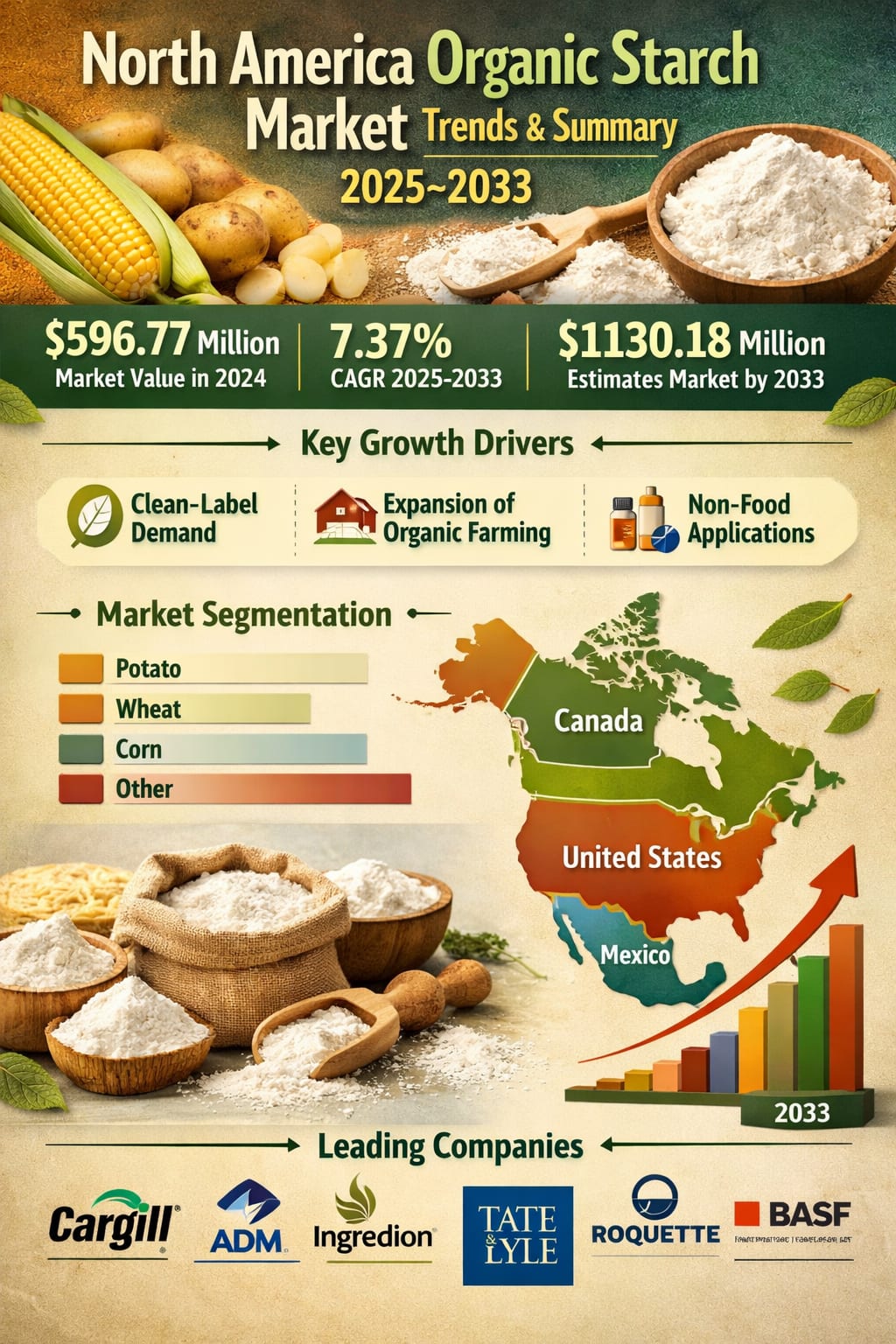
The North America Organic Starch Market was valued at US$ 596.77 million in 2024 and is projected to expand at a CAGR of 7.37% from 2025 to 2033, reaching US$ 1,130.18 million by 2033. This growth is being driven by the rising demand for natural, organic, and clean-label food ingredients, the widening use of organic starch across food, pharmaceutical, cosmetic, and bio-based industries, and the growing consumer preference for health-focused and sustainable products.
Organic starch is a natural carbohydrate extracted from organically grown sources such as corn, potatoes, wheat, rice, and tapioca, cultivated without synthetic fertilizers, pesticides, or genetically modified organisms (GMOs). Unlike conventional starch, organic starch must comply with strict organic certification standards, making it particularly attractive to manufacturers targeting clean-label and premium product segments.
In the food and beverage sector, organic starch is widely used in soups, sauces, bakery products, dairy alternatives, and gluten-free foods due to its excellent thickening, binding, and stabilizing properties. Beyond food, organic starch plays an important role in pharmaceutical formulations (as excipients and capsule coatings), in cosmetics (as a natural absorbent and texturizer), and increasingly in biodegradable packaging and bio-based adhesives. As sustainability and transparency become central to purchasing decisions, organic starch is steadily moving from a niche ingredient to a mainstream solution across North America.
Key Growth Drivers in the North American Organic Starch Market
Rising Demand for Clean-Label and Organic Foods
One of the strongest forces behind the market’s expansion is the surging consumer demand for clean-label and organic food products. Shoppers across the United States, Canada, and Mexico are increasingly scrutinizing ingredient lists, favoring products that are free from synthetic additives, artificial chemicals, and GMOs. As a result, food manufacturers are progressively replacing conventional starches with certified organic alternatives.
Organic starch serves as a natural thickener, stabilizer, and binder, making it particularly valuable in bakery, dairy, sauces, and gluten-free formulations. Its ability to deliver functionality while maintaining a clean-label claim has made it a preferred choice for brands seeking to align with health-conscious consumers.
A notable example of industry momentum came in October 2022, when Roquette, a global leader in plant-based ingredients, introduced a new range of organic pea ingredients, including organic pea starch and protein, produced at its facility in Portage la Prairie, Canada. The products are sourced from a network of organic pea farmers, offering customers improved traceability, reliability, and quality assurance—all critical factors in today’s clean-label market.
Expansion of Organic Farming and Sustainable Practices
The steady growth of organic agriculture in North America has significantly strengthened the supply base for organic starch production. Government-backed certifications such as USDA Organic and Canada Organic have encouraged more farmers to adopt sustainable, chemical-free farming methods, improving both the availability and credibility of organic raw materials.
This shift is also closely tied to corporate sustainability goals. Many food and ingredient companies are committing to carbon reduction, responsible sourcing, and environmentally friendly supply chains, which further boosts the appeal of organic starch.
In May 2023, the U.S. Department of Agriculture (USDA) announced increased support for domestic organic producers under its Organic Transition Initiative, launched in late 2022. The program aims to help existing organic farmers and those transitioning to organic production through additional funding and technical assistance. Such initiatives are expected to improve long-term raw material availability and stabilize supply chains for organic starch manufacturers.
Growing Use in Non-Food Sectors
While food applications remain dominant, non-food industries are becoming increasingly important growth engines for the organic starch market. In the pharmaceutical sector, organic starch is widely used as an excipient, binder, and disintegrant in tablet and capsule formulations. In cosmetics and personal care, it is valued for its natural absorbent properties, helping improve texture and oil control in powders and skincare products.
Perhaps most promising is the rising interest in bioplastics, biodegradable packaging, and green adhesives, where organic starch serves as a renewable and compostable alternative to petroleum-based materials. This diversification is helping the market reduce dependence on food applications alone and positioning organic starch as a key ingredient in the broader bio-based economy.
In August 2024, Roquette Frères expanded its range of tapioca-based cook-up starches—CLEARAM R 4010, CLEARAM TR 3010, CLEARAM TR 2510, and CLEARAM TR 2010—designed to enhance texture, viscosity, and elasticity in dairy desserts, sauces, and bakery fillings. Such innovations highlight how starch producers continue to improve functionality while supporting clean-label and plant-based product development.
Challenges in the North America Organic Starch Market
High Production Costs and Limited Supply
Despite its strong growth outlook, the organic starch market faces notable cost-related challenges. Organic farming typically involves lower yields, stricter certification requirements, and higher production costs compared to conventional agriculture. The use of natural fertilizers and pesticide-free cultivation methods increases input costs, which are ultimately reflected in the price of organic starch.
Additionally, the limited number of certified organic farms restricts the overall supply of organic raw materials, putting further upward pressure on prices. This creates a competitive disadvantage when compared to cheaper, widely available conventional starches, particularly in price-sensitive applications.
Competition from Conventional and Modified Starches
Organic starch also competes directly with conventional and chemically modified starches, which often offer greater functional performance, higher stability, and lower cost. Many processed food and industrial applications still rely on modified starches because they can be tailored for specific performance requirements such as extreme temperatures, pH stability, or long shelf life.
For organic starch producers, the ongoing challenge is to match or approach the performance of modified starches while maintaining strict organic certification standards. Continuous innovation and process improvements will be essential to close this functionality gap.
Segment Analysis
North America Organic Potato Starch Market
Organic potato starch is experiencing strong growth due to its widespread use in gluten-free baking, meat processing, and dairy alternatives. It offers excellent water-binding capacity and high viscosity, making it ideal for soups, sauces, baby food, and plant-based meat substitutes. Its neutral taste, allergen-free profile, and clean-label appeal further strengthen its position in organic food formulations. Rising demand for gluten-free and plant-based products continues to support this segment’s steady expansion.
North America Organic Wheat Starch Market
Organic wheat starch is gaining traction in the bakery and confectionery industries due to its ability to improve dough elasticity, texture, and moisture retention. It is commonly used in bread, pastries, and pasta, where organic certification adds marketing value. Beyond food, organic wheat starch also finds applications in the pharmaceutical and cosmetic sectors as a natural binder and stabilizer.
North America Organic Starch Bakery Market
The bakery sector is one of the largest consumers of organic starch in North America. Organic starch enhances texture, shelf life, and water retention in products such as bread, cakes, cookies, and pastries. The growing popularity of organic and gluten-free baked goods has accelerated demand for organic corn, potato, and tapioca starches. Additionally, organic starch is widely used in fillings and frostings to maintain consistency while preserving clean-label credentials.
North America Organic Starch Meat Market
In the meat and plant-based meat sectors, organic starch is used as a binder and moisture-retention agent, improving the texture and juiciness of products such as sausages, burgers, and deli slices. With rising demand for organic and clean-label meat products, manufacturers increasingly rely on organic potato and tapioca starches. Organic starch is also used in coatings and breadings to achieve crispiness while meeting organic certification standards.
North America Organic Starch Dry Blends Market
Organic starch plays a vital role in dry blends, including seasoning mixes, baking powders, instant soups, and beverage formulations. It improves flowability, mixability, and stability, making it a key ingredient in pre-packaged bakery mixes, protein powders, and meal replacements. The growing popularity of organic convenience foods and ready-to-cook products is driving strong demand in this segment, especially for non-GMO and gluten-free blends.
Country-Level Insights
United States Organic Starch Market
The United States dominates the North American organic starch market, supported by high consumer demand for organic foods, a growing vegan population, and strict USDA organic certification standards. Organic starch is widely used in dairy alternatives, sauces, and gluten-free products, and the presence of major organic food brands and retailers further strengthens market growth. Expanding applications in biodegradable packaging and personal care products are also contributing to market diversification.
Canada Organic Starch Market
Canada’s organic starch market is growing steadily due to increasing awareness of clean-label products and the expansion of the organic farming sector. Rising demand for organic baby food, functional beverages, and plant-based proteins is boosting the use of organic starch as a natural stabilizer. Government support for sustainable agriculture and eco-friendly packaging solutions is also encouraging the adoption of organic starch in biodegradable materials.
Mexico Organic Starch Market
In Mexico, demand for organic starch is rising due to the growing popularity of organic processed foods, clean-label bakery products, and natural thickeners in traditional cuisine. Organic corn starch is widely used in tortillas, sauces, and soups, while expanding organic farming programs and export-oriented production support supply growth. The country’s natural cosmetics and personal care market is also driving demand for organic starch as a binder and absorbent.
Market Segmentation
By Ingredient:
Potato
Wheat
Corn
Other
By End User:
Bakery
Meat
Confectionery
Dry Blends
By Country:
United States
Canada
Mexico
Company Analysis
All key players are covered from four viewpoints: Overview, Key Persons, Recent Developments, and Revenue.
Major Companies Profiled:
Cargill, Incorporated
ADM
Tate & Lyle
Ingredion
Roquette Frères
BASF
Naturex S.A.
The Kraft Heinz Company
Emsland Group
American Key Food Products
Final Thoughts
The North America Organic Starch Market is entering a phase of sustained and diversified growth, driven by clean-label demand, expanding organic farming, and rising applications beyond food. While challenges such as higher costs and competition from modified starches remain, continuous innovation, supportive government policies, and strong consumer preference for natural and sustainable ingredients are expected to keep the market on a solid upward trajectory through 2033.
As organic starch continues to move from a niche ingredient to a strategic component in food, pharmaceuticals, cosmetics, and bio-based materials, its role in shaping a healthier, more sustainable ingredient ecosystem across North America will only become more significant.
About the Creator
Tom Shane
Tom Shane is a content writer specializing in SEO-driven blogs, product descriptions, and thought leadership. He crafts engaging, research-backed content that connects with audiences and drives results.
Australia Graphite Market: Powering the Clean‑Energy Transition and Industrial Demand
The Australia graphite market is undergoing a dramatic transformation as global demand for critical battery materials accelerates alongside robust industrial consumption. According to the latest IMARC Group analysis, the market was valued at USD 519.80 million in 2025 and is projected to expand to USD 2,258.71 million by 2034, representing a substantial compound annual growth rate (CAGR) of 17.73% during 2026–2034.
By Amélie Bellea day ago in Trader
Australia Electric Iron Market Poised for Strong Growth on the Back of Urban Lifestyles and Smart Innovation
The Australia electric iron market reached approximately USD 41.8 Million in 2025 and is projected to grow to USD 97.1 Million by 2034, expanding at a CAGR of 9.81% during the forecast period of 2026–2034. This striking growth reflects robust consumer demand for modern, efficient home appliances and an evolving retail environment where convenience and technology are increasingly central to purchase decisions.
By Rashi Sharmaabout 17 hours ago in Trader




Comments
There are no comments for this story
Be the first to respond and start the conversation.