
North America Limestone Market Trends & Summary (2025–2033)
Infrastructure Boom, Sustainability Goals, and Technology Upgrades Drive a USD 45.29 Billion Market by 2033

Introduction: A Quiet Giant Behind Modern Infrastructure
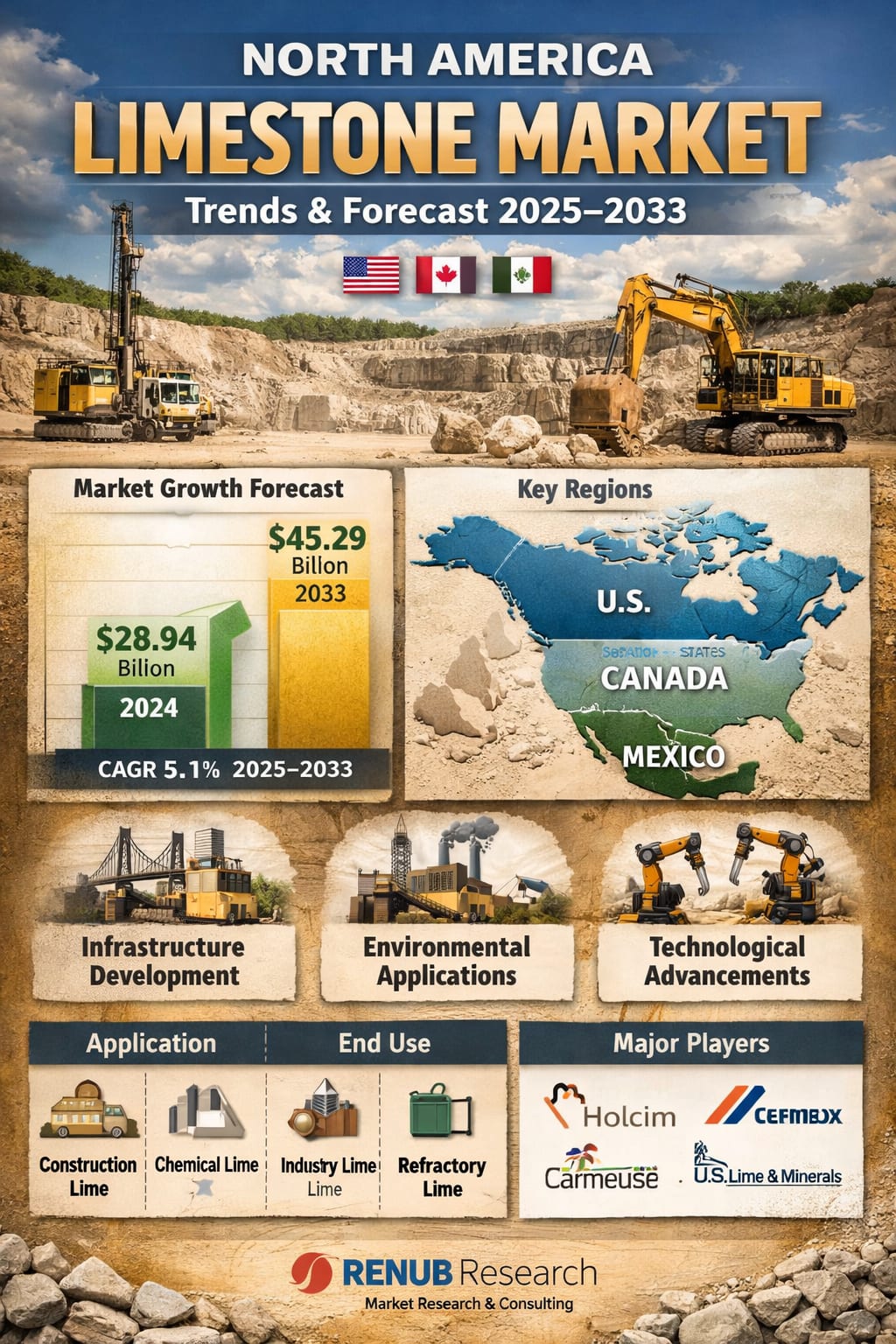
The North America limestone market is one of those foundational industries that rarely makes headlines, yet it supports almost every major development story across the region—from highways and bridges to housing, steel, agriculture, and environmental protection. According to Renub Research, the North America Limestone Market is expected to grow from US$ 28.94 billion in 2024 to US$ 45.29 billion by 2033, registering a compound annual growth rate (CAGR) of 5.1% from 2025 to 2033.
This steady and reliable growth reflects more than just rising construction activity. It signals a broader transformation in how limestone is mined, processed, and applied across industries. The market is being shaped by three powerful forces: large-scale infrastructure investment, expanding environmental applications, and rapid technological modernization in extraction and processing.
As governments across the United States, Canada, and Mexico push forward with ambitious infrastructure and housing programs, limestone continues to play a central role as a core raw material for cement, aggregates, and industrial lime. At the same time, industries are increasingly turning to limestone for environmental solutions, such as flue gas desulfurization and soil treatment, reinforcing its strategic importance beyond construction alone.
Market Overview: Why Limestone Still Matters
Limestone is one of the most widely used industrial minerals in North America. Its importance stems from its versatility. It is essential for cement production, a key ingredient in concrete aggregates, a flux in steelmaking, a soil conditioner in agriculture, and a neutralizing agent in environmental applications.
Urbanization continues to reshape North American cities, creating sustained demand for new roads, bridges, residential buildings, commercial spaces, and public infrastructure. Every one of these projects depends, directly or indirectly, on limestone. As a result, the region’s limestone industry remains closely tied to the health of the construction and infrastructure sectors.
Beyond construction, limestone has also become increasingly important in the context of environmental responsibility and industrial decarbonization. Industries seeking to reduce emissions and comply with stricter environmental regulations rely on limestone-based processes to control pollutants, treat water, and manage industrial waste. This shift toward cleaner production methods is adding a new layer of long-term demand to the market.
Technological progress is another defining feature of the current market landscape. Modern mining operations now rely on automation, precision blasting, advanced crushing and grinding systems, and real-time monitoring technologies. These innovations have made limestone extraction more efficient, safer, and more cost-effective, while also helping to reduce waste and environmental impact.
Renub Research Market Outlook: Strong and Steady Growth
Renub Research estimates that the North America Limestone Market will expand from US$ 28.94 billion in 2024 to US$ 45.29 billion by 2033, growing at a CAGR of 5.1% during 2025–2033. This growth trajectory reflects both rising volume demand and increasing value-added applications across multiple industries.
The construction sector remains the largest consumer of limestone, driven by infrastructure renewal, housing development, and commercial construction. However, industrial uses—particularly in steel, chemicals, and environmental management—are also expected to contribute significantly to market expansion over the forecast period.
What makes this growth especially notable is its resilience. Even in periods of economic uncertainty, limestone demand tends to remain relatively stable because it is tied to essential activities such as infrastructure maintenance, public works, and basic industrial production. This makes the market attractive not only from a volume perspective, but also from a long-term investment standpoint.
Key Growth Drivers
1. Infrastructure Development
Infrastructure development is the single most important driver of the North America limestone market. Governments across the region are investing heavily in modernizing transportation networks, utilities, and public facilities. Limestone is a critical input in cement and concrete, making it indispensable for roads, bridges, airports, railways, and urban development projects.
In the United States, the push to rebuild aging infrastructure has gained strong momentum. In May 2022, the government announced that more than USD 110 billion would be allocated to over 4,300 specific projects, including upgrades to ports and airports, repairs to roads and bridges, and the replacement of lead pipes to ensure clean water supply. These initiatives are expected to benefit nearly 3,200 communities across all 50 states and create sustained demand for limestone throughout the forecast period.
Canada is following a similar path, supported by initiatives such as the Made in Canada program, the New Building Canada Plan, and the Affordable Housing Initiative (AHI). In August 2022, the Canadian government announced an investment of over USD 2 billion to support three major projects aimed at building nearly 17,000 homes nationwide, including thousands of affordable housing units. Each of these projects adds directly to the demand for cement, aggregates, and construction lime.
Mexico is also experiencing strong infrastructure and urban development activity, particularly in transport, housing, and industrial zones, further strengthening regional limestone consumption.
2. Rise in Environmental Applications
Beyond construction, limestone plays a growing role in environmental protection and sustainability. One of its most important uses is in flue gas desulfurization (FGD) systems, which help reduce sulfur dioxide emissions from coal-fired power plants and other industrial facilities. As environmental regulations become stricter across North America, demand for limestone in pollution control systems continues to rise.
In agriculture, limestone is widely used to neutralize acidic soils, improve soil structure, and enhance crop productivity. This application is especially important in regions where soil acidity limits agricultural output. By restoring soil balance, limestone supports more sustainable and efficient farming practices.
Limestone is also used in water treatment and industrial waste management, thanks to its natural neutralizing and filtering properties. As industries and municipalities place greater emphasis on clean water and responsible waste disposal, these applications are expected to contribute steadily to market growth.
3. Technological Advancements in Mining and Processing
Technological progress is transforming how limestone is extracted, processed, and delivered to end users. Modern mining operations increasingly rely on automation, advanced drilling and blasting techniques, precision crushing and grinding systems, and digital monitoring tools.
These innovations improve productivity, enhance product quality, and reduce operating costs. They also help address environmental concerns by minimizing waste, optimizing energy use, and reducing emissions associated with mining and transportation.
Logistics and supply chain improvements are further strengthening the market. Faster, more efficient transportation systems ensure timely delivery of limestone products while helping companies lower their carbon footprint. As sustainability and cost-efficiency become top priorities, technology will remain a critical enabler of long-term growth in the North America limestone market.
Challenges Facing the Market
1. Public Opposition and Permitting Delays
Despite strong demand, limestone mining often faces resistance from local communities and environmental groups. Concerns about land degradation, dust, noise, water usage, and habitat disruption can lead to public opposition and lengthy permitting processes.
These delays increase project costs and create uncertainty for producers, particularly when trying to expand existing operations or open new quarries. While technological improvements have reduced many environmental impacts, community acceptance and regulatory compliance remain key challenges for the industry.
2. Land Use and Resource Depletion
Land use conflicts and the gradual depletion of high-quality limestone reserves pose long-term challenges. Continuous extraction can lead to landscape changes and ecological impacts, making it harder to secure approvals for new mining sites.
As easily accessible reserves become scarcer, companies must invest more in exploration, land reclamation, and sustainable mining practices. Balancing economic needs with environmental responsibility will be essential for maintaining a stable supply of limestone in the years ahead.
Country-Level Insights
United States Limestone Market
The United States represents the largest share of the North America limestone market, supported by strong demand from construction, manufacturing, agriculture, and environmental applications. Limestone is widely used in cement and lime production, steelmaking, and soil conditioning, making it a cornerstone of multiple industries.
The U.S. market also benefits from large and diverse limestone reserves. In 2024, the U.S. Geological Survey used machine learning and water testing to estimate that the Smackover Formation—a vast limestone geological unit beneath parts of Arkansas, Louisiana, Texas, Alabama, Mississippi, and Florida—contains between 5 and 19 million tons of lithium reserves. While this finding is primarily related to critical minerals, it highlights the geological and industrial importance of limestone formations in the country.
Canada Limestone Market
Canada’s limestone market plays a vital role in construction, industry, and agriculture. Limestone is essential for cement manufacturing, road building, and soil treatment. The country has abundant limestone reserves, including major sites such as Alberta’s Hammerstone Quarry, supporting both domestic consumption and exports.
However, the market faces challenges from fluctuating export volumes and competition from other limestone-producing countries. Even so, strong infrastructure investment and housing development continue to provide a stable foundation for long-term growth.
Mexico Limestone Market
Mexico’s limestone market is a key part of the country’s construction, chemical, and agricultural sectors. Large reserves, particularly in regions such as Quintana Roo, support extensive cement production and infrastructure development.
At the same time, the industry faces increasing scrutiny related to environmental protection and land use. Balancing economic development with sustainable resource management remains a central issue for the Mexican limestone sector.
Market Segmentation
By Type:
Magnesian Limestone
High Calcium Limestone
By Application:
Industry Lime
Chemical Lime
Construction Lime
Refractory Lime
By End Use:
Construction
Iron & Steel
Agriculture
Chemical
Others
By Country:
United States
Canada
Mexico
Rest of North America
Competitive Landscape and Company Analysis
The North America limestone market is moderately consolidated, with several major players operating across mining, processing, and downstream applications. Key companies covered include:
United States Lime & Minerals Inc.
Imerys SA
The National Lime & Stone Company
Carmeuse
Holcim Limited
Imerys
CEMEX S.A.B. de C.V.
Mineral Technologies Inc.
These companies compete on the basis of resource access, product quality, technological capability, and supply chain efficiency. Ongoing investments in automation, sustainability, and value-added products are shaping competitive strategies across the industry.
Final Thoughts: A Market Built on Fundamentals
The North America limestone market stands on strong and enduring fundamentals. With Renub Research forecasting growth from US$ 28.94 billion in 2024 to US$ 45.29 billion by 2033 at a CAGR of 5.1%, the industry is clearly positioned for a decade of steady expansion.
Infrastructure development, environmental applications, and technological progress are working together to sustain demand across construction, industry, and agriculture. While challenges related to land use, regulation, and community concerns remain, the industry’s shift toward more efficient and sustainable practices offers a clear path forward.
In many ways, limestone remains the quiet backbone of modern development in North America—rarely noticed, but absolutely essential. As cities grow, industries modernize, and sustainability goals become more ambitious, limestone will continue to play a central role in shaping the region’s economic and industrial future.
About the Creator
Britannia Industries Shares Jump 5% After Strong Q3 Results, Profit Rises 17% YoY
. Introduction Britannia Industries shares rallied sharply in market trading after the FMCG major reported a strong set of third-quarter earnings. The company posted a 17% year-on-year increase in net profit, reaching ₹582 crore, while revenue rose by 10%, beating market expectations. The upbeat performance boosted investor confidence, sending Britannia’s stock up nearly 5% and making it one of the top gainers in the consumer goods space.
By Hammad Nawaz4 days ago in Trader
Meta Stock Analysis: Can Meta Platforms Sustain Growth in the Age of AI and Social Media Saturation?
Introduction Meta stock has experienced dramatic shifts in investor sentiment over the past few years. From rapid growth driven by social media dominance to sharp pullbacks during periods of heavy spending, Meta Platforms Inc. has remained at the center of the technology investment conversation. As the company behind some of the world’s most widely used digital platforms, Meta continues to influence how billions of people connect, communicate, and consume content online.
By Hammad Nawazabout 7 hours ago in Trader
Nancy Guthrie: Is a miracle still possible after close to two weeks?
Close to two weeks since Nancy Guthrie's abduction As of February 12, 2026, Nancy Guthrie remains classified as missing for 12 days, but there is no official confirmation that she is deceased. Blood matching Guthrie’s DNA was found on her front porch, indicating she likely suffered an injury during the abduction.
By Cheryl E Preston4 days ago in Geeks




Comments
There are no comments for this story
Be the first to respond and start the conversation.