
Asia Pacific Crowdfunding Market Trends & Summary: A New Age of Digital Fundraising (2025–2033)
From donations to equity investments, crowdfunding is reshaping how capital flows across Asia Pacific’s digital economy

Introduction: A Region Redefining Fundraising
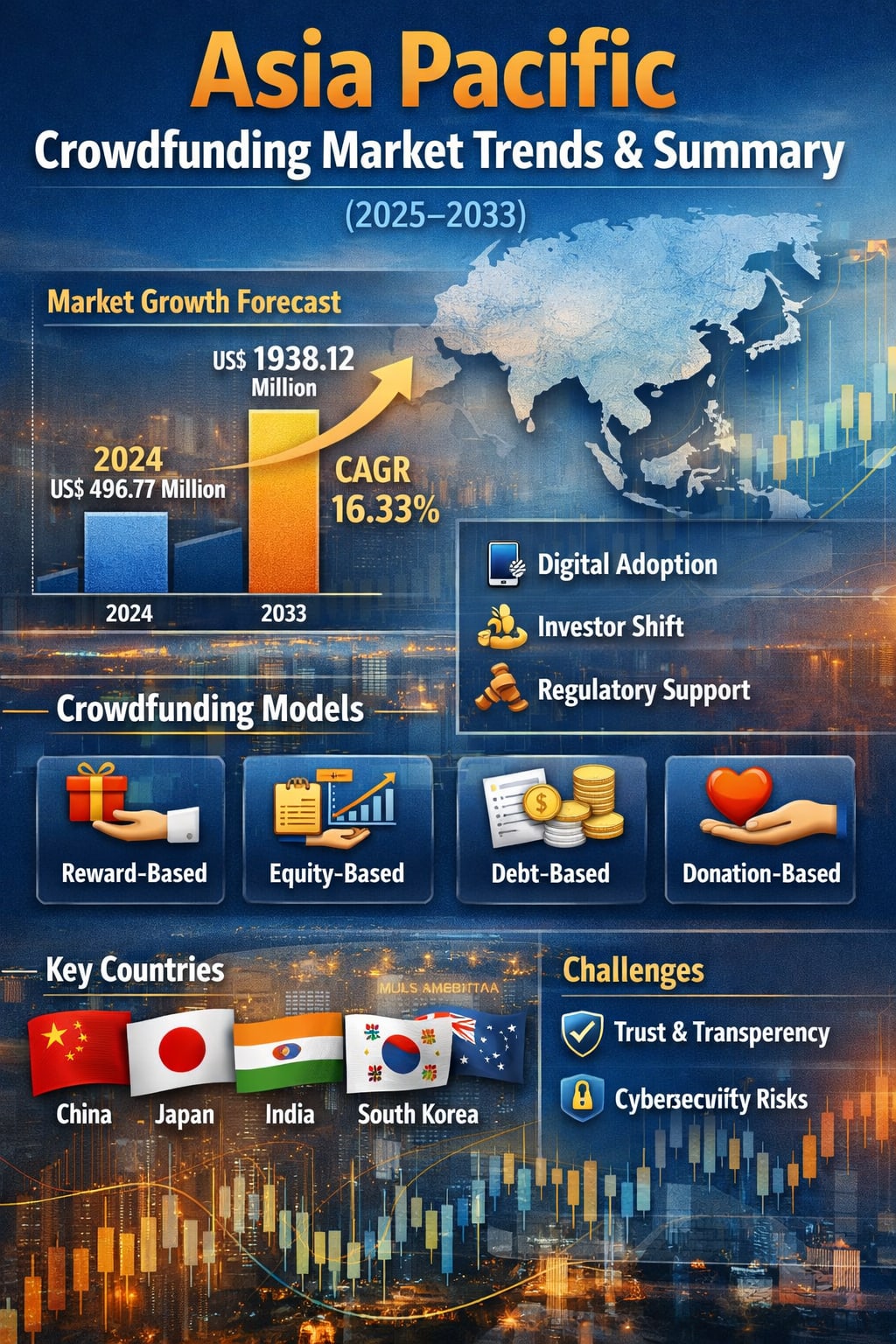
The Asia Pacific crowdfunding market is entering a defining phase of growth, driven by digital transformation, changing investor behavior, and a growing appetite for alternative finance. According to Renub Research, the Asia Pacific Crowdfunding Market is expected to reach US$ 1,938.12 million by 2033, up from US$ 496.77 million in 2024, registering a strong CAGR of 16.33% from 2025 to 2033.
This rapid expansion reflects more than just numbers. It signals a structural shift in how individuals, startups, social enterprises, and creative projects raise capital. Traditional funding routes such as bank loans and venture capital are no longer the only options. Instead, digital platforms now allow entrepreneurs to connect directly with supporters, investors, and communities across borders.
Crowdfunding in Asia Pacific has evolved into a multi-model ecosystem that includes reward-based, equity-based, debt-based, and donation-based funding. These models serve a wide range of sectors—from technology and media to healthcare and real estate—making crowdfunding a versatile financial tool for both commercial and social objectives. As digital penetration deepens and regulatory frameworks mature, the region is steadily positioning itself as one of the most dynamic crowdfunding markets in the world.
Market Overview: Why Asia Pacific Is Leading the Shift
A thriving entrepreneurial culture, rising internet penetration, and growing trust in digital payments have created fertile ground for crowdfunding in Asia Pacific. The region is home to some of the world’s most active startup ecosystems, as well as millions of small businesses and creators who often struggle to access traditional financing.
Crowdfunding platforms are filling this gap by offering flexible, accessible, and relatively low-cost fundraising options. With smartphones and mobile payment systems becoming ubiquitous, even individuals in smaller cities and semi-urban areas can now launch campaigns and attract backers from across the region and beyond. This has effectively democratized access to capital and reduced the dependence on traditional financial intermediaries.
At the same time, different crowdfunding models are gaining traction. Reward-based crowdfunding remains popular among creators and product innovators, while donation-based crowdfunding is widely used for social causes, healthcare, and education. Debt-based (P2P lending) and equity-based crowdfunding are also gaining attention, particularly among startups and small businesses looking for growth capital.
However, the market still faces challenges. Regulatory fragmentation, trust issues, and varying levels of investor awareness continue to slow adoption in some countries. Addressing these concerns through clearer regulations, better platform governance, and improved user education will be crucial for sustaining long-term growth.
India’s Outlook: Regulation Meets Opportunity
In India, crowdfunding has traditionally been dominated by donation-based and reward-based models, especially in areas such as healthcare, education, and social causes. Platforms like Milaap and Ketto have built strong visibility by focusing on impact-driven campaigns that resonate with a broad audience.
At the same time, interest in equity and debt-based crowdfunding is growing among startups and small businesses. Tighter lending conditions from banks and cautious venture capital investments have pushed many entrepreneurs to explore alternative funding routes. The Securities and Exchange Board of India (SEBI) has been actively reviewing the regulatory framework for equity crowdfunding to ensure investor protection and market stability.
In November 2024, SEBI recommended changes to angel fund investment limits, signaling a broader intent to modernize and standardize the funding ecosystem. If clear and supportive regulations are introduced, equity crowdfunding could unlock a new wave of micro-investments, allowing startups to raise capital from a large base of small investors in a more democratic and transparent way.
Key Growth Drivers Shaping the Market
1. Growing Digital Penetration
Digital adoption is one of the strongest pillars supporting the growth of the Asia Pacific crowdfunding market. The widespread use of smartphones, affordable internet access, and seamless digital payment systems has dramatically lowered entry barriers for both fundraisers and contributors.
Campaigns can now be launched, promoted, and funded entirely online, often within days. Social media and digital marketing tools further amplify reach, enabling projects to attract global attention and support. This digital accessibility has made crowdfunding a powerful tool not just in major cities, but also in smaller towns and emerging markets across the region.
2. Shifting Investor Mindset
Investors in Asia Pacific are no longer driven solely by financial returns. Many now seek opportunities that align with their personal values, social impact goals, or interest in niche industries. Crowdfunding platforms provide a direct and transparent way to support such projects, whether they involve innovative products, community initiatives, or social causes.
This emotional and value-driven connection between backers and projects has strengthened the appeal of crowdfunding. Contributors often feel a sense of ownership and participation, which goes beyond traditional investing. As a result, intentional and purpose-driven funding is becoming a defining trend in the region’s crowdfunding ecosystem.
3. Cost-Effective Capital Raising
For startups, creators, and small businesses, crowdfunding offers a far more accessible alternative to traditional financing. Unlike bank loans or venture capital, crowdfunding does not usually require lengthy approval processes or high intermediary fees. Campaigns can be launched quickly, tested in the market, and refined based on real-time feedback from supporters.
Beyond funding, crowdfunding also helps build early communities, validate ideas, and generate brand awareness. This combination of capital access and market engagement makes crowdfunding especially attractive in a region as diverse and fast-moving as Asia Pacific.
Challenges That Could Slow the Momentum
1. Trust and Transparency Issues
Trust remains a cornerstone of successful crowdfunding, yet it is also one of the market’s biggest vulnerabilities. Concerns over fraudulent campaigns, misrepresentation of projects, and misuse of funds can quickly undermine user confidence.
Without strong verification processes and transparent reporting, both backers and genuine fundraisers may hesitate to participate. Strengthening platform governance, improving due diligence, and encouraging regular project updates are essential steps toward building long-term credibility in the market.
2. Rising Cybersecurity Risks
Crowdfunding platforms handle large volumes of sensitive data, including personal information and financial transactions. This makes them attractive targets for cyberattacks, data breaches, and online fraud.
A single major security incident can significantly damage a platform’s reputation and erode user trust. To counter this, platforms must invest heavily in cybersecurity measures such as encryption, multi-factor authentication, and regular security audits. In a digital-first market, strong security is not optional—it is fundamental to sustainable growth.
Country-Level Insights
China: Scale Meets Regulation
China’s crowdfunding market has undergone significant transformation over the years. Early rapid expansion was followed by regulatory tightening due to concerns over fraud and platform reliability. This led to market consolidation, with fewer but stronger players remaining.
Major technology giants such as Alibaba, JD.com, Baidu, and Tencent have entered the space, leveraging their massive user bases and advanced payment ecosystems. While regulatory oversight remains strict, it has also improved market stability and investor protection. Going forward, China’s crowdfunding market is expected to grow steadily, supported by technology integration and increasing consumer participation.
Japan: Trust-Centered and Community-Focused
Japan’s crowdfunding ecosystem is characterized by a strong emphasis on quality, trust, and community-driven projects. Platforms such as Makuake, Campfire, and ReadyFor support a wide range of initiatives, from product innovation to social and regional development projects.
Cultural factors play an important role, including a preference for reliability and community impact. While cautious investment behavior and platform competition pose challenges, Japan’s market is expected to continue expanding through deeper digital integration and broader demographic participation.
India: Impact-Led but Poised for Financial Innovation
India’s crowdfunding market is currently strongest in donation-based campaigns, particularly in healthcare, education, and social causes. The widespread adoption of digital payments has made it easier for individuals to contribute, even in small amounts.
However, regulatory uncertainty continues to limit the growth of equity crowdfunding. If clearer rules are introduced, India could see rapid expansion in startup-focused crowdfunding, supported by its massive digital population and thriving entrepreneurial ecosystem.
South Korea: Regulation-Backed Innovation
South Korea has built a well-structured crowdfunding market supported by government regulations and a strong startup culture. Platforms like Wadiz have become central to funding projects in technology, fashion, and social initiatives.
Revisions to the Capital Markets Act have provided a legal framework for equity and debt-based crowdfunding, enabling startups to access capital more easily. While regulatory complexity and public awareness remain challenges, the market is expected to continue its upward trajectory in the coming years.
Market Segmentation Snapshot
By Type:
Reward-based
Equity-based
Debt-based
Donation-based
Others
By Application:
Food & Beverage
Technology
Media
Real Estate
Healthcare
Others
By Country:
China
Japan
India
South Korea
Thailand
Malaysia
Indonesia
Australia
New Zealand
Rest of Asia Pacific
Company Analysis Covered (Four Viewpoints: Overview, Key Persons, Recent Developments, Revenue):
Fundly
Alibaba Group Holding Ltd
Kickstarter, PBC
Indiegogo, Inc.
GoFundMe
Fundable
SeedInvest Technology, LLC
Crowdcube
Corteva Agriscience
Final Thoughts: Crowdfunding as a Core Financial Pillar
The Asia Pacific crowdfunding market is no longer a niche segment of the financial world. With the market projected to grow from US$ 496.77 million in 2024 to US$ 1,938.12 million by 2033, at a CAGR of 16.33%, it is clear that crowdfunding is becoming a core pillar of the region’s alternative finance ecosystem.
As digital infrastructure strengthens and regulatory frameworks mature, crowdfunding will continue to empower entrepreneurs, creators, and social innovators across Asia Pacific. The journey ahead will not be without challenges—trust, transparency, and cybersecurity will remain critical concerns. But with the right balance of technology, regulation, and user education, crowdfunding is well-positioned to reshape how capital is raised, ideas are funded, and communities come together in the digital age.
About the Creator
Understanding Technical Analysis: A Beginner’s Guide for Stock Traders
Introduction Technical analysis is a method used by traders to evaluate and predict stock price movements based on historical price data and market trends. Unlike fundamental analysis, which focuses on a company’s financial health, technical analysis emphasizes charts, patterns, and indicators to guide trading decisions.
By Hammad Nawaza day ago in Trader



Comments
There are no comments for this story
Be the first to respond and start the conversation.