
North America Industrial Enzymes Market Trends & Summary (2025–2033)
Sustainable Manufacturing, Clean-Label Foods, and Biofuel Expansion Are Powering a USD 4 Billion Market Transformation

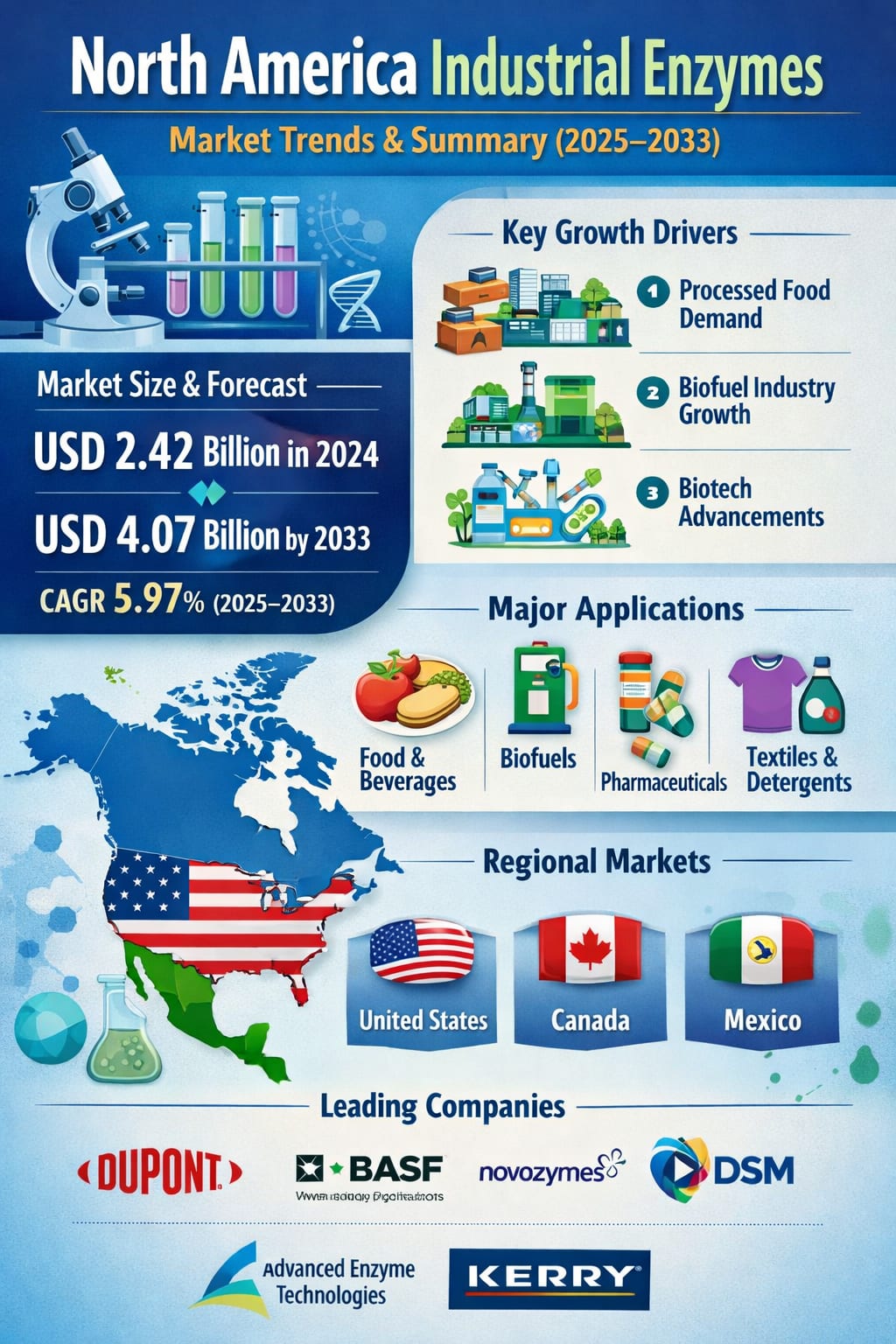
North America Industrial Enzymes Market Outlook
The North America Industrial Enzymes Market was valued at USD 2.42 billion in 2024 and is projected to reach USD 4.07 billion by 2033, growing at a CAGR of 5.97% from 2025 to 2033. This steady expansion reflects the region’s accelerating shift toward sustainable manufacturing, cleaner production technologies, and efficiency-driven industrial processes.
Industrial enzymes are biological catalysts that accelerate chemical reactions without being consumed in the process. Derived from microorganisms, plants, and animals, these enzymes are widely used across multiple industries including food and beverages, detergents, animal feed, biofuels, textiles, pharmaceuticals, personal care, agriculture, and paper & pulp. Their growing appeal lies in their high specificity, operational efficiency, and environmentally friendly nature, making them a preferred alternative to traditional chemical catalysts.
In North America, the adoption of enzyme-based solutions is being reinforced by strict environmental regulations, rising consumer demand for cleaner and safer products, and continuous innovation in biotechnology. The United States and Canada, in particular, are investing heavily in enzyme engineering, fermentation technologies, and bio-based manufacturing, positioning the region as one of the world’s most advanced industrial enzyme markets.
As industries seek to reduce carbon footprints, minimize waste, and improve process efficiency, industrial enzymes are becoming not just a cost-saving tool—but a strategic necessity.
Key Growth Drivers Shaping the Market
Rising Demand for Processed and Convenience Foods
One of the most powerful growth drivers for the North America industrial enzymes market is the surging consumption of processed and packaged foods. Modern lifestyles, urbanization, and busy work schedules have reshaped consumer eating habits, increasing reliance on ready-to-eat meals, baked goods, dairy products, and functional beverages.
Enzymes play a critical role in food processing by enhancing flavor, improving texture, extending shelf life, and boosting nutritional value. For instance, amylases are used in baking to improve dough handling and bread quality, proteases assist in protein modification, and lactases help produce lactose-free dairy products.
At the same time, consumers are increasingly demanding clean-label, natural, and minimally processed foods. Enzyme-based processes allow manufacturers to reduce chemical additives while maintaining product consistency and safety. This dual push—toward convenience and clean labels—continues to strengthen enzyme adoption across North America’s food and beverage sector.
Expansion of the Biofuel Industry
The push for cleaner energy and reduced dependence on fossil fuels is another major catalyst for enzyme demand. Enzymes, particularly carbohydrases and cellulases, are essential in the production of bioethanol and biodiesel, where they help break down starches and cellulose into fermentable sugars.
The United States remains one of the world’s largest producers of biofuels, supported by government mandates and environmental policies encouraging renewable energy use. Although biofuel statistics vary by region, global trends clearly indicate rising biodiesel and bioethanol production, reinforcing the need for more efficient enzymatic conversion processes.
As industries and governments continue to prioritize decarbonization and sustainable energy, enzyme-based biofuel production is expected to remain a strong growth pillar for the North American industrial enzymes market.
Advances in Enzyme Engineering and Biotechnology
Biotechnology breakthroughs have dramatically expanded the performance and application range of industrial enzymes. Through genetic engineering, protein optimization, and strain development, modern enzymes can now withstand high temperatures, extreme pH levels, and harsh industrial conditions.
These improvements are opening doors for enzyme use in pharmaceuticals, textiles, wastewater treatment, detergents, and specialty chemicals. For example, in September 2022, Koninklijke DSM N.V. introduced Delvo Plant Go, an oat-based dairy alternative enzyme solution that offers reduced hydrolysis time and cost savings while supporting non-GMO and organic formulations.
Such innovations not only improve efficiency but also lower operational costs in the long run, encouraging wider industrial adoption across North America.
Challenges Facing the Market
High Production and Development Costs
Despite their advantages, industrial enzymes are capital-intensive to develop and manufacture. The process involves advanced R&D, fermentation infrastructure, downstream processing, and strict quality control. For small and medium-sized enterprises, these costs can become a significant barrier to entry.
Additionally, maintaining enzyme stability, activity, and shelf life during storage and transportation further adds to operational expenses. While large multinational companies can absorb these costs, smaller players often struggle to compete, which may limit market diversification.
Regulatory Hurdles and Compliance Pressure
The North American market operates under strict regulatory frameworks, particularly in food, pharmaceuticals, and personal care. Regulatory bodies such as the FDA and EPA impose rigorous safety, labeling, and environmental compliance requirements.
While these regulations ensure consumer safety and environmental protection, they can also delay product launches and increase compliance costs, especially for new or innovative enzyme formulations. Navigating this complex regulatory landscape remains a key challenge for both domestic manufacturers and international entrants.
Market Segment Insights
North America Industrial Carbohydrase Enzymes Market
Carbohydrases, including amylases and cellulases, represent one of the largest segments of the market. These enzymes are widely used in food and beverages, bioethanol production, textile processing, and paper & pulp industries.
Their ability to break down complex carbohydrates into simpler sugars improves process efficiency, product quality, and energy utilization. As demand for sustainable and energy-efficient manufacturing grows, carbohydrase enzymes continue to see strong adoption across North America.
North America Industrial Lipases Enzymes Market
Lipases are gaining popularity due to their versatile industrial applications. They are extensively used in detergents for stain removal, in food processing for flavor development, and in biodiesel production for fat conversion.
In the dairy sector, lipases contribute to cheese flavor enhancement, while in cleaning products, they improve degreasing performance. Their biodegradable and eco-friendly nature aligns perfectly with the sustainability goals of modern industries, making them a fast-growing enzyme category in the region.
North America Industrial Food & Beverages Enzymes Market
The food and beverage industry remains the largest consumer of industrial enzymes in North America. Enzymes such as proteases, amylases, and lactases are essential for improving production efficiency, taste, texture, and nutritional profiles of processed foods and drinks.
With rising demand for natural, organic, and clean-label products, manufacturers are increasingly replacing chemical additives with enzyme-based solutions. This trend is expected to sustain strong growth in this segment throughout the forecast period.
North America Industrial Personal Care & Cosmetics Enzymes Market
Enzymes are also gaining traction in personal care and cosmetics, thanks to their gentle exfoliating, cleansing, and anti-aging properties. Proteases and lipases are commonly used in skincare products as natural alternatives to harsh chemical exfoliants.
As consumers become more conscious about skin safety, sustainability, and biodegradable ingredients, cosmetic brands are shifting toward enzyme-based formulations, further expanding this niche but fast-growing segment.
Source-Based Market Overview
Microorganism-Based Enzymes
Enzymes derived from microorganisms such as Bacillus and Aspergillus dominate the North American market due to their high yield, scalability, and cost-effectiveness. These enzymes are widely used in detergents, textiles, food processing, and biofuels.
The ability to genetically modify microbial strains for specific industrial needs has significantly accelerated innovation and commercialization in this segment.
Plant-Based Enzymes
Plant-derived enzymes such as papain (from papaya) and bromelain (from pineapple) are gaining popularity, particularly in food, nutraceuticals, and skincare applications. Consumers prefer these enzymes for their natural, organic, and allergen-friendly image.
However, challenges related to stability, consistency, and large-scale production still limit their market share compared to microbial enzymes.
Country-Level Market Insights
United States Industrial Enzymes Market
The United States holds the largest share of the North American industrial enzymes market, supported by advanced biotech infrastructure, strong R&D investment, and the presence of major global players.
Enzyme applications are expanding rapidly across food processing, biofuels, and pharmaceuticals. Government support for clean technologies and strict regulatory oversight also shape market dynamics. In 2023, the FDA approved a significant number of enzyme-based food additives under GRAS guidelines, reinforcing both innovation and compliance in the market.
Canada Industrial Enzymes Market
Canada’s market is growing steadily, driven by the country’s focus on sustainability, organic food production, and environmental management. Enzymes are increasingly used in food processing, textiles, and wastewater treatment.
In October 2022, Ginkgo Bioworks announced a collaboration with Merck to engineer enzymes for biocatalysts used in pharmaceutical manufacturing, highlighting Canada’s growing role in biotech-driven enzyme innovation.
Mexico Industrial Enzymes Market
Mexico is emerging as a high-growth market, particularly in food & beverages, textiles, and biofuels. Rising middle-class consumption, industrialization, and government support for renewable energy are boosting enzyme adoption.
While multinational presence is still lower than in the U.S. and Canada, increasing investments and manufacturing expansion are steadily strengthening Mexico’s position in the regional enzyme market.
Market Segmentation Overview
By Type:
Carbohydrase
Proteases
Lipases
Polymerases & Nucleases
Other Types
By Application:
Food & Beverages
Detergents
Animal Feed
Biofuels
Textiles
Personal Care & Cosmetics
Agriculture
Others
By Source:
Microorganism
Plant
Animal
By Country:
United States
Canada
Mexico
Rest of North America
Competitive Landscape and Key Players
The North America industrial enzymes market is moderately consolidated, with major players focusing on innovation, strategic partnerships, and product diversification. Companies are typically analyzed across company overview, key personnel, recent developments, and revenue performance.
Key Players Include:
DuPont Danisco
BASF SE
Advanced Enzyme Technologies
Dyadic International Inc.
Associated British Foods Plc.
Novozymes
DSM
Kerry Group PLC
These companies continue to invest in enzyme engineering, sustainable solutions, and application-specific products to maintain competitive advantage.
Final Thoughts
The North America industrial enzymes market is entering a decisive growth phase, driven by sustainability goals, technological innovation, and rising demand across food, energy, healthcare, and manufacturing sectors. With the market expected to grow from USD 2.42 billion in 2024 to USD 4.07 billion by 2033, enzymes are no longer just processing aids—they are becoming strategic enablers of green and efficient industry.
As regulatory frameworks tighten and consumers demand cleaner products, enzyme-based solutions will continue to replace traditional chemical processes. Companies that invest in R&D, scalable production, and application-specific innovation will be best positioned to capture the next wave of growth in this evolving market.
About the Creator
Tom Shane
Tom Shane is a content writer specializing in SEO-driven blogs, product descriptions, and thought leadership. He crafts engaging, research-backed content that connects with audiences and drives results.
United States Diabetes Market Size, Trends, Growth & Forecast 2034
United States Diabetes Market Overview The United States diabetes market is expanding steadily due to the rising prevalence of diabetes, increasing awareness about early diagnosis, and continuous advancements in treatment and monitoring technologies. Diabetes remains one of the most common chronic diseases in the country, affecting millions of individuals across different age groups. Sedentary lifestyles, unhealthy dietary habits, obesity, and genetic predisposition are major factors contributing to the growing patient population.
By Kim Soo hyun3 days ago in Trader




Comments
There are no comments for this story
Be the first to respond and start the conversation.